
The 10 most beautiful beaches in Mallorca
Mallorca is a coastal paradise with over 300 beaches spread along 550 km of coastline. From hidden coves to expansive white sand beaches, here's a selection of the 10 best, catering to different tastes: families, adventurers, those seeking tranquility, or those looking for comfortable amenities.
Quick Summary:
- Playa de Muro : Ideal for families, with shallow waters and full services.
- Es Trenc : Virgin beach with dunes and turquoise waters.
- Cala Agulla : Protected nature among pine trees and dunes.
- Sa Calobra : Unique landscape with 200-meter cliffs.
- Alcúdia Beach : Perfect for children, with 7 km of sand and a nearby old town.
- Formentor : Pine trees right up to the shore and spectacular views.
- Cala Mesquida : Dunes and waves, ideal for water sports.
- Cala Mondragó : Two beaches in a natural park.
- Sant Elm : Views of Sa Dragonera and historical routes.
- It's Caragol : Tranquility after a 40-minute walk.
Each beach has its own unique charm, from wild landscapes to family-friendly areas with amenities. Get ready to discover them!
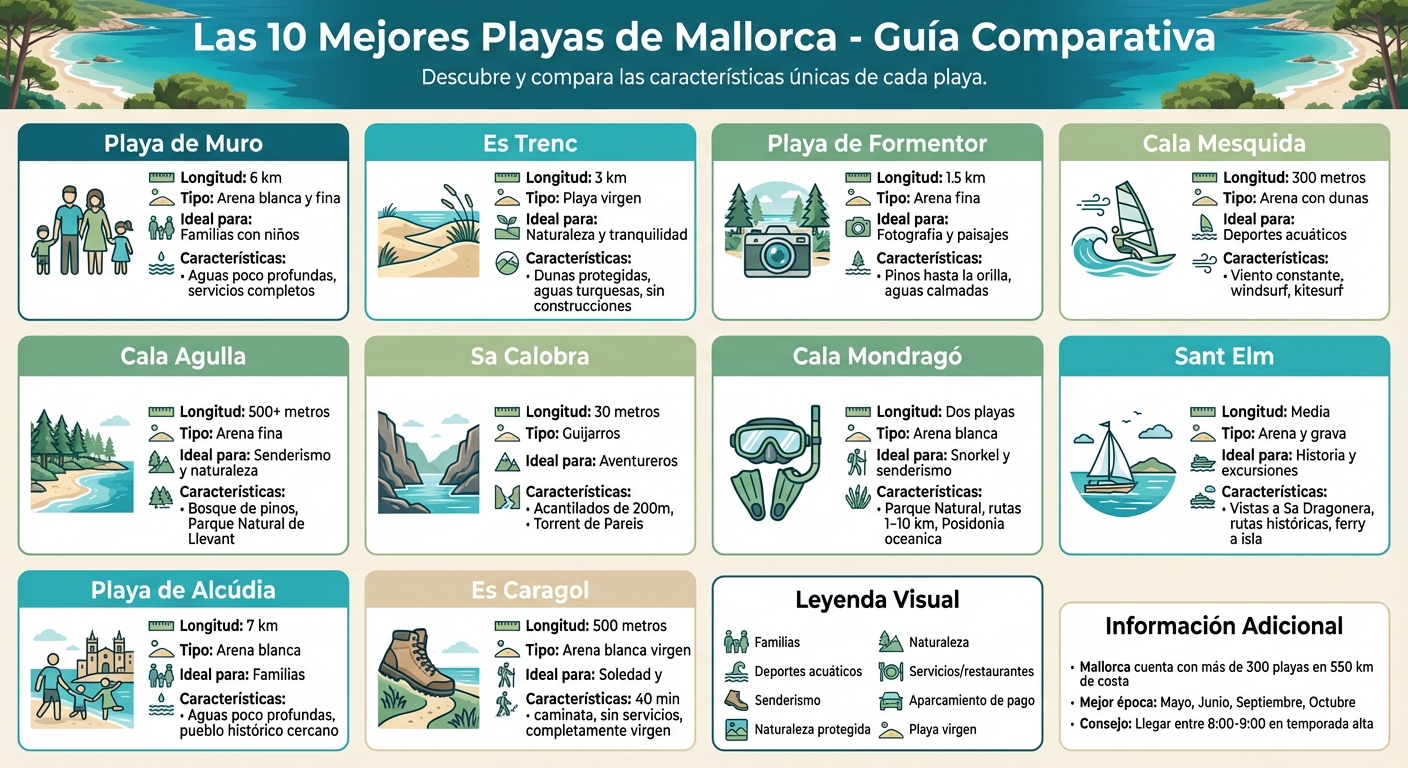
A visual guide to the 10 best beaches in Mallorca: features and services
The BEST beaches in MALLORCA and how to get there🩵(pt.1)
sbb-itb-2b14d48
1. Playa de Muro: White Sand and Shallow Waters
If you're traveling with family, Playa de Muro is a destination you can't miss. This beach, located in the Bay of Alcúdia, stretches for 6 kilometers of fine, white sand, with waters so calm and shallow that you can walk several meters into the sea without your knees getting wet. It's the perfect place for little ones to enjoy the water without a care in the world.
What makes Playa de Muro special is its dual nature. On one hand, the areas near the hotels, such as the Grupotel Los Principes & Spa or the Hotel Condesa, offer a wide range of services. On the other hand, there's the Es Comú area, which retains its almost untouched character. Here, the protected dunes and pine trees of the Parc Natural de s'Albufera reach right to the shore, creating a tranquil haven even in the height of August.
How to get there and what to find
Getting to Playa de Muro is easy, whether by car or public transport. The L21 bus from Alcúdia gets you there in just 15 minutes, which also allows you to avoid the €8 parking fee. If you prefer to drive, you can find free parking on residential streets outside the regulated parking zone (ORA), although during peak season it's advisable to arrive between 8:00 and 9:00 to guarantee a spot.
"It's a very long beach, which makes it ideal for both leisurely strolls along the shore and enjoying a refreshing swim when the weather is nice." - JOAN, TripAdvisor
The beach is accessible to everyone. Its wooden walkways are perfect for strollers or people with reduced mobility. It also has lifeguards, showers, restrooms, and beach bars like La Ponderosa, Can Gavella, and Figueret, known for their delicious paellas and fresh fish.
Activities and Best Time to Visit
Playa de Muro stands out not only for its beauty but also for the activities it offers. Thanks to the constant wind, you can try sports like windsurfing or paddle surfing, with lessons available from €45 for two hours. For families with older children, pedal boats, glass-bottom boat trips, or a game of beach volleyball are ideal options.
If you're looking for something different, the s'Albufera Natural Park awaits you with unique hiking trails. You can stroll among the dunes, observe birds, or enjoy the pine forests that contrast with the blue of the sea. During the winter months, such as February, the beach becomes almost deserted, perfect for a peaceful walk while the Tramuntana wind fills the air. If you prefer to avoid the crowds, May, June, September, and October are ideal months to enjoy its waters in a more tranquil setting.
2. Es Trenc: Dunes and Turquoise Water
If there's one place that captures the natural essence of Mallorca, it's Es Trenc. This beach, stretching for 3 kilometers, is one of the last unspoiled corners of the island. Located between Ses Covetes and Colònia de Sant Jordi , it's surrounded by a unique landscape: protected dunes, pine forests, and the Campos salt flats, where the traditional Flor de Sal (flower of salt) is still produced in its 700 crystallization ponds. On clear days, the views extend as far as the Cabrera archipelago, located 11 nautical miles away.
What distinguishes Es Trenc is not only its picture-perfect white sand and turquoise waters, but also its unspoiled character. As part of the Es Salobrar natural area, it encompasses 1,500 hectares free of hotels or large buildings. However, you will find historical remnants such as World War II bunkers, now used as sun shelters. While other beaches offer a more urbanized atmosphere, Es Trenc maintains its wild spirit, reflecting the island's commitment to environmental protection.
Access and Parking
Reaching Es Trenc from Palma takes between 45 and 50 minutes by car, following the route towards Campos, Ses Salines, and Colònia de Sant Jordi. During the summer months, access can be difficult due to narrow roads and frequent traffic jams, which can last up to 40 minutes. Parking fills up quickly, so it's advisable to arrive early, between 8:00 and 9:00 a.m., especially between June and September.
Parking costs vary: cars between €7 and €10, motorcycles €3, and bicycles €2. If you prefer to avoid driving, bus line 530 connects Palma or Campos with the beach, and during peak season there is a shuttle service from the Sa Ràpita Yacht Club. Another relaxed option is to arrive by catamaran or on a private excursion from Colònia de Sant Jordi.
"The beach is beautiful. Clean water and sandy beaches... but parking is not free: bike €2, motorbike €3, car €8, van €20." - Patricia Johana S, TripAdvisor
Once you've parked, be prepared for a 15-minute walk to the beach. As it's a protected area, don't expect many amenities: there are no public restrooms and the beach bars are very basic. It's advisable to bring your own water, food, and sunscreen. While access can be a bit tricky, the reward is a beach that retains its special character year-round.
Throughout the Seasons
Es Trenc changes with the seasons. During July and August, the beach is packed with visitors, and the space can feel cramped due to the number of towels. However, outside of peak season, it regains its tranquility and natural charm. Visiting at sunset is a particularly magical experience: fewer people, a golden light illuminating the dunes, and the chance to enjoy one of Mallorca's best sunsets from the beach bars.
In spring and autumn, when the water is still pleasant for swimming but the crowds have disappeared, Es Trenc is at its best. May, June, September, and October are ideal months to enjoy its beauty without the hustle and bustle. In winter, even though the water is too cold for swimming, strolling along the deserted shore with the Tramuntana wind blowing through the dunes is an almost meditative experience.
It's worth noting that some areas, especially towards the north, are known for being frequented by nudists. Additionally, in certain sections the water's edge can be quite steep, and it's common to find seagrass (Posidonia oceanica) accumulated on the shore. This isn't trash, but rather a sign of a healthy marine ecosystem.
3. Cala Agulla: Protected Pine Forests and Dunes
In northeast Mallorca, just 1.8 km from Capdepera and near the lively resort of Cala Ratjada , lies Cala Agulla, a beach that combines natural landscapes with easy access. With over 500 meters of fine sand, surrounded by a lush pine forest and protected dunes, it also serves as the gateway to the Llevant Natural Park .
Since 1991, Cala Agulla has been protected as a Natural Area of Special Interest, which has allowed it to preserve its pristine character, despite having basic services such as lifeguards, beach bars, and umbrella rentals. Interestingly, the width of the beach varies by up to 10 meters depending on the season and the wind: if the wind blows from the west, the sand accumulates, but with easterly or northerly winds, the beach narrows.
To get there from Palma, follow the Ma-15 motorway towards Artà and then take the Ma-4040 to the signposted turnoff. There is a large public car park about 100 meters from the beach, with rates between €7 and €10 per day. In summer, it's best to arrive between 8:00 and 9:00 to find a spot in the car park or on the beach.
This combination of nature and leisure options makes Cala Agulla an ideal place to relax or explore.
Hiking and Water Activities
More than 10 hiking trails start from Cala Agulla, including the one that leads to the secluded beach of S'Arenalet des Verger. You can also walk to the tranquil Cala Moltó or follow a coastal path that connects to Cala Lliteras.
For water sports, you can rent kayaks, paddleboards, and pedal boats. Motorized activities like banana boat rides and water skiing are also available. Days with waves are perfect for surfing, and the crystal-clear waters are ideal for snorkeling. A popular diving school is located in nearby Cala Lliteras.
What the Locals Know
Before you go, check the wind direction to make the most of the beach space. If you want to explore the trails towards Cala Mesquida or the natural park, wear comfortable shoes and bring plenty of water, as these areas have no facilities.
The shallow waters make Cala Agulla a perfect spot for beach tennis and other water sports, creating a lively atmosphere in the summer. Locals know that after dark, the beach also comes alive and becomes a popular meeting place. If you're looking for more peace and quiet, visit in May, June, or September, when the waters are still warm and there are fewer people.
4. Sa Calobra and Torrent de Pareis: Between 200 Meter Cliffs
This corner of Mallorca is anything but typical. Here, the Torrent de Pareis gorge carves its way between vertical walls over 200 meters high, creating a natural spectacle that resembles a limestone cathedral. The small, pebbly beach is barely 30 meters long, but its visual impact is enormous. If you're looking for a place that breaks with the island's usual landscapes, this is it.
Reaching Sa Calobra is an adventure in itself. The MA-2141 road descends almost 1,000 meters in just 14 kilometers, with extreme curves like the famous "Nudo de sa Corbata" (Knot of the Tie) , where the road twists and turns 360 degrees, passing under itself. It's not a journey for those prone to motion sickness, as the tight bends and the presence of tour buses make it quite a challenge. If you prefer something more relaxed, you can take a boat from Port de Sóller . This one-hour trip will allow you to admire the imposing cliffs from the sea.
The Path and the Walk
For extreme hiking enthusiasts, another option is to descend the canyon from Escorca. This route, about 9 kilometers long, takes around 5 hours and crosses the dry streambed, surrounded by vertical rock walls. However, it is only recommended for experienced hikers and only when the stream is dry, as rain could turn it into a dangerous trap.
If you decide to go by car, it's best to arrive before 10:00 to find a spot in the paid parking lot. From there, a short walk will take you through tunnels carved into the rock to the mouth of the stream. The contrast between the gray stone and the turquoise water will leave you speechless.
What You Are Going to Experience
Once there, the spectacle is unparalleled. The crystal-clear water is inviting for a swim, but don't forget to wear water shoes or closed footwear , as the rocky bottom can be uncomfortable. The beach is small and fills up quickly around midday with the arrival of tourist boats. If you want to enjoy some peace and quiet, stay until sunset, when the golden light transforms the cliffs and most of the visitors have already left.
For photography enthusiasts, the famous road bend is a must-see. Furthermore, if you enjoy canyoning or climbing, this canyon is a highly sought-after destination in Mallorca. Just be sure to bring water and food, as there are no facilities in the canyon.
5. Alcúdia Beach: Long Beach with a Nearby Historic Town
If you're looking for the perfect place to enjoy with young children without any hassle, Alcúdia Beach is an ideal choice. With its 7 kilometers of fine, white sand, this beach stands out for its impeccable cleanliness. Its shallow waters are perfect for children to play and walk safely.
The beach is fully equipped for families: it has lifeguards, Red Cross stations during peak season, showers, public restrooms, and children's play areas with swings on the sand. Furthermore, the access is flat, making it easy to use with strollers. Located right in Port d'Alcúdia, you'll also find supermarkets, pharmacies, and restaurants nearby. Want to combine beach fun with a bit of history? Alcúdia has much more to offer. However, if you're driving, it's best to arrive early, as finding parking near the beach in summer can be difficult.
The Old Town and Other Charms
Beyond the beach, Alcúdia offers a unique blend of relaxation and culture. Just a few kilometers away lies its old town, the oldest city in the Balearic Islands. This area, enclosed by medieval walls, is full of cobbled streets and is home to a traditional market. Furthermore, bus lines 322 and 352 conveniently connect the town to the beach, and boat trips depart from the port to explore pirate caves and other hidden gems along the coast. If you prefer a more natural setting, the northern end of the beach borders the S'Albufera Natural Reserve, ideal for birdwatching and strolling among the dunes.
The Best Time to Visit
June and September are ideal months to enjoy Alcúdia Beach. During this period, the water is already warm, avoiding the crowds typical of July and August. Thanks to its large size, even in the height of summer, the beach allows visitors to spread out, offering a less overwhelming experience than smaller coves. If you're looking for a quieter atmosphere, head towards the areas near S'Albufera, away from the busier port areas. Like many beaches in Mallorca, Alcúdia has its charm both in summer and during the calmer seasons, showcasing the incredible variety the island has to offer. We continue to discover how each beach changes with the seasons!
6. Formentor Beach: Pines that Kiss the Water
If I had to choose the most photogenic beach in Mallorca, Formentor would undoubtedly be on the podium. This beach boasts 1.5 km of fine sand and a spectacular contrast: Mediterranean pines whose shade reaches right to the water's edge, creating a perfect natural haven. It's the kind of place where you don't need a parasol because nature provides it for you.
The water here has an almost magical calm. You can walk up to 500 meters out to sea and still touch the bottom, making Formentor an ideal spot for families with young children or those learning to swim. However, the beach is quite narrow and fills up quickly in the summer. The Formentor peninsula, known as the "Mallorcan Finisterre," combines the majesty of the Serra de Tramuntana mountains with the serenity of the Mediterranean, as if it were designed for a postcard. Furthermore, the trails surrounding the beach offer an experience that goes beyond just the sand and the sea.
The Road and the Parking Lot
Getting to Formentor is an adventure in itself. The Ma-2210 road winds its way around the peninsula with breathtaking curves. Before heading down to the beach, a stop at the Sa Creueta viewpoint (also known as Mirador des Colomer), located 232 meters above sea level, is a must. From there, the views are simply spectacular.
However, access can be complicated in summer. Between June 1st and October 31st, the road is regulated between 10:00 AM and 10:00 PM, and if the parking lot at kilometer marker 8 is full, the road is blocked at kilometer marker 2. To avoid problems, it's best to arrive before 9:00 AM or use the TIB 334 bus line, which costs between €1.80 and €6. Another interesting alternative is the seasonal ferries from Port de Pollença and Alcúdia, which also offer a journey with stunning views. From November to May, the road is open without restrictions.
Best Moments and Viewpoints
If you're looking to enjoy Formentor in peace and quiet, June and September are ideal. The water is warm, there are fewer people, and you can enjoy the tranquility that disappears in the height of summer. If you visit during peak season, it's best to arrive early to secure a good spot under the pine trees.
As evening falls, the day can end at the Formentor Lighthouse , perched 159 meters above sea level. It's a place where the sun bids farewell with a spectacular display of golden light over the cliffs, making every bend in the road worthwhile. For snorkeling enthusiasts, the rocky areas at either end of the beach conceal fascinating marine life. And if you prefer a bit more solitude, hiking trails lead from the peninsula to Cala Figuera and Cala Murta . Formentor, with its lighthouse at sunset, is one of those gems that make Mallorca unforgettable.
7. Cala Mesquida: Dunes and Wind
Not all beaches are suited for tranquil tourism. Cala Mesquida , in northeastern Mallorca, is a prime example. Stretching 300 meters, this beach stands out for its wild character, immediately apparent upon arrival. The dunes extend inland, preserving a pristine environment, while the Mediterranean pines seem to defy the constant wind. As part of the Llevant Natural Park, the beach maintains its natural essence, offering a distinct experience compared to the island's more developed coves. This untamed setting attracts those seeking adventure and unspoiled nature.
What makes Cala Mesquida special is its exposure to the wind. Unlike calmer beaches like Formentor, here the sea is energetic, with waves that are a magnet for windsurfers and kitesurfers. North and easterly winds can make the water quite choppy, so it's advisable to check the weather forecast before visiting. Although there's a small beach bar near the entrance, much of the beach remains unspoiled, protecting both the dune ecosystem and the local wildlife. This combination of elements makes Cala Mesquida an ideal spot for both water sports and exploring its natural surroundings.
Wind Sports and Hiking
If you're a fan of windsurfing or kitesurfing, Cala Mesquida is a place you can't miss. The north and east winds create perfect conditions for these activities. What's more, the water remains shallow for a good distance from the shore, making it a safe spot for beginners or anyone who wants to enjoy the sea without worrying about deep water.
For those who prefer dry land, Cala Mesquida is the starting point for several coastal hiking trails. From here, the Llevant Natural Park offers paths that connect to nearby coves such as Cala Agulla and Cala Moltó. These routes allow you to discover even wilder landscapes and hidden corners. However, if you plan to alternate between beach and hiking, it's best to wear appropriate footwear rather than flip-flops.
Plan According to Time
Wind is a key factor in the Cala Mesquida experience, so planning your visit according to the weather conditions is essential. When north or east winds blow, the sea can be choppy and the available sandy area shrinks. Conversely, with westerly winds, the beach widens and the waters calm, offering a more relaxed atmosphere.
The best months to enjoy Cala Mesquida are May, June, September, and October. During these months, the water is warm, there are fewer tourists, and the weather is still ideal for swimming. In peak season (June to September), it's advisable to arrive early, between 8:00 and 9:00 a.m., to secure parking and a good spot on the sand. Especially in August, the beach rewards early birds. Furthermore, the Tramuntana wind can blow strongly, adding a touch of intensity to the experience. Cala Mesquida is a place where nature reigns supreme, offering a different experience depending on the season and the wind.
8. Cala Mondragó: Two Beaches in a Natural Park
If you're looking for beaches in Mallorca that combine white sand, Mediterranean forest, and coastal paths, Cala Mondragó is an ideal choice. Located in the heart of the Mondragó Natural Park—protected since 1992—this area boasts two connected beaches: Cala Mondragó (also known as Ses Fonts de n'Alís) and S'Amarador , each with its own unique charm. S'Amarador is larger and retains a pristine feel, surrounded by pine trees that provide natural shade. Cala Mondragó, on the other hand, offers more amenities, such as beach bars. For those of us who live in Mallorca, Mondragó is a perfect place to unwind: no jet skis or large buildings, just the tranquil Mediterranean and the sounds of birds.
The bay has a curious "fishtail" shape, creating these two twin coves. Inside, a wetland area is home to eels, grass snakes, and migratory birds. In 1995, the European Community declared it a Special Protection Area for Birds (SPA). If you're interested in wildlife, bring binoculars, as it's an excellent spot for birdwatching. Furthermore, the contrast between the pine trees, the cliffs, and the underwater meadows of Posidonia oceanica creates a unique environment, ideal for those who enjoy snorkeling or simply swimming in its crystal-clear waters.
Hiking Trails and Snorkeling
A coastal path connects the two beaches, passing by a viewpoint perfect for capturing panoramic views of the bay. There are marked trails ranging from 1 to 10 km that wind through pine forests and lead to smaller coves like Es Borquit. If you prefer exploring the water, the rocky areas along the cliffs are ideal for snorkeling: visibility is excellent, and the Posidonia seagrass meadows attract a wide variety of fish. Furthermore, for those traveling with children, the gentle slope of the water allows you to walk several meters before it becomes deep, making it one of the safest beaches in Mallorca.
What to Know Before You Go
Before planning your visit, there are a few practical details to keep in mind. Parking is about 500 meters from the beach, and although some sources indicate it's free, it's best to arrive early in July and August, as it's a very popular destination with families. Despite being a protected area, Mondragó has been awarded the Blue Flag and offers services such as restrooms, showers, lifeguards, and sunbed rentals. If you're looking for a more natural setting, S'Amarador is the perfect choice; if you prefer amenities and restaurants, Cala Mondragó will be your best option. The ideal months to visit are June and September , when the water is warm, there are fewer people, and the light is perfect for hiking the trails. If you plan to explore beyond the beaches, wearing comfortable shoes will allow you to discover hidden coves and enjoy the park's trails.
9. Sant Elm Beach: Views of Sa Dragonera Island
If you're looking for a beach in Mallorca that combines tranquility, history, and unique scenery, Sant Elm is a sure bet . Located on the island's southwest tip, this sandy and pebbly beach boasts the unmistakable silhouette of Sa Dragonera, a protected island that resembles a sleeping dragon in the sea. To get there from Palma, simply take the PM-1 and the C-719 towards Andratx, then continue on the PM-103. This small village retains its essence as an old fishing port, with no large hotels, just a few seaside restaurants, and a peaceful atmosphere that invites you to stay longer than planned.
What makes Sant Elm special is not just its beach with its calm waters, ideal for a relaxing swim, but everything that surrounds it. The area is steeped in history: nearby Cala en Basset was a pirate haven until the mid-20th century and retains a wild, timeless feel. Furthermore, Sant Elm was the starting point for King James I's fleet during the conquest of Mallorca in 1229. Strolling through its surroundings is like stepping back in time, among 16th-century defensive towers and the ruins of a 19th-century Trappist monastery. This corner of the world combines history and nature, making it a perfect place to explore both by land and sea.
Boat Trips and Coastal Walks
From the small port of Sant Elm, daily ferries connect to Sa Dragonera between March and November. It's a short trip, just 15 minutes, but essential if you want to explore the trails of this protected island and climb to the ruins of the Na Popia lighthouse. Once there, several marked paths will allow you to discover this natural park.
If you prefer to stay on dry land, the La Trapa circular route is a gem for hiking enthusiasts. This 9-kilometer (approximately 3.5-hour) trail leads you to the ruins of a Trappist monastery founded in 1810 by monks who fled the French Revolution. Archduke Ludwig Salvator described this place as:
"From there we are offered a wide panorama into the distance... This place is ideal for a Trappist monastery due to its location."
For something shorter, the trail to the Cala en Basset Tower, built in 1583 to protect against pirates, is a fantastic option. This path winds through pine forests and ends at a rocky cove with turquoise waters. Many visitors take the opportunity to collect the area's red clay and mix it with seawater as a natural skin treatment. Be sure to wear appropriate footwear, especially for La Trapa, as the descent on the west side can be steep and slippery. It's also important to bring water and some food, as there are no shops or services outside the village.
Tips for Enjoying It to the Fullest
Private parking in Sant Elm usually costs around €5 per day, so it's a good idea to arrive early, especially in summer, to secure a spot. If you don't want to drive, bus line 100 connects Palma with Sant Elm. For those interested in the La Trapa route, it's recommended to hike up through the inland valley and down along the coast, enjoying the views of Sa Dragonera throughout the return journey.
Unlike other, more crowded beaches, Sant Elm retains the charm of a fishing village that is so cherished by the island's residents. The ideal months to visit are May, June, and September, when temperatures are milder and the paths are less crowded. A 15-minute walk from the main beach to the port, along the coast, will lead you to discover small viewpoints and local shops. Sant Elm is more than just a beach; it's a place that invites you to combine relaxation with adventure, hiking boots, and a desire to explore.
10. It's Caragol: 40 minutes towards tranquility
Continuing our exploration of Mallorca's most pristine beaches, we arrived at Es Caragol. If someone asked me to name a beach that embodies wildness and purity, this would be one of the first on my list. Located at the southern tip of the island, about 500 meters long and 60 meters wide, Es Caragol has no amenities: no beach bars, no sunbed rentals, no trash cans. It's the kind of place that rewards those willing to walk to discover its magic. That walk is part of the charm, and what awaits you at the end is a completely untouched environment.
Access by foot or boat limits the number of visitors, making it a peaceful haven even in peak season. While other beaches, like Es Trenc, are packed with tourists, Es Caragol maintains that feeling of having discovered a special corner of the world. White sand, crystal-clear waters, and a silence broken only by the waves create a unique atmosphere. For many, this is the perfect reward after a coastal walk. If you're interested, here's how to get there from the Ses Salines Lighthouse.
The trail from the Ses Salines Lighthouse
The starting point is the Ses Salines Lighthouse, the southernmost point of Mallorca. From there, a coastal path leads west-northwest in a walk of about 30–40 minutes, depending on your pace. The path is direct but completely exposed to the sun, so it's best to do it early in the summer or during the cooler months.
If you decide to extend your walk by another 20–30 minutes (approximately 5 kilometers from the lighthouse), you'll reach Caló des Mármols, an even more secluded beach. However, Es Caragol already offers enough isolation without needing to prolong the walk. The path has rocky sections, so forget the flip-flops and opt for comfortable, closed-toe shoes.
What to bring with you
There are no services at Es Caragol, so it's essential to come prepared. Bring plenty of water, especially in summer when the heat can be intense and there's no shade along the trail. It's also a good idea to bring some food, high-SPF sunscreen, a hat, sunglasses, and a bag to collect your trash.
"It's essential to bring a hat, water, sunscreen, and comfortable shoes." - Street Travelers
Remember that this is a protected area and there are no trash cans, so everything you bring with you must come back with you. If you plan to park at the lighthouse, try to arrive early, as spaces fill up quickly during peak season. Es Caragol isn't for those seeking comfort, but for those who enjoy the challenge as part of the experience, this place is a little slice of paradise.
Beaches in all seasons
As we've already mentioned, each beach in Mallorca has something special to offer in every season, and here's why. With nearly 300 days of sunshine a year, the island's beaches aren't just for summer. Locals know this well: in winter, beaches like Es Trenc empty out, offering miles of almost deserted sand. In spring, they become perfect spots for invigorating walks, and in autumn, they're bathed in a golden light that transforms them into unique landscapes.
Off-season activities
Each season brings unique opportunities to enjoy the beaches in different ways. During winter, temperatures rarely drop below 10°C, and although the sea cools to around 15°C, the beaches take on a tranquil and special atmosphere. Sa Calobra, with its imposing cliffs, becomes a natural spectacle untouched by tourists. Meanwhile, Formentor Beach, surrounded by pine trees that reach the shore, is ideal for long walks without the sweltering summer heat. Even in the coldest months, such as January and February, with an average of 7 hours of sunshine per day, you can enjoy routes like the one to Cala Mondragó or the hike from Cap de Ses Salines to Es Caragol.
In September and October, the water still maintains pleasant temperatures between 20 and 23°C, making it ideal to combine activities like a morning hike with a relaxing afternoon swim in places like Cala Agulla or Cala Mesquida. However, it's advisable to check the weather forecast in October. In spring, before the peak season begins in May, the northern beaches like Playa de Alcúdia or Playa de Muro are perfect for cycling and walking through the Parc Natural de s'Albufera, where it's possible to spot flamingos and other migratory birds.
Equipment for different conditions
To enjoy these activities, it's important to have the right gear. Although the sun shines, mornings and evenings can be cool, especially if the Tramuntana wind is blowing. A windproof jacket is essential for coastal routes like those in the Llevant Natural Park or the trails from Sant Elm to Sa Dragonera. Choosing the right footwear is also crucial: forget flip-flops if you plan to walk to Es Caragol or Cala Tuent; closed-toe shoes with good grip are the best option.
If you're someone who enjoys both the beach and the mountains year-round, Peregrin Tuk in Palma has everything you need. With over 30 years of experience, they offer technical clothing, lightweight backpacks, and versatile garments suitable for everything from a winter stroll through Es Trenc to a spring hike along the GR 221. It's not just about being prepared, but about enjoying every season in the comfort you deserve.
Conclusion
Living in Mallorca means having 340 beaches at our fingertips, each with its own unique charm. Every weekend we can choose one depending on the wind, the light, or simply our desire to explore. But with this privilege comes a responsibility: to protect these natural treasures . The dunes of Es Trenc, the pine forests of Cala Agulla (a Natural Area of Special Interest since 1991), and the Posidonia oceanica seagrass that covers the seabed of S'Amarador are delicate ecosystems that deserve both our respect and our admiration.
When we leave trash in a pristine cove, step on a dune, or park outside designated areas, we are damaging an environment that has taken centuries to form. Plan your visits responsibly : arrive early, use sustainable transport whenever possible, avoid peak hours on crowded beaches, and above all, make sure to leave every place as you found it. Better yet, leave it a little better.
To truly enjoy these wonders, having the right equipment is essential. Exploring Mallorca beach by beach or trail by trail is a luxury accessible year-round, but doing it properly requires preparation. You'll need good footwear for the 40-minute walk to Es Caragol, a backpack, and technical clothing for those cool March mornings. If you're in Palma, stop by Peregrin Tuk : with over 30 years of experience, they know exactly what you need for every corner of the island and every season.
These beaches will remain unique only if we treat them as what they are: a shared treasure, not just a fleeting backdrop . Enjoy them, take photos, swim in their waters... but above all, take care of them as part of the natural heritage that belongs to us all.
FAQs
Which is the most beautiful beach in Mallorca?
Es Trenc has earned its reputation thanks to its fine white sand, impressive dunes, and virtually untouched environment. This corner of the island offers an experience that combines natural beauty and tranquility, making it an unmissable destination for both locals and visitors.
Are there any unspoiled beaches in Mallorca?
Mallorca boasts unspoiled beaches like Caló des Moro , which retains its natural, wild essence. These beaches are known for their crystal-clear waters and lack of tourist amenities, giving them a special charm. Furthermore, their accessibility only on foot makes them a perfect refuge for those seeking tranquility, especially when visited outside of peak hours.
What is the best time to go to the beach in Mallorca?
From June to September, Mallorca's beaches transform into a true paradise. During these summer months, temperatures range from 23°C to 31°C, offering a perfect Mediterranean climate. Sunny days and warm sea water create the ideal atmosphere to relax and fully enjoy everything these shores have to offer.
Which beaches in Mallorca are best for going with children?
The best beaches to enjoy as a family with children in Mallorca include Playa de Muro and Playa de Alcúdia .
Playa de Muro is known for its shallow waters and soft sand, ideal for young children to play safely. Playa de Alcúdia , on the other hand, is famous for its large size, family-friendly atmosphere, and perfect conditions for children. Both are safe and comfortable options for an unforgettable day on the Mallorcan coast.
Where to buy outdoor gear in Mallorca to combine beach and hiking?
In Palma de Mallorca, Peregrin Tuk is a local shop with over 30 years of experience, specializing in outdoor gear. Here you'll find a wide selection of technical clothing, footwear, backpacks, and accessories perfect for enjoying the beach or hiking the island's trails. If you're planning to explore Mallorca, this is a must-visit for getting equipped.
Is it possible to hike to any beach in Mallorca?
Absolutely! Mallorca offers hiking trails that lead to spectacular beaches and coves, combining adventure with unique landscapes. For example, the Torrent de Pareis is a breathtaking destination. This enclave, surrounded by imposing cliffs, requires traversing paths and caves, making the journey an unforgettable experience.
Another excellent option is the route to Sa Calobra , in the municipality of Escorca. It's accessible on foot via mountain paths that offer breathtaking panoramic views. These routes not only connect you with nature but also allow you to discover hidden gems that can only be reached with a bit of effort and an adventurous spirit.