
What happened to the Patagonia brand?
Patagonia has not disappeared or become an NGO. The brand continues to operate as usual: same Patagonia clothing products, quality, and management team. The difference lies in the destination of its profits. Since 2022, Yvon Chouinard, its founder, transferred ownership of the company to two entities: Patagonia Purpose Trust and Holdfast Collective. This ensures that all profits not reinvested in the business go towards combating the climate crisis.
The essentials:
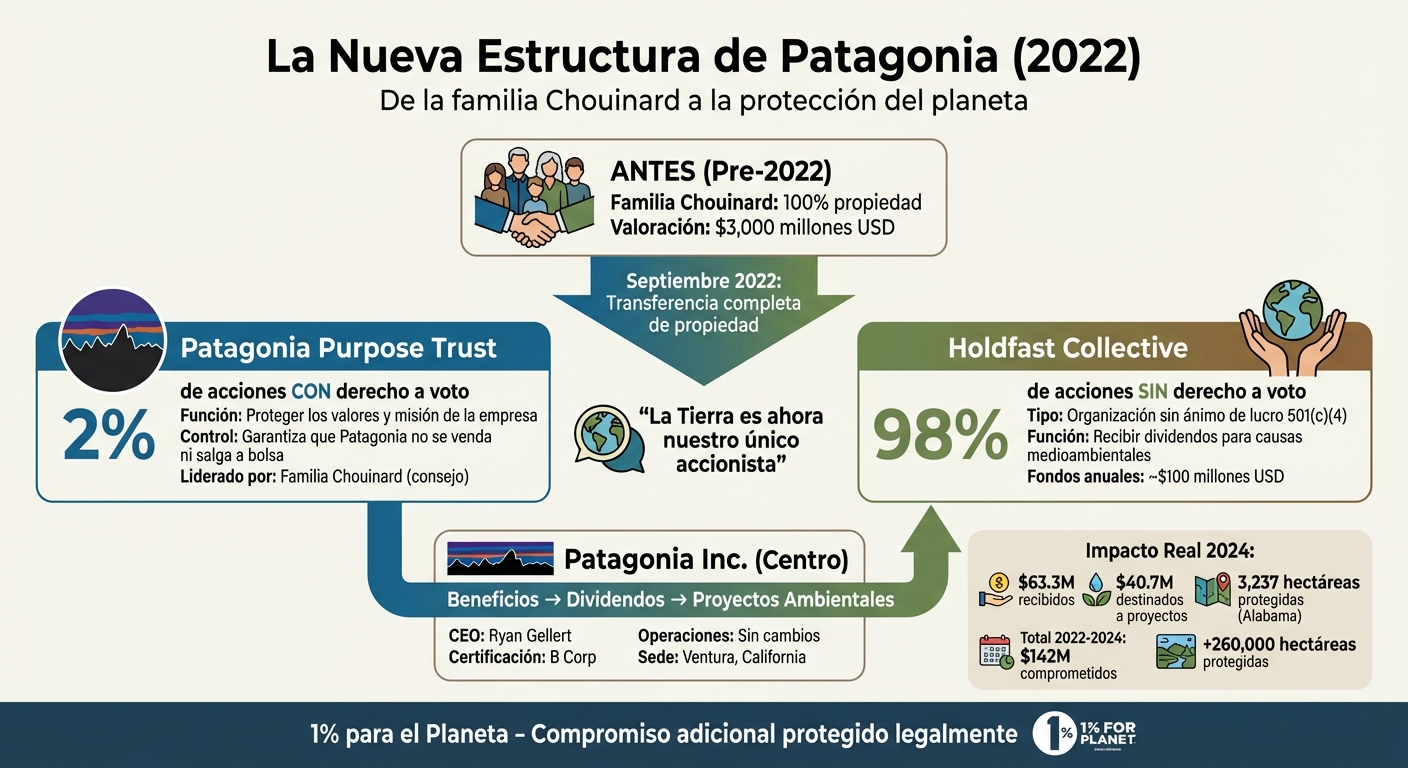
- Ownership: 2% of voting shares are in the Patagonia Purpose Trust, which protects the company's values. The remaining 98% belongs to the Holdfast Collective, which uses dividends for environmental projects.
- Operations: Patagonia continues to operate as usual, with Ryan Gellert as CEO and its headquarters in Ventura, California.
- Impact: In 2024, for example, the Holdfast Collective allocated over $40 million to initiatives such as land conservation and ecosystem restoration.
Conclusion: If you buy from Patagonia, you still get high-quality products, but now your money also directly supports causes to protect the planet.
The Founder of Patagonia Donated His Company | The Patagonia Case
sbb-itb-2b14d48
The moment Yvon Chouinard changed everything
Patagonia's ownership structure after the 2022 transfer
Who is Yvon Chouinard
Let's talk about Yvon Chouinard, a man who broke the mold and redefined what it means to lead a company.
Chouinard, born in 1938, doesn't fit the typical entrepreneur profile. His story began as a climber and craftsman, designing his own carabiners and pitons to protect rocks while climbing. In 1973, he founded Patagonia, but he always made it clear that his intention was never to build a business empire:
“I never wanted to be a businessman. I started as a craftsman, making climbing gear for my friends and myself, and it naturally evolved into Patagonia.”
From the beginning, his priority was not growth at all costs, but the protection of the planet. In 1996, he made the decision that Patagonia would only use 100% organic cotton, and he also co-founded the "1% for the Planet" movement, an initiative for companies to donate a portion of their revenues to environmental causes.
This committed vision reached a climax in 2022, when Chouinard made an unprecedented decision to ensure that Patagonia remained true to its values.
The 2022 ownership transfer
In September 2022, Yvon Chouinard, along with his wife Malinda and children Fletcher and Claire, decided to transfer 100% of Patagonia's ownership to two new entities. With an estimated valuation of $3 billion, this restructuring ensured that the company's profits had a clear purpose.
2% of the voting shares were assigned to the Patagonia Purpose Trust. This entity was created to ensure that the company maintained its original mission and did not deviate from its principles. The remaining 98%, non-voting shares, were transferred to the Holdfast Collective, a non-profit organization designed to receive Patagonia's dividends and allocate them directly to combating the climate crisis.
Chouinard took this route instead of selling the company or going public, thus preventing Patagonia's environmental goals from being subordinated to quarterly profit pressures. The family also bore a significant cost: they paid $17 million in taxes to implement this model and avoid the tax burdens associated with a traditional inheritance.
“Instead of ‘going public,’ we could say we’re ‘going purpose.’ Instead of extracting value from nature and transforming it into wealth for investors, we’ll use the wealth Patagonia creates to protect the source of all wealth.”
What is the Holdfast Collective?
The Holdfast Collective is a non-profit organization registered as a 501(c), specifically created to receive and manage the profits generated by Patagonia. Although it owns 98% of the company's shares, it has no voting rights.
This initiative is not a traditional donation or a common philanthropic act. It is a game-changing ownership model: Patagonia continues to generate profits, but instead of going into the hands of private investors, those funds are directly allocated to combating the climate crisis, protecting biodiversity, and supporting communities that depend on healthy ecosystems.
The 501(c) legal structure grants the Holdfast Collective unique flexibility to engage in political activism. This means that, in addition to funding environmental projects, it can support causes and candidates committed to the environment.
How the Holdfast Collective uses the money
Each year, Patagonia transfers approximately $100 million in dividends to the Holdfast Collective, provided the company's financial health allows it. These funds come from the remaining profits after reinvesting in the business and maintaining the necessary reserves for its operation.
The Collective uses this money for a wide range of initiatives: protecting natural spaces, restoring damaged ecosystems, supporting local communities in vulnerable areas, and lobbying for concrete measures against climate change. This is not a simple green marketing exercise; it is a legal mechanism designed to ensure that resources are exclusively dedicated to protecting the planet.
The Chouinard family remains involved in the direction of the Collective's investments, staying true to the values that have always defined Patagonia.
What is interesting about this model is that it does not alter the day-to-day operations of the company, as explained below.
Patagonia Inc continues to operate normally
Patagonia Inc has not closed, been sold, or gone public. The company operates with the same structure, team, and quality standards as always. Ryan Gellert remains the CEO, stores remain open, and the company maintains its B Corp certification and its status as a benefit corporation in California.
While the Holdfast Collective channels profits towards combating climate change, Patagonia Inc continues with its usual operations. The only difference is the destination of the profits: what previously went to the Chouinard family now directly funds the Collective's goals. Otherwise, everything remains the same.
Is Patagonia still the same company?
It depends on how you look at it. Patagonia Inc continues to produce its technical apparel with the same quality standards, under the direction of Ryan Gellert, and maintains its B Corp certification. If you visit a Patagonia store today, everything looks the same as always.
But what has really changed is who benefits from the company: now, all profits are dedicated to combating the climate crisis through the Holdfast Collective. As Yvon Chouinard expressed:
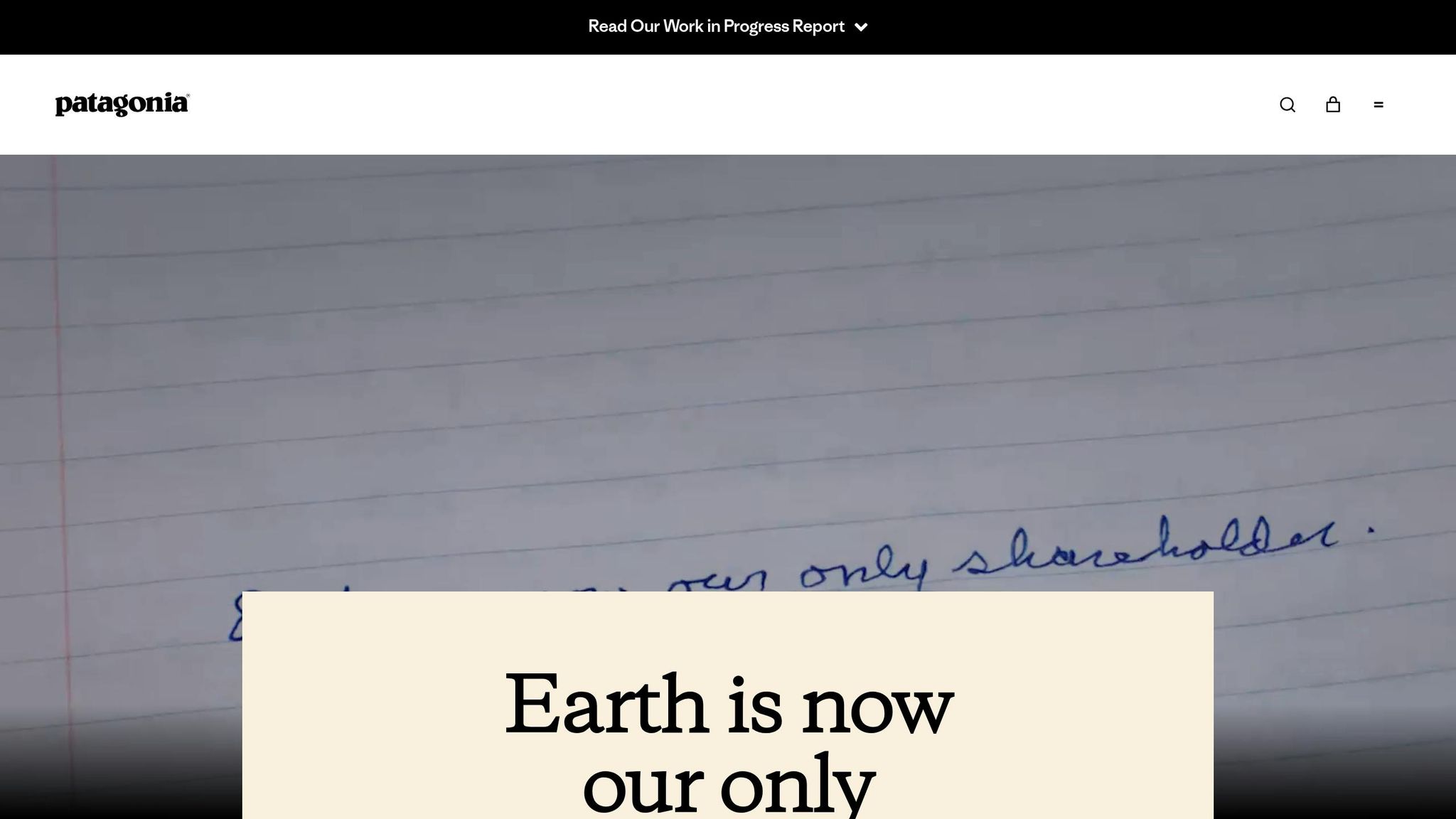
"Earth is now our only shareholder".
This legal change places Patagonia in a unique position within the outdoor apparel sector. No other brand has a similar model. Let's explore how this new structure affects its daily management.
The purpose-driven ownership model
The Patagonia Purpose Trust controls 100% of the voting shares (which represent 2% of the total), ensuring that the company cannot be sold, go public, or deviate from its environmental mission. Although the Chouinard family is no longer the owner in the traditional sense, they continue to lead the trust and are part of the board of directors.
This model eliminates the typical pressures of quarterly growth, which often lead to decisions such as cutting costs or outsourcing production. Instead, Patagonia remains firm in its commitment to sustainability, prioritizing its long-term values over immediate profits.
Despite these internal changes, for customers, the experience remains the same.
Same quality and repair policies
Patagonia's Ironclad Guarantee remains intact. This means you can repair, exchange, or request a refund for any garment that does not meet your expectations. In addition, the Worn Wear program continues to operate as always, repairing used clothing to extend its useful life and reduce unnecessary consumption.
Patagonia also continues its 1% for the Planet commitment, donating that percentage of its annual sales to local environmental organizations. This commitment is legally protected by the Patagonia Purpose Trust, ensuring that it cannot be altered. The 2022 restructuring not only preserved its "buy less, buy better" philosophy, but strengthened it even further.
What changes for the customer who buys Patagonia?
If you've ever wondered if the change at Patagonia affects what you buy, the answer is simple: the quality remains the same, but now your money has a direct impact on environmental initiatives. Let's see how this benefits you as a customer.
Your purchase supports real projects to protect the planet
Every time Patagonia closes the year with profits, what is not reinvested in the company goes as a dividend to the Holdfast Collective. This means that every euro you spend helps to fund real environmental projects. It's not just a slogan; it's a commitment backed by its legal structure.
In 2024, for example, the Holdfast Collective received $63.3 million from Patagonia's profits and allocated around $40.7 million to grants for projects such as the protection of 3,237 hectares in the Mobile-Tensaw Delta, Alabama, or the conservation of biodiversity through Re:wild. Since 2022, they have committed $142 million to conservation initiatives, protecting over 260,000 hectares of land.
Additionally, Patagonia maintains its 1% for the Planet commitment, donating this percentage of its annual sales to local environmental organizations. This commitment is now legally protected by the Patagonia Purpose Trust, which ensures that it cannot be modified, no matter what happens to the company.
Quality and services, intact
Although your money now supports environmental causes, the quality you expect from Patagonia has not changed at all. The Ironclad Guarantee and the Worn Wear program continue to function as always, reinforcing the "buy less, buy better" philosophy that defines the brand.
The structural change of 2022 did not affect your customer experience. The only thing that has changed is the destination of profits: previously they went to the Chouinard family, and now they are destined to protect the environment. So you can continue to trust Patagonia products, knowing that your purchase also helps care for the planet.
Yvon Chouinard's legacy beyond 2022
Decades of environmental activism
The donation made in 2022 is the result of a trajectory marked by activism. Since 1985, Patagonia has allocated 1% of its annual sales to support environmental organizations, a commitment that has endured for four decades. In addition, in 2002, Yvon Chouinard and Craig Mathews founded "1% for the Planet," an initiative that connects companies with this philosophy of global collaboration.
However, Patagonia's commitment is not limited to donations. In 1996, the company made the decision to exclusively use organic cotton in all its production, eliminating synthetic pesticides from its supply chain. It also launched the Worn Wear program, which promotes the repair and reuse of clothing as part of its stance against consumerism. They have even gone so far as to close their stores on Black Friday, sending a clear message against excess.
These actions reflect a deep and lasting commitment that, after 50 years, is formalized through a structural change.
The logical step after 50 years of consistency
After decades of sustainable practices, in 2018 Patagonia took another step by redefining its corporate purpose with the statement: "We're in business to save our home planet". This change paved the way for the legal transformation that materialized in 2022, when the donation to the Holdfast Collective ensured that this mission would remain a permanent legal commitment. As Chouinard explained:
"If we could do the right thing to earn enough to pay the bills, we could influence customers and other businesses and, maybe, change the system along the way."
The 2022 decision was not improvised; it was the natural outcome of 50 years of consistent work. Selling the company or going public would have compromised the values that Patagonia represents. With the current structure, the environmental mission is legally protected, ensuring that its essence is not diluted under future owners. More than a change, this evolution ensures that Patagonia's legacy endures over time.
FAQs
Has Patagonia closed or been bought?
No, Patagonia has not closed or been acquired by another company. It continues to operate as a private company, but in 2022 something important happened: its founder decided to donate ownership of the company to two non-profit organizations: Patagonia Purpose Trust and Holdfast Collective.
The reason? To ensure that the brand's profits are directed towards two key objectives: combating climate change and protecting the environment. It is a step that reflects a deep commitment to caring for the planet.
What is the Holdfast Collective?
The Holdfast Collective is a non-profit organization founded in 2022 with a very clear purpose: to manage Patagonia's profits after Yvon Chouinard's decision to donate the company. Its main mission is to channel these revenues towards initiatives that combat climate change and protect natural ecosystems.
In this way, Patagonia continues to operate as a private company, but with a model that prioritizes environmental care over economic profits.
Does Yvon Chouinard still own Patagonia?
No, Yvon Chouinard is no longer the owner of Patagonia. In 2022, he made the decision to donate the company to the Patagonia Purpose Trust and the Holdfast Collective, two non-profit organizations created with the aim of combating climate change and preserving the environment.
Is there still a lifetime warranty on Patagonia products?
The lifetime warranty on Patagonia products remains in effect. The company maintains its commitment to quality in the design, manufacturing, and sale of its products, with no changes in this aspect of its structure.
Where can I buy Patagonia in Mallorca?
You can purchase Patagonia products in Mallorca through their official online store. Additionally, if you prefer to buy in person, you can use their store locator to find authorized dealers in your area.