
Who owns Patagonia?
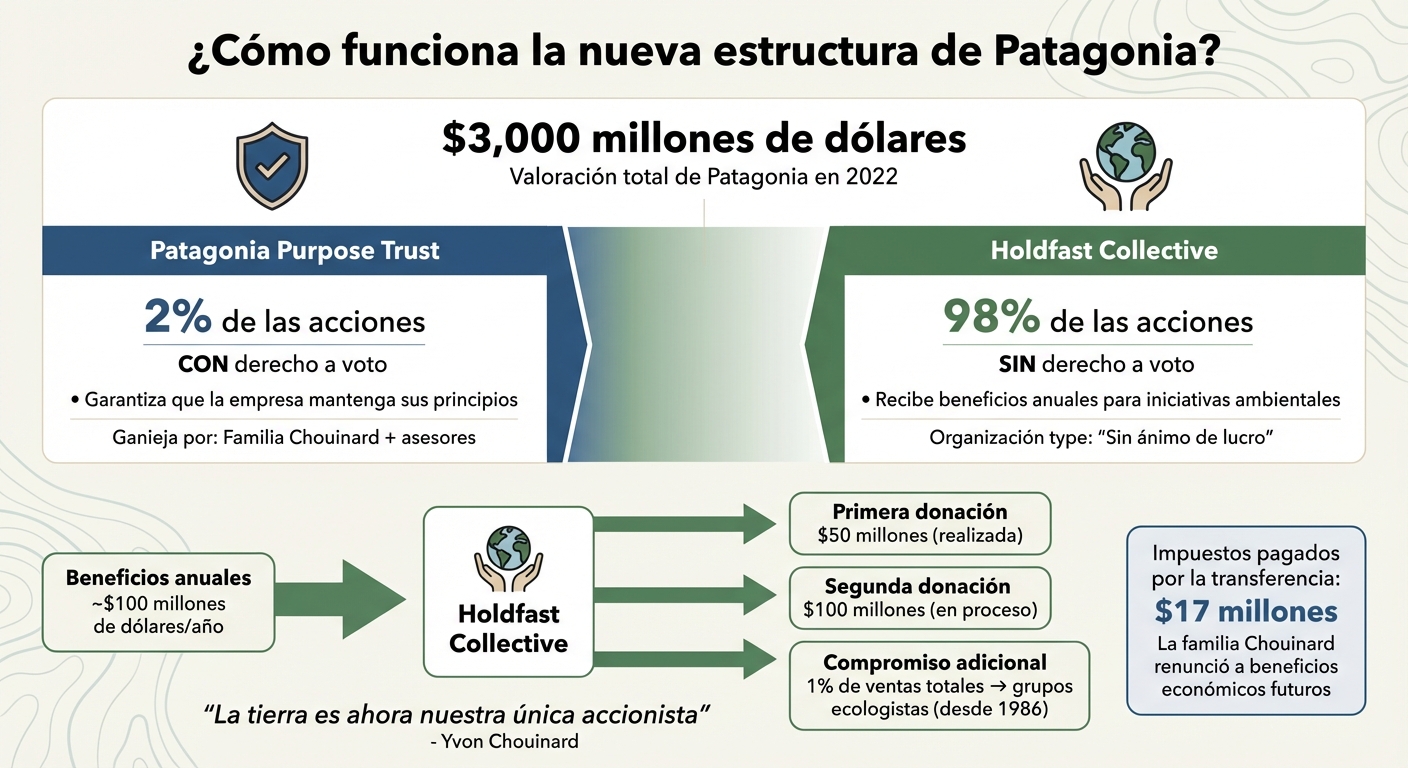
Since 2022, Patagonia has no owner in the traditional sense. Its founder, Yvon Chouinard, along with his family, transferred 100% of the company, valued at approximately $3 billion, to two entities: the Patagonia Purpose Trust and the Holdfast Collective.
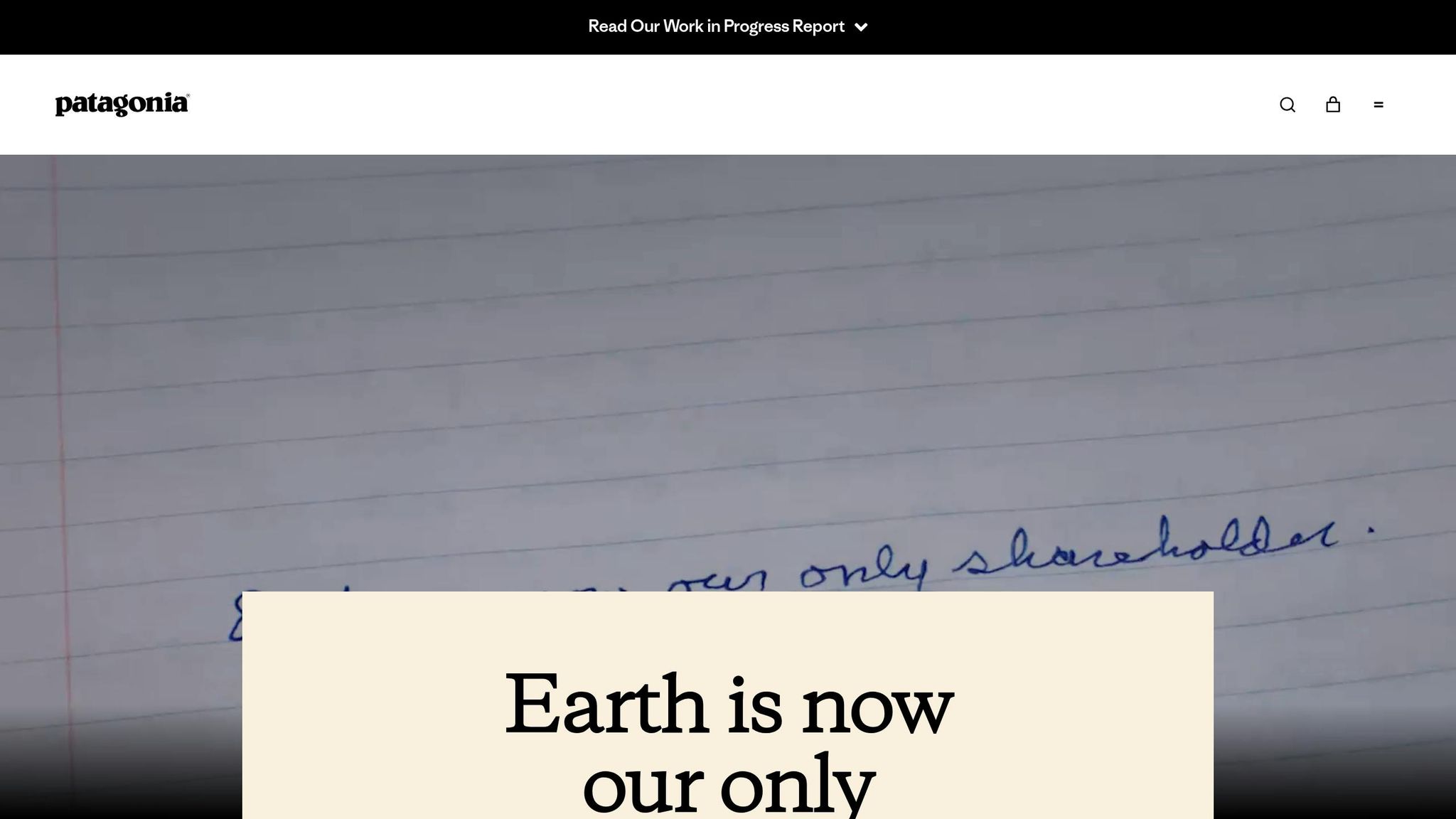
The primary goal of this decision is to dedicate all of the company's profits to combating the climate crisis. Instead of selling it, going public, or leaving it to his children, they chose a structure that ensures profits are reinvested in the planet. As Chouinard expressed: "Earth is now our only shareholder."
Key facts:
- Patagonia Purpose Trust: Controls 2% of the voting stock, ensuring the company maintains its principles.
- Holdfast Collective: Owns 98% of the non-voting stock and receives annual profits (approximately $100 million) to fund environmental initiatives.
- The Chouinard family paid $17 million in taxes on the transfer and waived any future economic benefits.
Patagonia continues to operate as a private company, with its values and quality intact, but now its profits have a single purpose: to protect the planet.
Yvon Chouinard: the man who built Patagonia
From garage workshop to global brand
Yvon Chouinard, born in 1938, spent his youth climbing in Yosemite during the "Golden Age" of Californian climbing. He had no intention of being a businessman; he was simply a climber seeking better tools for his passion. In 1957, he taught himself blacksmithing to make hardened steel pitons, which he sold from the trunk of his car. This was the birth of Chouinard Equipment, a company that emerged more out of necessity than ambition.
The leap to Patagonia happened almost by accident. In 1970, Chouinard brought some durable rugby shirts from Scotland that began to attract the attention of other climbers. Three years later, in 1973, he founded Patagonia as an extension of his equipment business. From the beginning, his vision was clear: create durable products, grow slowly, and avoid going public. These decisions reflected his commitment to quality and the environment, setting a different course from many traditional companies.
A different business approach
Chouinard always considered himself more of a craftsman than an entrepreneur.
"I never wanted to be a businessman. I started as a craftsman, making climbing gear for my friends and myself, and then I got into clothing."
This mindset was reflected in all his business decisions. In 1972, when steel pitons accounted for 70% of his company's revenue, he realized they were damaging rock cracks in Yosemite. Along with his partner Tom Frost, he published a 14-page essay in his catalog promoting "clean climbing" and introduced Hexentrics and aluminum Stoppers, alternatives that left no marks on the rocks. He gave up his most profitable product to maintain consistency with environmental respect.
This same logic led Patagonia to make risky decisions aligned with its principles. In 1996, after an audit revealed the chemical impact of conventional cotton, it decided to switch to 100% organic cotton, despite the costs and the need to rebuild its supply chain. In 2011, Patagonia surprised everyone by publishing an advertisement in the New York Times with the headline "Don't Buy This Jacket," encouraging consumers to repair their clothes instead of buying new ones. For Chouinard, profits were a consequence, not the main goal.
His lifestyle reflected his values. Despite being a multimillionaire, he lived on about $60,000 a year and drove a 1987 Toyota Corolla.
"I'm not a consumer. I use everything until it completely falls apart."
This austerity was not a marketing strategy, but a genuine expression of his principles, the same ones that defined Patagonia's path and laid the groundwork for future revolutionary decisions.
sbb-itb-2b14d48
The TRUE story of PATAGONIA | Let my people go surfing | Biography of YVON CHOUINARD
The 2022 decision: handing the company over to the planet
Patagonia ownership structure: share distribution and profit destination
In September 2022, Yvon Chouinard made a decision that revolutionized the business world. With Patagonia, a company valued at $3 billion, he decided not to sell it, not to take it public, and not to leave it to his children. Instead, he transferred 100% of the shares to two entities designed to protect the planet, paying $17 million in taxes for this operation. Although for many this decision was unexpected, for those who know his philosophy, it was a natural step.
The legal structure of this transfer is complex, but its objective is clear: to ensure that Patagonia's values remain intact. The company's ownership was divided between the Patagonia Purpose Trust and the Holdfast Collective, eliminating the traditional control of the Chouinard family. Here's how this new structure works.
"Instead of extracting value from nature and transforming it into profits for our investors, we will use the wealth Patagonia creates to protect the source of all well-being."
- Yvon Chouinard, Patagonia
The Patagonia Purpose Trust
This trust controls 2% of the shares, which are the only ones with voting rights. Its mission is to ensure that Patagonia remains true to its original purpose. The Chouinard family, along with a team of advisors, oversees this trust to ensure that the company's decisions do not compromise the principles that have guided Patagonia for more than 50 years.
The Holdfast Collective
The Holdfast Collective, a non-profit organization, owns 98% of the remaining shares, which have no voting rights. Each year, this entity receives the profits generated by Patagonia, once the company's reinvestment needs are covered. These funds, which amount to approximately $100 million annually, are allocated to combating climate change, protecting ecosystems, and supporting communities. After the announcement of this new structure, a first donation of $50 million was made, with another $100 million already in process.
"Earth is now our only shareholder."
- Yvon Chouinard, Patagonia
All profits exceeding the company's needs are used to protect the planet. Additionally, Patagonia maintains its commitment to donate 1% of its total sales to environmental groups, a practice that continues regardless of financial results.
How Patagonia works now
It remains a private company
Patagonia continues to operate as a private company based in Ventura, California, just as it did before September 2022. It has not gone public nor undergone merger or acquisition processes. Its management team continues to handle decisions related to design, production, and distribution as usual.
The products maintain their quality, the lifetime guarantee remains in effect, and the commitment to standards of excellence remains intact. If you bought a Patagonia jacket in 2021 and another in 2024, you will notice that the product has not changed. The only difference lies in how the profits generated by its sales are distributed.
Where the money goes
Patagonia's revenues are reinvested in key areas such as quality improvement, process optimization, fair wage payments, and research into more sustainable materials. Once these costs are covered, net profits are channeled as dividends to the Holdfast Collective.
This collective uses the funds to support initiatives aimed at conserving ecosystems, promoting the use of renewable energy, and combating climate change. Additionally, Patagonia maintains its commitment to donate 1% of its total sales to environmental groups, a practice it has been doing since 1986. Essentially, although the company operates as always, its ultimate goal remains clear: the planet is its only real shareholder.
Why Chouinard refused to sell or go public
The problem with traditional buyers
In 2022, Patagonia reached an estimated valuation of $3 billion. For any entrepreneur, this figure could have meant a golden opportunity to sell. However, Yvon Chouinard, Patagonia's founder, did not even consider it. Why? Because he knew that traditional buyers would not guarantee the preservation of the company's values, team, and essence.
Investment funds and multinational corporations typically prioritize short-term economic returns. This implies reducing costs, increasing margins, and, in many cases, compromising the principles that make a brand like Patagonia special. Chouinard was unwilling to sacrifice what he had built for greater profits.
He also did not consider the option of going public. According to him:
"Even public companies with good intentions are under too much pressure to create short-term gains at the expense of long-term vitality and responsibility."
The financial markets model, with its obsession with quarterly results and constant growth, directly clashed with Patagonia's philosophy: produce less, do it better, and reinvest in the planet. Given these limitations, Chouinard decided to take a completely different path.
The planet as the only shareholder
Instead of choosing between selling or going public, Chouinard devised a radical solution. Instead of transforming natural resources into wealth for investors, he decided that Patagonia's profits would be used to protect the planet, which he considers the source of all value. As he explained:
"Instead of 'going public,' we could say we're 'going purpose.' Earth is now our only shareholder."
This was not just a symbolic gesture. Patagonia's new legal structure ensures that the Patagonia Purpose Trust controls the company's votes, while the Holdfast Collective receives the profits. Thus, some $100 million a year is dedicated to combating the climate crisis. In addition, the Chouinard family paid $17 million in taxes on the transfer of shares, without taking advantage of any tax deductions for the donation to the Holdfast Collective.
Dr. Ayana Elizabeth Johnson, a member of Patagonia's board, highlighted the importance of this change:
"If we want to protect nature and support communities, companies cannot continue to adhere to the prevailing economic model. Patagonia has been breaking the mold for decades, and now they have shattered it."
A model that could change the business world
Challenging the profit-first model
In 2022, Patagonia surprised the business world by adopting a structure that prioritizes the planet's well-being over profits. This change was not just a symbolic move, but a step towards a new approach that has sparked debates in business schools, among investors, and in boardrooms: is it possible to run a successful company without the main goal being to maximize shareholder profits?
Although Patagonia has achieved significant financial success, what really stands out is how it uses its profits. Instead of enriching investment funds or large fortunes, it allocates them directly to combating the climate crisis. This model demonstrates that economic results are not at odds with environmental responsibility.
For a long time, Yvon Chouinard, Patagonia's founder, has advocated for a different kind of capitalism. In his own words:
"I hope this can influence a new form of capitalism that is not about a small group getting rich while another large group remains poor."
This statement is not just an ideal, but the reflection of decades of building a company that has always challenged traditional market rules.
Other companies with similar structures
Patagonia is not alone on this path; other companies have adopted structures that also prioritize social or environmental goals, although few have done so with the same transparency and determination. For example:
- Rolex: Since 1945, it has belonged to a non-profit foundation.
- Bosch: This German technology giant is 92% controlled by a foundation that reinvests profits in social and scientific projects.
- IKEA: Operates under a complex foundation structure that limits dividend distribution.
However, what distinguishes Patagonia is its radical decision to dedicate all of its net profits to the planet. This is not a move to optimize taxes or a marketing strategy, but a genuine commitment to a different way of understanding capitalism. In 2022, this decision continues to mark a before and after in the business world.
FAQs
Who is the current owner of Patagonia?
The current owner of Patagonia is the Holdfast Collective, a non-profit organization founded by Yvon Chouinard. This organization controls 98% of the voting shares and allocates the company's profits to support environmental causes. For its part, the Chouinard family manages the remaining 2% through the Patagonia Purpose Trust, ensuring that the brand's mission endures over time.
Is the Chouinard family still involved with the company?
In 2022, Yvon Chouinard decided to transfer ownership of Patagonia to the Holdfast Collective and the Patagonia Purpose Trust. With this move, the Chouinard family ceased to be involved in the company's management and no longer receives direct economic benefits from it.
What does the Holdfast Collective do with Patagonia's money?
The Holdfast Collective uses Patagonia's net profits to support environmental initiatives. These funds are allocated to projects such as conserving natural areas, promoting renewable energy, and protecting key ecosystems.
Has Patagonia been bought by a large company?
No, Patagonia has not been bought by any large corporation. In 2022, Yvon Chouinard, the brand's founder, made an uncommon decision: he transferred ownership of the company to a trust and the non-profit organization Holdfast Collective. This move ensures that Patagonia remains a private company, dedicated to a greater purpose: all its profits are used to combat climate change.
Has the quality of Patagonia products changed since the donation?
The quality of Patagonia products has not been affected by the donation. The brand continues to work with the same high standards in design, production, and philosophy. Additionally, its management team and distribution network remain unchanged, guaranteeing the same experience they have always offered.
Where can I buy Patagonia in Mallorca?
You can purchase Patagonia products in Mallorca in several ways. One option is through their online store, which offers shipping throughout Spain, including Mallorca. Additionally, you can also find them in physical stores and at authorized distributors located in the region.