
Bellver Castle: history, visit, and routes through Palma's most emblematic forest
What makes Bellver Castle special? It is the only circular castle in Spain, located 112 meters above sea level, with spectacular views of Palma, the bay, and the Serra de Tramuntana. This monument combines centuries of history, from its construction in 1311 as a royal residence, to its use as a prison and, today, as a museum. In addition, it is surrounded by a 100-hectare Mediterranean forest, perfect for walks and unwinding.
Key information:
- History: Built by James II of Majorca, it has been a royal residence, a prison, and a symbol of the city.
- Unique architecture: Circular plan with three integrated towers and an isolated keep.
- Museum: Houses the Palma History Museum, with artifacts from the Talayotic period to Roman and Arab times.
- Forest: More than 100 hectares of pine trees, walking trails, and natural viewpoints.
- Visits: General admission €4, free on Sundays. Opening hours from April to September: Tuesday to Saturday 10:00-19:00; Sundays 10:00-15:00.
Bellver Castle is not only a historical site but also a place to enjoy nature, views, and cultural events. Ideal for visitors and residents who want to discover or rediscover one of Palma's most emblematic spots.
What's Hidden Inside Bellver Castle in Palma de Mallorca?
sbb-itb-2b14d48
The history of Bellver Castle
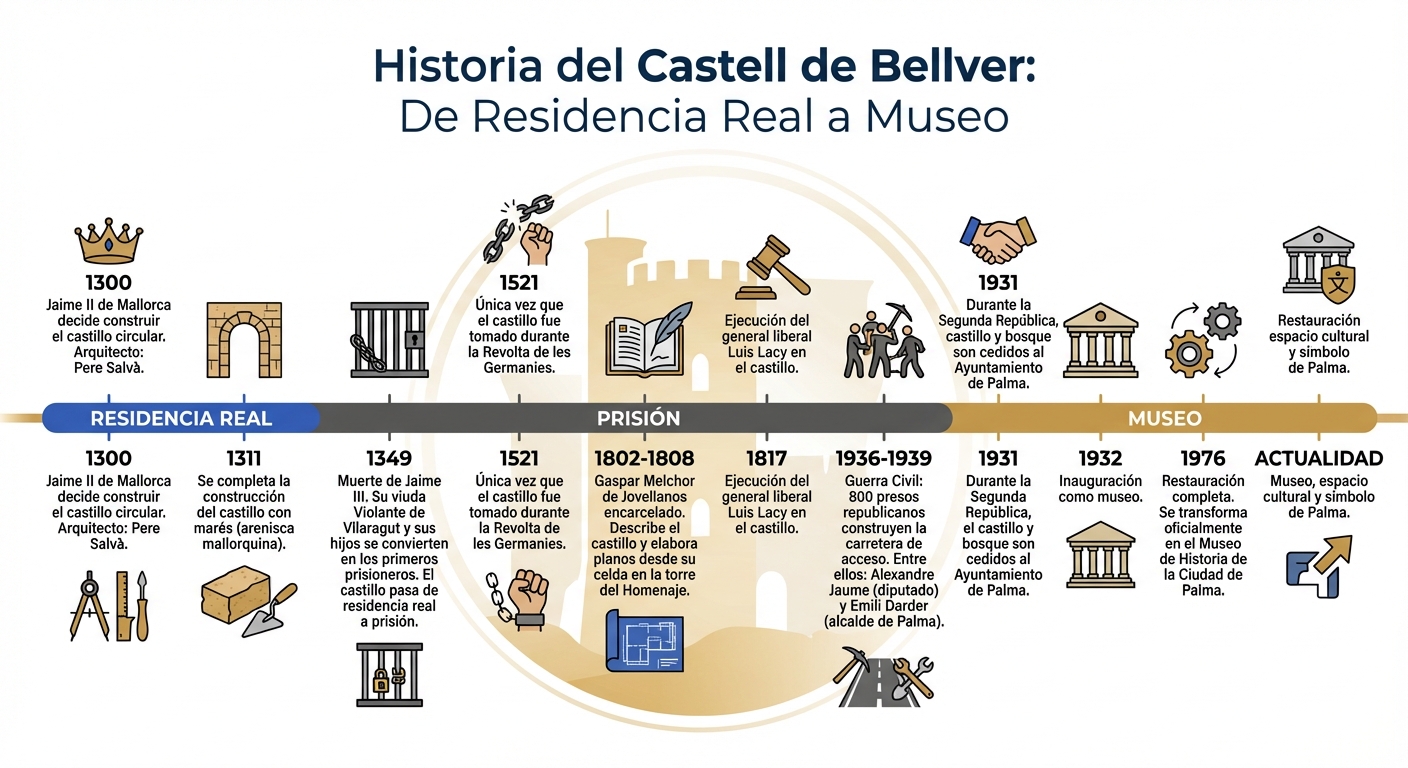
Historical timeline of Bellver Castle from 1300 to the present day
Construction and Gothic Design
In 1300, King James II of Majorca decided to erect a circular castle, an unusual design for the time. The project was entrusted to Pere Salvà, an architect who also worked on the Royal Palace of La Almudaina, with the aim of creating a summer residence for the royal family and a fortress to protect the bay. Construction was completed in 1311.
The castle was built with marés, a golden-toned Majorcan sandstone extracted from caves beneath the hill. Its design, unique in European Gothic style, features a circular plan, three integrated semicircular towers, and a keep, isolated from the rest and connected by a pointed arch bridge.
Why a circular shape? The most accepted theory suggests that Pere Salvà was inspired by Herodium, the circular palace built by Herod the Great in the West Bank. In addition to its distinctive aesthetics, this structure offered defensive advantages. The keep, being isolated, was conceived as the last refuge in case of an attack. This design makes Bellver Castle the only circular castle in Spain and one of the oldest in Europe with this configuration. As a Palmesan, I have always been impressed by how every architectural detail seems to narrate a fragment of its history.
From Royal Residence to Prison
During its early years, Bellver Castle was the residence of the Kings of Majorca. James II, his son Sancho, and his grandson James III enjoyed the views and the breeze from the bay. However, this period as a palace was brief. After the death of James III in 1349, his widow, Violante de Vilaragut, and their children were among the first prisoners in the castle. This change marked a turning point in its use, from royal residence to prison.
Over the centuries, the castle housed numerous illustrious prisoners. One of the best-known cases is that of Gaspar Melchor de Jovellanos, an enlightened minister and thinker, imprisoned between 1802 and 1808 for political reasons. During his confinement, he described the castle in detail and drew up plans. From his cell in the keep, it must have been a bitter contrast to contemplate the splendor of the landscape while living deprived of freedom.
Other notable episodes include the stay of the French physicist François Arago, who took refuge in the castle to escape a mob accusing him of espionage while measuring the Paris meridian. General Luis Lacy, executed in 1817 in the castle, is also remembered. During the Civil War, up to 800 republican prisoners were forced to work on the construction of the access road to the castle, including Alexandre Jaume, a deputy, and Emili Darder, mayor of Palma.
Despite its turbulent history, the castle was only taken once, during the Revolt of the Brotherhoods in 1521. On other occasions, its strategic position 112 meters above sea level allowed it to resist sieges and conflicts. Over time, Bellver Castle left behind its military and carceral character to become a cultural symbol.
Palma City History Museum
In 1931, during the Second Republic, the castle and its forest were ceded to the Palma City Council. A year later, it opened as a museum. After a complete restoration in 1976, it was officially transformed into the Palma City History Museum.
Currently, the museum exhibits pieces that tell the island's history, from the Talayotic period to the Roman and Arab eras. Among its treasures is the Despuig collection, which includes sculptures, busts, and reliefs that contrast with the austere Gothic halls of the castle. Wandering through its exhibitions is like traversing the chapters of a history that intertwines kings, prisoners, and modern visitors. In addition, the surrounding forest completes the experience, offering a space where history and nature meet.
What to see at Bellver Castle
The circular courtyard
The courtyard is the heart of the castle, with two levels of Gothic arcades that invite you to explore its rooms fluidly. In the center, a wellhead stands out, connecting to the underground cistern, essential for water supply in its time. Light plays a unique role here: in the morning, it gently enters through the upper arcades, while at midday it floods the space with clarity. If you have the opportunity to attend one of the concerts held in this place, you will be impressed by the acoustics that fill the venue. From the courtyard, you can access the terrace, continuing the experience.
The terrace and the views
Located 112 meters above sea level, the terrace offers a spectacular view of Palma. From there, you can admire the bay, the Cathedral with its unmistakable silhouette, the port, the Serra de Tramuntana, and the Palma Plain, all in a 360° panorama. The castle's name, bell veer (meaning "beautiful view" in Old Catalan), lives up to this impressive setting. Sunsets from here are unforgettable, with the golden light enhancing every corner of the bay and the ships in the port. It's one of those places you can't help but show to those visiting Palma for the first time.
The keep and Jovellanos' cell
The keep, separated from the main building and connected only by a bridge crossing the moat, holds a fascinating history. Gaspar Melchor de Jovellanos was imprisoned here between 1802 and 1808. From his cell, the illustrious minister contemplated the bay and worked on a detailed description of the castle, also commissioning the first plans of the building. As you tour the tower, you can imagine Jovellanos' moments of reflection, while every corner seems to tell a fragment of his story.
The museum collection
The City History Museum primarily occupies the ground floor, around the courtyard. In its halls, the classical sculptures from the Despuig collection contrast with the sobriety of the Gothic architecture, creating a fascinating connection between eras. The light filtering through the arcades illuminates the busts and reliefs, integrating them perfectly into the castle's environment. Additionally, for those who wish to delve deeper into the darker past of the site, the Alexandre Jaume Auxiliary Library preserves documents about political prisoners from the Civil War, offering a more complete historical perspective.
Bellver Forest: routes and trails
Main circular route
Bellver Forest is Palma's great green lung, with more than 100 hectares of Mediterranean pine forest just 3 kilometers from the center. For those of us who live here, it's an essential place, a natural refuge that reminds us of the importance of these spaces in urban life. The main circular route, which surrounds the castle, is perfect for enjoying a walk among pine trees, wild olive trees, and scrubland. With 3-4 kilometers of easy terrain and no major inclines, it's ideal for families, morning runners, or anyone needing to disconnect from the city's hustle and bustle.
Along the way, you'll find several natural viewpoints that offer views of the bay through the tops of the pine trees. In the summer months, the sea breeze adds a refreshing touch to the route. On Sunday mornings, the forest comes alive with runners, cyclists, families with dogs, and people simply strolling or exercising. It's a space that Palmesans frequently use, although we often forget its value. If you're looking for an experience with a historical touch, the routes to the castle are an excellent alternative.
Walking routes to the castle
For those who prefer to walk up, Carrer del Polvorín is an option full of history. This cobbled path, starting in the El Terreno neighborhood, was built to transport artillery to the castle. The climb, surrounded by stone walls and vegetation, is gradual, and the castle majestically appears among the trees at the end of the journey.
Another option is the main paved road, although its history is more somber. Built during the Civil War, it was constructed by the forced labor of some 800 republican prisoners incarcerated in the castle. Today, this road is used by cars and buses, although many prefer the trails through the pine trees for a quieter and more natural walk.
In addition to these main routes, the forest has less-traveled paths for those seeking a more serene environment.
Secondary trails and quiet areas
If you stray from the main route, you'll discover secondary paths where calm reigns. There are picnic areas under the pines, hidden stone benches with unique views, and perfect spots to unwind and enjoy nature in solitude.
Among the notable places in the forest are the municipal Mounted Police stables and the Chapel of San Alonso Rodríguez, built between 1879 and 1885. You can also visit a large cave that, in the past, was used as a municipal vehicle depot. If you have the opportunity to go on the second Sunday after Easter, you can enjoy the Diumenge de l'Àngel, a local tradition where many Palma families go up to the forest to spend the day together.
Practical information for your visit
How to get there
Bellver Castle is located about 3 kilometers from the center of Palma, at an altitude of 112 meters. If you decide to go by car, access is via Camilo José Cela street, where you'll find a free car park right next to the castle. Keep in mind that on weekends it can fill up quickly.
If you prefer public transport, bus lines 1 and 20 will drop you nearby, although you will have to walk the final stretch. For those who enjoy walking, Carrer del Polvorín, which connects the El Terreno neighborhood with the castle, is a historical and highly recommended route.
Opening hours and ticket prices
Knowing the opening hours and fees is key to planning your visit. From April to September, the castle is open from Tuesday to Saturday from 10:00 to 19:00, and on Sundays and holidays from 10:00 to 15:00. From October to March, it closes an hour earlier on weekdays, i.e., from 10:00 to 18:00. It remains closed on Mondays throughout the year, as well as on specific dates such as January 1, May 1, December 25, and Easter Sunday.
The fees are as follows:
- General admission: €4
- Reduced rate: €2 (for pensioners and young people aged 14 to 18)
- Palma residents: €2.50
In addition, admission is free on Sundays for everyone, although there are usually more visitors. Children under 14, groups of retirees, teachers, ICOM members, and people with disabilities also enter for free.
You can buy tickets at the visitor reception center, located in the car park. This area also has a cafeteria, a souvenir shop, and a small interpretation center. Remember that tickets are sold up to 30 minutes before closing time, so it's ideal to arrive 45 minutes in advance. If you're interested in a guided tour, these are available from Tuesday to Saturday: in English at 11:00 and in Spanish at 12:30, lasting approximately 30 minutes with a minimum of 5 participants.
Best time to visit
The time of day you choose can make all the difference to your experience at Bellver Castle. Late afternoon is, without a doubt, the most special. The golden light filtering through the arcades of the courtyard, the views of the bay with the sun setting over the sea, and the cooler atmosphere create a magical setting. As someone who has lived in Palma, I can say that these sunsets have something unique that transforms every corner of the castle into an unforgettable postcard. In summer, with extended hours until 7 PM, it's perfect for enjoying this natural spectacle.
If you prefer to avoid crowds, it's best to go early on a weekday morning. Although admission is free on Sundays, these tend to be busier days, especially with families. On the other hand, if you visit in spring, keep in mind that the second Sunday after Easter celebrates Diumenge de l'Àngel, a local tradition where many people from Palma go up to the forest. On that day you will find a festive atmosphere, but also more people than usual.
Conclusion
After exploring its history, its towers, and its trails, Bellver Castle emerges as much more than a mere monument: it is an essential corner of everyday life in Palma. This place combines history, architecture, and Mediterranean nature in a unique space, located just three kilometers from the city center. From its terrace, it offers 360° panoramic views encompassing the bay, a museum that narrates centuries of Palma's history, and a pine forest that serves as a refuge from the urban hustle and bustle.
It is not only a witness to the past but also a space that connects tradition with Palma's modern life. Strolling through the Gothic arcades of its circular courtyard, climbing to the terrace to feel the sea breeze and contemplate the cathedral, the port, and the Serra de Tramuntana is an unforgettable experience. And descending through the forest trails, surrounded by the scent of pine and salt, one feels truly in the city's green lung.
Whether you are a visitor or a resident, Bellver Castle always holds a corner to discover. This castle, once a royal residence, fortress, and prison, has been transformed into a vibrant space where concerts, exhibitions, and unique sunset moments take place.
Let the forest envelop you, enjoy the bay views, and find something new every time you visit. Bellver Castle always has something special to offer, whether it's your first visit or your hundredth.
FAQs
What is Bellver Castle?
Bellver Castle, located in the beautiful city of Palma de Mallorca, stands out for its circular design, which is unusual both in Spain and in Europe. This medieval castle, built in the 14th century under the orders of King James II, has had multiple uses throughout the centuries.
Initially, it served as a royal residence, offering refuge and comfort to royalty. Later, its strategic position made it a key defensive fortress for the island. It was also used as a prison, witnessing numerous historical events.
Today, the castle houses the City History Museum, where visitors can explore Palma's past through fascinating exhibitions and collections. In addition to its historical value, Bellver Castle is a prominent symbol of Mallorca's identity, attracting tourists and locals who wish to enjoy its unique architecture and spectacular views.
Why is Bellver Castle circular?
The circular design of Bellver Castle stands out as a rarity in Spain and draws inspiration from constructions like the Herodium. Its round plan, complemented by three attached towers and an independent keep, combines influences from European Gothic. This design not only aimed to optimize defense and provide panoramic views, but also represented an architectural uniqueness for its time.
How much does entry to Bellver Castle cost?
Admission to Bellver Castle costs approximately 8 euros, although there are discounts for residents and students. Additionally, on certain special days, admission is free. It is advisable to check the updated schedules and rates before planning your visit.
What is the best time to visit Bellver Castle?
Sunset is perfect for exploring Bellver Castle. The golden light transforms the arcades of the courtyard into a visual spectacle, while the views of Palma Bay gain even more beauty. It is an experience that remains etched in memory.
Can you walk through Bellver Forest for free?
Yes, Bellver Forest is a public space that you can access without paying anything. It's perfect for walking, running, or having a good time with the family. This place is open to all visitors and has no entrance fee.
What routes are there in Bellver Forest?
Bellver Forest is a perfect place for those looking to enjoy nature and breathtaking views. Its main route is a circular path of about 3-4 km that surrounds the castle, ideal for family walks, running, or simply a leisurely stroll.
In addition, there are less crowded secondary paths that hide picnic areas and viewpoints with unique views. From the base of the forest, several paved accesses lead to the castle, surrounded by pine trees and scrubland, creating an ideal atmosphere to disconnect from the daily hustle and bustle.