
Alaró Castle: Mallorca's Most Iconic Hiking Trail
If you're looking for an experience in Mallorca that combines nature, history, and spectacular views, Castell d'Alaró is the perfect choice. This medieval castle, located 822 meters above sea level, offers hiking trails for all levels, from the easy ascent from Es Verger restaurant to the longer route from Alaró village.
Why visit?
- Ancient history: From its origins as an Islamic fortress to its conversion into a Christian sanctuary, every corner tells tales of resistance and heroism.
- Unbeatable views: From the top, you can see the Serra de Tramuntana, the bays of Palma and Alcúdia, and even Cabrera on clear days.
- Cozy refuge: Enjoy a pa amb oli or spend the night in a unique setting.
Main routes:
- From Es Verger: 3 km, moderate difficulty, ideal for beginners.
- From Orient: 10 km, for those seeking tranquility and a greater challenge.
- From Alaró village: 14 km round trip, a complete experience that includes history and nature.
Wear trekking shoes, bring enough water, and a windbreaker. Autumn and spring are the best times to visit. If you can, book a stay at the refuge to enjoy the magic of the castle at sunrise.
The history of Castell d'Alaró
From Islamic fortress to Christian castle
Before the arrival of the Muslims in 902, Castell d'Alaró already served as a refuge for the rum, descendants of Romans, Vandals, and Byzantines. The mountain, with its impressive verticality, offered an almost impenetrable natural defense. During the Muslim conquest, these defenders resisted for eight years and six months, but eventually surrendered due to lack of provisions.
Under Islamic rule, the castle was known as Hisn Alarün. During this period, advanced infrastructures were built, such as six Arab-style cisterns that are still preserved today and supplied water to the garrison. After the conquest of Mallorca by Jaume I in 1231, the castle's role changed: the Muslims sought refuge in it, but the fortress fell when the king confirmed that they would not receive help from Tunisia. An old legend tells that the spilled blood of the Saracens stained the rocks so much that "it has not yet been erased."
This past of resistance and struggle sets the stage for the famous legend of Cabrit and Bassa.
The story of Cabrit and Bassa
The most iconic episode of Castell d'Alaró is that of Guillem Cabrit and Guillem Bassa, two captains who in 1285 defended the fortress against Alfonso III of Aragon. Loyal to King Jaume II of Mallorca, they refused to surrender. Alfonso III, furious, uttered the phrase: "Cabrit, you say? Good catch! Well, like cabrits (goats) I swear to roast you." And he fulfilled his threat: both were executed by being roasted alive in the town square of Alaró, becoming symbols of loyalty and sacrifice.
Today, two ribs of Cabrit and Bassa are kept as relics in a reliquary inside the castle's oratory. In addition, their images are depicted in altarpieces of several Mallorcan churches. In 1622, on November 6, their remains were transferred from Palma Cathedral to the castle, transforming the place from a military fortress into a pilgrimage sanctuary.
Every corner of the castle continues to evoke these stories of bravery and devotion.
Historic vestiges at the summit
The summit of Castell d'Alaró is a living testament to its rich history. The 14th-century Gothic walls surround the main enclosure, along with defensive towers such as the Torre del Homenaje, known as Es Constipador due to the cold wind that surprises hikers after the ascent, and the Torre de sa Cova, also called the Moorish Prison. Next to these military structures is the Oratorio de la Mare de Déu del Refugi, built in 1622, which stands out for its Renaissance portal and Baroque altarpiece.
Among the details you can't miss are the Arab cisterns and a curious circular mark on the stone next to the first door, which, according to tradition, corresponds to the footprint of Jaume I's horse during the conquest. Every stone and every structure here tells stories of battles, sacrifices, and legends that seem to come alive when the wind passes through the walls. Visiting this place in person is an experience that connects with centuries of history.
sbb-itb-2b14d48
Mallorca Hiking: Excursion to Alaro Castle from Es Verger Restaurant, Alaro, Mallorca (Majorca).
How to climb Castell d'Alaró
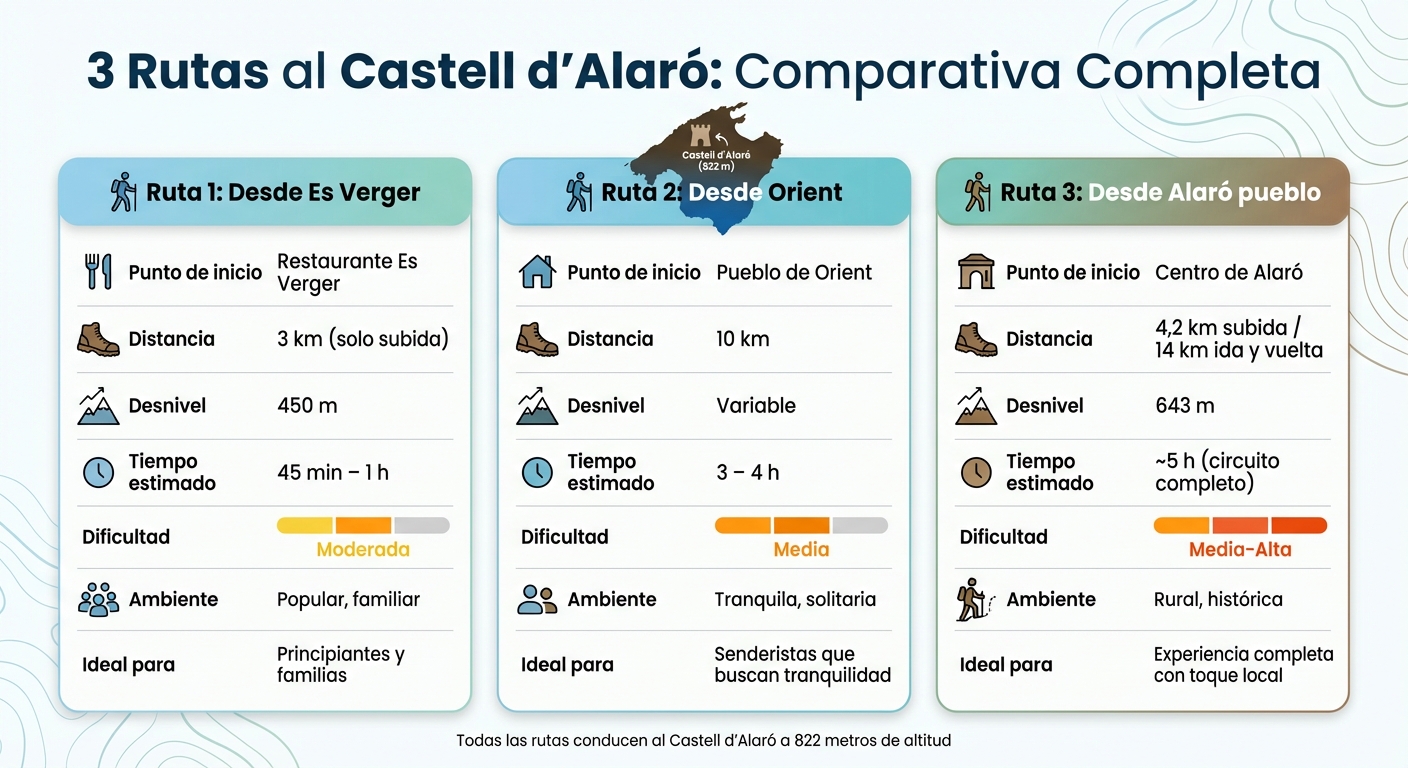
Comparison of the 3 hiking trails to Castell d'Alaró
There are three main ways to reach the castle, each with its own charm. The choice will depend on your time, physical fitness, and whether you prefer a more crowded or quiet route.
The main route from Es Verger
This is the ideal option for first-time visitors to the castle. The starting point is the Es Verger restaurant, which is accessed by car via a narrow and steep mountain road from Alaró. It is important to arrive early, as the parking lot fills up quickly on weekends.
From Es Verger to the top, it is about 3 km with an elevation gain of 450 m, which takes between 45 minutes and 1 hour of walking, depending on the pace. The journey starts gently, but soon becomes steeper, with a cobbled path surrounded by holm oaks and dry stone walls. Halfway up, the first landscapes of the Pla de Mallorca begin to appear, offering an excellent place to rest, hydrate, and enjoy the views.
The final stretch crosses the castle walls, where a mark on the stone recalls the legend of Jaume I's horse. Just before arriving, you will pass under the Torre del Homenaje, known as Es Constipador, because the cold wind that blows there has chilled more than one sweaty visitor. Bringing a windbreaker in your backpack is a good idea.
This route has a moderate difficulty. The cobbled terrain can be slippery if wet, so it is essential to wear trekking shoes with good grip. As it is the most popular, it is common to find families and groups enjoying the route.
The longer route from Orient
For those seeking a greater challenge and more tranquility, the route from Orient is an excellent alternative. This picturesque village, located in a valley of the Tramuntana, offers a peaceful and charming start. With 10 km of route, this trail crosses forests and olive groves, showing a more solitary side of the Tramuntana.
The estimated time to complete this route is 3 to 4 hours. The path follows the Camino de Ses Artigues and connects to the castle via its northern slope. It is a perfect experience for those who enjoy the mountains without rushing, accompanied only by the sound of the wind and the occasional bleating of goats.
The difficulty is medium, mainly due to the distance. It is essential to bring enough water, as there are no fountains on the way, and to protect yourself from the sun, especially in the warmer months. This option is ideal for hikers with some experience who are looking for a more complete day out.
The complete route from Alaró village
This is the longest and least trafficked option, starting in the center of Alaró village. The route is about 4.2 km uphill (about 14 km round trip) and has an accumulated elevation gain of 643 m. Completing the full circuit takes about 5 hours.
The journey starts in the urban area, following the road towards Orient, but soon deviates along the original path, an ancient trail that passes through traditional possessions such as Son Curt and Son Penyaflor. This route combines history, rural culture, and nature, passing by dry stone walls, centuries-old olive groves, and stately homes that seem frozen in time.
It is a route designed for those who want to experience the complete journey: starting from the village, crossing the Mallorcan countryside, reaching the castle, and returning with the satisfaction of having completed an entire journey. The difficulty is medium-high due to the distance, although the path itself does not present major technical complications. It is not recommended for small children or accessible for strollers or wheelchairs.
Comparison of the 3 routes
Here is a table comparing the main characteristics of each route:
| Route | Starting point | Distance (approx.) | Elevation gain | Estimated time | Difficulty | Environment |
|---|---|---|---|---|---|---|
| From Es Verger | Es Verger Restaurant | 3 km (uphill only) | 450 m | 45 min – 1 h | Moderate | Popular, family-friendly |
| From Orient | Orient Village | 10 km | Variable | 3 – 4 h | Medium | Quiet, solitary |
| From Alaró village | Alaró center | 4.2 km (uphill) / 14 km | 643 m | ~5 h | Medium-High | Rural, historical |
If it's your first time, I suggest starting with the Es Verger route. For those who prefer a quieter and more mountainous environment, the option from Orient is ideal. And if you want a complete experience with a local touch, the route from Alaró village will not disappoint. All routes lead to the same castle, where the ruins and the refuge await to culminate the adventure.
What you will find at the summit
Exploring the castle ruins
Upon reaching the summit, you will be greeted by the ruins of Castell d'Alaró, an authentic journey into the past among stone walls. The first stop is the Torre del Homenaje, known as Es Constipador. This curious nickname comes from the sudden change in temperature felt when passing through it, something that has surprised more than one visitor after the ascent.
The castle preserves remains of the 14th-century Gothic walls, including the outer wall and defensive towers such as the Torre de Migjorn and the Torre de sa Cova, also called the Moorish Prison. The latter, with its battlements and loopholes, is located next to the Cova de Sant Antoni, a cave that was once a hermitage. Near the entrance, a mark on the rock brings to life the legend of Jaume I's horse.
In the center of the castle stands the Oratorio de la Verge del Refugi, built in 1622. Its interior houses a Baroque altarpiece and decorations by Antoni Soldati, as well as the ribs of Cabrit and Bassa, heroes who defended the fortress. Six Arab-style cisterns can also be seen, witnesses to the ingenuity that allowed them to resist prolonged sieges.
From the stone viewpoints, Orengar and El Mirador, spectacular views are obtained. Orengar offers a panoramic view of the Serra de Tramuntana with peaks such as Puig Major and the Serra d'Alfàbia, while El Mirador opens towards the bay of Palma, even reaching the silhouette of Cabrera on clear days. At 822 meters above sea level, these views make the climb worthwhile. And after touring the castle, the nearby refuge is the ideal place to rest and recharge.
Food and accommodation at the refuge
The mountain refuge, located next to the oratory, is the heart of Castell d'Alaró. With space for 30 people, it offers basic bunk beds and heating. If you want to spend the night, it is necessary to book by calling 971 18 21 12 and bring a sleeping bag and towel. The price is around 12 to 15 € per person.
The refuge has a cafeteria and restaurant, but don't expect modern comforts: water is limited and all supplies arrive on the backs of two donkeys, the only permanent inhabitants along with the host. This detail, far from being an inconvenience, adds a special charm. A simple pa amb oli after the hike tastes like a true delicacy, and the omelet, cheese, and fresh tomato have a special flavor in this setting.
"Don't expect great luxuries or a very extensive menu, water is limited and all supplies are brought up on the backs of two donkeys, who, along with the host, are the only permanent inhabitants of the castle." - Ajuntament d'Alaró
The refuge opens every day at 9:00, so if you go up early you can enjoy breakfast while the sun illuminates the Pla de Mallorca. Spending the night here is a unique experience, with the silence of the castle broken only by the wind. And at dawn, the views are the perfect culmination to an unforgettable day.
The views from above
From the summit, you can contemplate a large part of the island. To the north, the Serra de Tramuntana displays its most iconic peaks: Puig Major, Puig de Massanella, Tossals Verds, and Serra d'Alfàbia. To the south, the Pla de Mallorca extends like a mosaic of fields and villages, with the bay of Palma shining in the distance. On the clearest days, the Cabrera archipelago can even be seen.
The bays of Palma and Alcúdia offer a stunning contrast from this strategic point. At sunset, the castle cliffs are tinged with an intense orange, while at night, the lights of the villages below seem like stars on earth. The Mirador de l'Orengar, named after the wild oregano that grows in its surroundings, is ideal for photographing the Tramuntana. Another viewpoint, without an official name, offers views that range from Felanitx to Palma, showing the agricultural richness of inland Mallorca. Sitting here, with the wind caressing your face and the landscape stretching as far as the eye can see, is to understand why Castell d'Alaró is an essential visit.
When to go and what to bring
Now that you know what awaits you at the summit, it's time to plan the best time for the ascent and prepare the necessary equipment to fully enjoy the experience.
Best time to climb Castell d'Alaró
Autumn and spring are the most recommended seasons for this route. With temperatures between 15 and 22 °C, the weather is ideal for walking without suffering extreme heat or intense cold. In addition, there are special events that make these dates even more attractive: on the first Sunday of September, a popular meal is celebrated at the refuge, coinciding with the Nativity of the Virgin, which brings together many hikers. On the other hand, on the Sunday after Easter, the Fiesta de l'Àngel or Pancaridad takes place, where locals go up to share traditional panadas in an atmosphere that combines hiking and traditions.
Winter also has its appeal, especially on clear days, when visibility even allows you to spot the Cabrera archipelago from the top. However, temperatures can be very low, so it is essential to dress warmly. In summer, although it is possible to do the route, it is advisable to start at dawn to avoid the scorching heat at the summit.
Equipment you will need
For this adventure, sturdy trekking footwear is essential. The cobbled path can be slippery if wet, and the rocky sections require good grip. Avoid sports shoes or running shoes, as they do not offer the necessary stability. Stores like Peregrin Tuk offer technical options perfect for this type of terrain.
Don't forget to bring enough water, as although there are sources like Font des Verro, these are often dry or reserved for animal use. At the summit, water is brought by donkeys, so availability is limited. It is also crucial to bring a windbreaker to protect yourself from the wind at the top. If you plan to spend the night at the refuge, you will need a sleeping bag and a towel; overnight stays cost between 12 and 15 € per person.
With this equipment, you can safely walk the trail and enjoy nature without complications.
Safety and trail etiquette tips
Castell d'Alaró is a living heritage that deserves respect. Take care of the wildlife, historical remains, and natural environment. Avoid climbing after recent rains, as the cobbled path becomes extremely slippery. If you are going alone, let someone know your route. The castle is part of the Natura 2000 network and is classified as a Special Protection Area for Birds.
Many sections of the route cross private properties, so it is important to stay on marked trails and not deviate without permission. In addition, be especially careful with historical elements, such as the Via Crucis, which has sometimes suffered vandalism. This route is not suitable for children under 6 years old or for strollers or wheelchairs. The mountain demands respect, but in return, it will give you an unforgettable experience.
Conclusion
Castell d'Alaró is not just another route in Mallorca. It is a place where history comes alive at 822 meters high, an effort rewarded with spectacular views that cover much of the island. It's about enjoying a pa amb oli after the climb and walking on terrain marked by legendary battles. This route encapsulates eleven centuries of history, from the Islamic fortress Hisn Alarün to the Christian sanctuary that crowns the summit.
Each ascent has something special: the light and wind change the experience according to the season, and there are always new details to discover. The 14th-century Gothic walls and the Islamic cisterns, which are still preserved, bear witness to a rich and diverse past. In addition, it is one of the three rock castles that survive on the island, offering a unique mix of accessibility and emotions.
"The strength of the watchtower lies in its natural location, the verticality of the mountain walls make it inaccessible." - Ajuntament d'Alaró
Castell d'Alaró offers something new every time you visit. If you have to choose only one excursion in Mallorca, let it be this one. Climb at dawn or dusk, and if possible, stay in the refuge to enjoy the mountain at your own pace. From the summit, the Serra de Tramuntana, the Pla, and the bays of Palma and Alcúdia unfold before you. This experience is the essence of hiking in Mallorca: a journey that connects every step with the land, history, and your inner self.
Lace up your boots, pack your backpack, and answer the call of the mountain. Castell d'Alaró awaits you.
FAQs
Is the climb to Castell d'Alaró difficult?
The route to Castell d'Alaró is considered of medium difficulty, ideal for those with moderate physical fitness. The most frequented route starts from Es Verger and covers about 3 kilometers, with an approximate elevation gain of 450 meters.
The estimated time to complete it ranges between 1 hour and 15 minutes and 1 hour and 30 minutes, depending on each person's pace.
It is essential to wear trekking footwear, a good amount of water, and be prepared to face sections with cobbled terrain and moderate slopes. A hike that combines challenge and spectacular views.
How long does it take to climb Castell d'Alaró?
The climb to Castell d'Alaró from the classic Es Verger route usually takes between 1 hour and 15 minutes and 1 hour and 30 minutes, depending on each person's pace and the condition of the path.
Can you eat at Castell d'Alaró?
Yes, you can eat at the Castell d'Alaró refuge. They serve simple dishes such as pa amb oli or omelets, ideal for recovering energy after the climb.
What is the best route to climb Castell d'Alaró?
It all depends on what you're looking for. The most well-known option is the classic route from Es Verger. This route is 3 km long, has an elevation gain of 450 meters, and takes approximately between 1 hour and 15 minutes and 1 hour and 30 minutes. It is perfect for hikers with intermediate experience.
If you prefer something longer and at a more leisurely pace, you can choose the route from Orient or from the urban center of Alaró. These alternatives are more demanding, but the views and the experience are worth the effort.
Can you sleep in the Castell d'Alaró refuge?
Yes, the Castell d'Alaró refuge has a guesthouse where you can spend the night and enjoy meals. It is important to make a prior reservation to guarantee your spot.
What footwear do I need to climb Castell d'Alaró?
To navigate this type of terrain, it is ideal to opt for trekking footwear with good soles. The path includes dry stone areas and rocky sections, especially in the final part, where the difficulty increases. Avoid sneakers or informal footwear, as the surface can be uneven and slippery, especially if it has rained recently.
Mountain boots or technical footwear with non-slip soles will not only give you greater safety but also comfort throughout the climb. This type of footwear is designed to offer stability and grip, key aspects on this type of route.