
GR 222 Mallorca: Complete Guide by Stages to Discover the Interior of the Island
The GR 222 , also known as the Artà-Lluc Route , is a 126.7 km trail connecting northeastern Mallorca with the heart of the Serra de Tramuntana mountain range . It crosses 11 municipalities and offers a diverse landscape: pristine beaches, farmland, and mountains. Although the trail markings are not yet complete (only stages 2 and 5 are fully marked), the route is ideal for those seeking tranquility and a unique experience on the island.
Key points:
- Beginning and end : Artà - Santuari de Lluc .
- Length : 126.7 km (101.5 km main + 25.2 km variants).
- Stages : 5 main stages, with both marked and unmarked sections.
- Accommodation : Basic shelters ( IBANAT ) and lodging in nearby villages.
- Comparison : Less demanding than the GR 221, but requires planning due to incomplete signage.
Why explore it?
The GR 222 trail takes you through villages like Santa Margalida, Llubí, and Inca, far from mass tourism, and combines nature, history, and local cuisine. It's perfect for exploring the Mallorcan interior at your own pace, enjoying rural landscapes, hidden coves, and mountains.
Check the details of each stage, tips for planning your route and accommodation recommendations in nearby towns.
What is GR 222?
The GR 222 , officially known as the Artà-Lluc Route , is a long-distance trail connecting northeastern Mallorca with the heart of the Serra de Tramuntana mountain range. With a total length of 126.7 km – 101.5 km for the main route and 25.2 km for variants – this trail begins in Artà and ends at the iconic Santuari de Lluc , located in the municipality of Escorca. At this point, the GR 222 joins the popular GR 221, creating a key link between the two routes and expanding the options for hiking enthusiasts on the island.
What distinguishes the GR 222 is its great variety of landscapes . While the GR 221 focuses on high mountain trails and dry-stone constructions, the GR 222 offers a completely different experience. The route encompasses everything from the cliffs and dunes of the Llevant Peninsula Natural Park , through the agricultural plains of Pla de Mallorca , with its almond groves and vineyards, to the Tramuntana Mountains. This trail crosses a total of 11 municipalities – Artà, Capdepera, Santa Margalida, Petra, Ariany, Maria de la Salut, Muro, Llubí, Inca, Selva, and Escorca – allowing hikers to discover the authentic interior of the island and enjoy landscapes that tell unique stories.
The route is divided into 5 main stages , although signage is not yet fully completed until March 2026. Currently, only Stage 2 (S'Arenalet des Verger - Betlem) and Stage 5 (Inca - Lluc) are fully signposted, while the remaining stages are partially marked or still lack signage. Furthermore, approximately 34 kilometers of the route follow paved roads, which facilitates navigation in certain sections.
In terms of infrastructure, the GR 222 does not have a dedicated network of mountain huts like the GR 221. However, hikers can use the public shelters managed by IBANAT at certain points along the route. Since accommodation options are limited, it is essential to plan ahead and consider staying in nearby villages to fully enjoy the experience. This advance planning is key to a comfortable hike.
sbb-itb-2b14d48
GR 222 vs GR 221: Which one to choose?
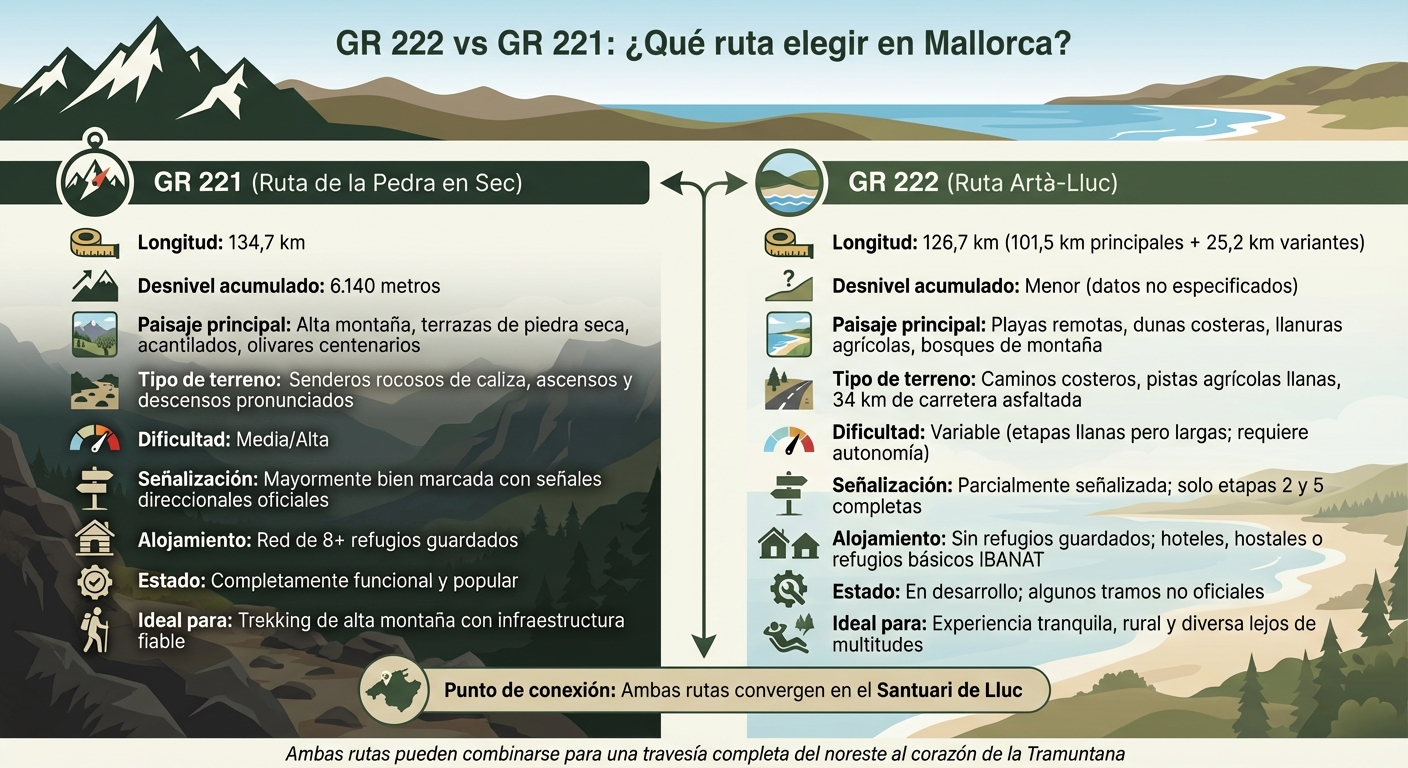
GR 222 vs GR 221 Mallorca: Complete comparison of hiking routes
Deciding between the GR 222 and the GR 221 depends on the type of adventure you're looking for in Mallorca. The GR 221 , known as the Dry Stone Route (Ruta de la Pedra en Sec), is ideal for those who enjoy high mountain terrain. This trail traverses the Serra de Tramuntana , a UNESCO World Heritage Site, and offers spectacular landscapes with limestone peaks, dry stone terraces, and views of the Mediterranean from its summits. Along its 134.7 km and a cumulative elevation gain of 6,140 meters , you'll find a well-developed infrastructure, with 8 staffed mountain huts and clear signage along most sections.
On the other hand, the GR 222 offers a more relaxed and diverse experience. This trail connects hidden coves and dunes in the Llevant Peninsula Natural Park with agricultural plains dotted with almond trees, vineyards, and windmills, before ascending into the forests surrounding Lluc. While less physically demanding, the GR 222 presents challenges such as partial signage and the absence of staffed mountain huts, requiring greater preparation and self-sufficiency.
In terms of difficulty , the GR 221 is characterized by its rocky terrain with continuous ascents and descents, making it more physically demanding. In contrast, the GR 222, with its long and often flat sections, requires hikers to be prepared to use GPS navigation due to incomplete signage. If you're looking for a classic mountain trekking experience with reliable infrastructure, the GR 221 is the best option. If you prefer something quieter and more solitary, with a mix of coastline, rural villages, and nature, the GR 222 will be perfect, provided you're willing to do more planning.
Both routes converge at the Lluc Sanctuary , allowing you to combine them for a longer hike. For example, you could start in Artà on the GR 222, reach Lluc, and then continue on the GR 221 towards Sóller or Pollença, creating a traverse that stretches from the northeast to the heart of the Tramuntana mountains. The following table summarizes the main differences between the two routes.
Comparative table: GR 222 vs GR 221
| Factor | GR 221 (Dry Stone Route) | GR 222 (Artà-Lluc Route) |
|---|---|---|
| Main landscape | High mountains, dry stone terraces, cliffs and centuries-old olive groves | Remote beaches, coastal dunes, agricultural plains, and mountain forests |
| Type of terrain | Rocky limestone paths, steep ascents and descents | Coastal paths, flat farm tracks and stretches of paved road |
| Difficulty | Medium/High (due to considerable accumulated elevation gain) | Variable (flat but long stages; requires autonomy) |
| Signaling | Mostly well marked with official directional signs | Partially signposted; some stages unmarked |
| Accommodation | Network of 8+ staffed shelters | No guarded shelters; hotels, hostels or basic shelters |
| Road status | Fully functional and popular | Under development; some sections are not yet official |
Stages of the GR 222
The GR 222 stretches for approximately 126.7 km, divided into five main stages. Although some sections lack complete signage, having a GPS and detailed maps is essential. This route combines diverse landscapes such as pristine beaches, agricultural fields, and the foothills of the Serra de Tramuntana mountain range. It is important to note that there are no staffed mountain huts on the GR 222, so it is advisable to plan your accommodation in advance in nearby villages or book one of the basic shelters managed by IBANAT.
Below, we show you a summary of each stage, designed to help you enjoy inland hiking in Mallorca .
Stage 1: Artà to Betlem
This 17.3 km stage (depending on the variant) crosses the Llevant Peninsula Natural Park. It begins in the old town of Artà, with a gentle climb to the Campament des Soldats (383 m), offering stunning views of the unspoiled coastline. The path descends to hidden coves such as Cala Torta, Cala Mitjana, and Cala Estreta, surrounded by dunes and pine forests. Along the way, you'll also pass by the Torre d'Albarca, an old defensive tower, and the Sa Duaia public estate. Before reaching Betlem, the trail crosses S'Alqueria Vella d'Avall, where the park's information center is located. The stage concludes at the Ermita de Betlem, a 19th-century sanctuary with basic shelter (advance booking required). The route has a moderate elevation gain, ideal for those seeking an accessible start.
Stage 2: Betlem to Colònia de Sant Pere
At 14 km long, this is the only fully signposted stage of the GR 222. The trail follows the coast, offering continuous views of the Bay of Alcúdia and, on the horizon, the Formentor peninsula. This section is mostly flat, ideal for enjoying a more relaxed pace. From Font de s'Ermita, next to the Hermitage of Betlem, the path winds between cliffs and small coves, passing through Caloscamps before reaching Colònia de Sant Pere. This small fishing village is perfect for refueling and enjoying the local cuisine.
Stage 3: Colònia de Sant Pere to Santa Margalida
At 31.3 km, this stage connects the coast with the interior of Mallorca. The trail initially hugs the coastline as far as Son Serra de Marina and then ventures into the Pla de Mallorca plain. Along the way, you'll encounter landscapes such as the Sa Canova dunes, the Estany des Bisbe wetland, and the Son Real Necropolis, an archaeological site linked to a variant of the route. As you continue, the coastal landscape gives way to almond groves, vineyards, and windmills. The stage ends in Santa Margalida, a traditional village. Although the elevation gain is minimal, the distance and high summer temperatures can make it challenging.
Stage 4: Santa Margalida to Inca
This 23.4 km section crosses the Pla de Mallorca, passing between fields and traditional farms. The lack of signage makes the use of GPS essential, especially in sections that cross private property. Along the way, you'll pass through Llubí, known for its capers and the Sant Crist del Remei hermitage. From there, the trail follows the old Camí Vell de Sineu to Inca, Mallorca's third-largest city, with a wide range of services and accommodation. Although the terrain is mostly flat, the need for navigation adds a level of difficulty.
Stage 5: Inca to Santuari de Lluc
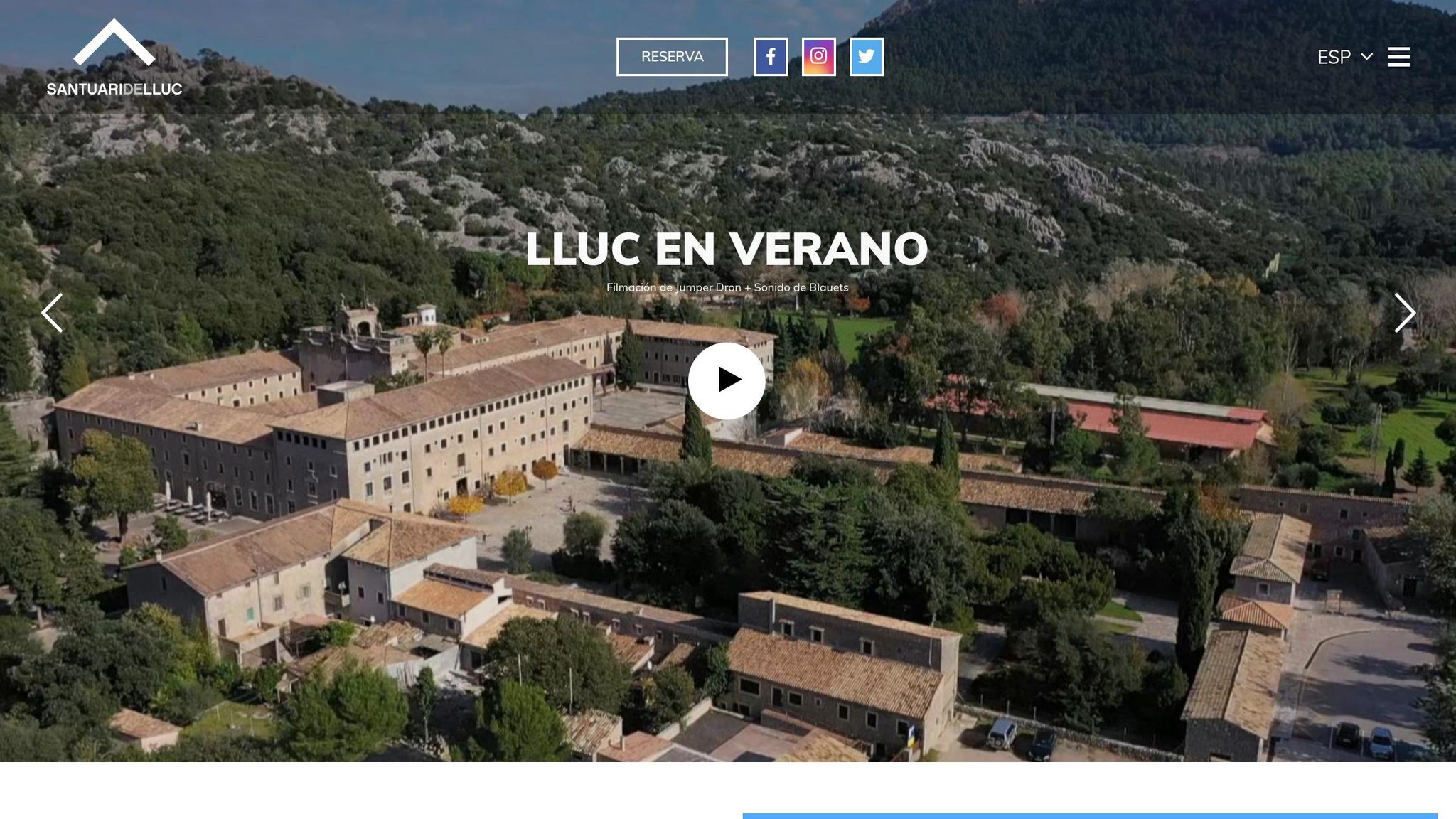
The final stage, 15.2 km long and fully signposted, offers a change of scenery as you leave the plains behind and enter the foothills of the Serra de Tramuntana. From Inca, the trail passes through the picturesque villages of Selva and Caimari, known for their terraces of centuries-old olive trees. From Caimari, the path follows the historic Camí Vell de Lluc, known as "sa Llengonissa" for its winding route. Upon reaching the Coll de sa Batalla (578 m), the highest point of the GR 222, you can enjoy spectacular views before descending to the Santuari de Lluc, the junction with the GR 221.
Must-see villages on the GR 222
The GR 222 Mallorca trail winds through some of the island's most authentic inland villages, where time seems to stand still. These enclaves, far removed from the hustle and bustle of the coastal areas, preserve the essence of rural Mallorca and offer hikers a glimpse into the culture, gastronomy, and heritage of the Pla region. Here are three villages that capture the true spirit of inland Mallorca.
Santa Margalida is a village with roots dating back to the 13th century. Its Gothic church and historic buildings such as the Posada de sa Boleda, Sa Granja, and the old Apotecaria Vella pharmacy bear witness to its rich history. On Tuesdays and Saturdays, the Plaça de la Vila comes alive with its market, where you can find fresh, local produce. Furthermore, Santa Margalida maintains the tradition of flour mills, notably the Molí d'en Curt and the Molí d'en Cifre .
Continuing along the route, we arrive at Llubí , a charming and traditional village. Its Hermitage of Sant Crist del Remei , located on the outskirts, is one of its heritage treasures. Llubí stands out not only for its historical value but also for its gastronomy. In the local bars, you can try frit mallorquí , a typical dish that mixes offal and vegetables, reflecting the area's resourceful cooking. As chef Andreu Genestra, originally from Inca, explains:
"The recipes that have endured the most are those of the old bourgeoisie and the church. The recipe book of the well-to-do classes who lived in the Pla, the interior of the island, where the arable fields and the riches were."
The route culminates in Inca , a vibrant city that blends tradition and modernity. As the third largest city in Mallorca, Inca marks the end of the fourth stage of the GR 222 and connects with the historic Camí Vell de Lluc. In addition to its wide range of services and accommodations, it is a renowned gastronomic destination. Among its most representative dishes are arròs brut (a spiced rice dish with meat and mushrooms) and roast suckling pig . For those with a sweet tooth, Forn de Sant Francesc is famous for its authentic ensaimada pastry. Inca is also an important transport hub, with trains and buses (line 301) connecting it to Palma and other destinations on the island.
Landscapes and nature on the GR 222
The GR 222 Mallorca offers an experience that goes beyond the island's typical beaches and coves. Stretching 126.7 kilometers , this route connects the unspoiled northeast coast with Mallorca's agricultural heartland, revealing the essence of the island's interior.
According to the Consell de Mallorca :
"The idea of the Artà - Lluc GR 222 route is to connect the mountains of Llevant... with the central area of the Serra de Tramuntana... It offers hikers a huge variety of landscapes, some of them quite exceptional."
In the central areas of Pla de Mallorca, the landscape transforms into a tapestry of almond trees, olive groves, and vineyards. During spring, the Mediterranean light illuminates the fields filled with wildflowers, creating a vibrant palette of colors. On clear days, it's even possible to see the island of Menorca from certain vantage points.
From elevated vantage points like Puig de Santa Magdalena , near Llubí, breathtaking panoramic views can be enjoyed. This viewpoint frames the island's agricultural mosaic, with the majestic Serra de Tramuntana as a backdrop. Furthermore, the surroundings are enriched by traditional architectural elements: dry stone walls, windmills, cisterns, and lime kilns, reflecting the deep connection between the landscape and local history.
Upon reaching Caimari on the fifth stage, the landscape changes dramatically. The vast olive groves surrounding the town give way to the imposing limestone mountains of the Tramuntana. This contrast encapsulates the essence of the GR 222: a visual journey that celebrates the natural and cultural diversity of inland Mallorca.
Local cuisine along the way
Hiking the GR 222 trail in Mallorca is like tasting the island's very heart. The culinary traditions of the Pla Mallorcan plains, inherited from the wealthy classes who once lived in these fertile lands, are palpable in every village along the route. Here, sobrasada , arròs brut , and ensaimada are as essential as the almond trees and vineyards that paint the landscape. Like the authentic villages of the interior, the gastronomy of this route reflects the richness of its history and culture.
For hikers, pa amb oli is a perfect choice. This brown bread, rubbed with ramallet tomato and drizzled with olive oil, often accompanied by sobrasada or cheese, is ideal for carrying in a backpack. Also noteworthy are cocarrois (small pastries filled with vegetables, raisins, and pine nuts) and panades de carne, which are excellent options for eating on the go.
In Inca , a key stop on the route between stages 4 and 5, the traditional cellers —former wine cellars converted into restaurants—offer hearty dishes like frit mallorquí , a delicious fried meat dish with potatoes and fennel, or roast suckling pig . This is the perfect place to enjoy an authentic meal and recharge your batteries.
And speaking of delicacies, the ensaimada deserves a special mention. In Inca, Forn de Sant Francesc is famous for making some of the best on the island. Its spongy texture, achieved thanks to the use of saïm (lard), is unmatched. In addition to the classic version, you can also try the one with sobrasada, a combination of sweet and savory flavors that costs around €15.95.
When you reach Caimari , on the final stage, olive oil takes center stage. This small town, surrounded by centuries-old olive trees, is the ideal place to buy Mallorcan Olive Oil with Protected Designation of Origin, a perfect souvenir before embarking on the final climb to Lluc. Furthermore, the weekly markets in Santa Margalida and Llubí offer the opportunity to buy products directly from local producers, such as artisanal cheeses, fresh sobrasada, and the famous cocas de trampó , a flatbread topped with peppers, onions, and tomatoes. All of this makes the experience a true feast for the senses.
| Product | Best location on the GR 222 | Description |
|---|---|---|
| Ensaimada | Artà, Inca (Forn de Sant Francesc) | Dough spiral with lard |
| Sobrasada | Markets of Santa Margalida, Llubí | Raw sausage cured with paprika |
| Arròs Brut | Cellers de Inca, Selva | Soupy rice with meat and spices |
| PDO olive oil | Caimari | Extra virgin olive oil from centuries-old olive trees |
| Pa amb oli | Any local bar | Bread with tomato, oil and cold cuts/cheese |
Accommodation on the GR 222
The GR 222 trail in Mallorca does not have an established network of mountain huts with permanent service, so it is crucial to arrange stops at IBANAT mountain huts, agriturismos (farm stays), and rural hotels located in the villages along the route. These options allow for a comfortable rest while enjoying the Mallorcan countryside.
On Stage 1 , the S'Arenalet des Verger Refuge, located in the Llevant Natural Park, is a highlight. This refuge offers a simple, unstaffed option. For those seeking more comfort, Artà has small hotels and rural guesthouses. Later, on Stage 3 , towns like Santa Margalida and Ariany feature agritourism establishments such as Hort Can Capita , perfect for replenishing energy after the more than 31 kilometers of this day's hike.
As you move towards the heart of the island, in Inca (Stage 4) you can find rural accommodations such as Els Ametllers or theAgroturismo Ses Illes in Costitx, which offers seven rooms, a swimming pool and breakfasts with local products.
After a rest in Inca, the final stretch to the Santuari de Lluc offers unique options surrounded by nature. On Stage 5 , Selva stands out for accommodations such as Can Cota Boutique , which boasts an infinity pool; Sa Bisbal , located in a 17th-century building; and Finca Son Arnau . Near the final destination, Agroturismo Son Alzines in Lluc offers apartments with kitchens, a swimming pool, and bicycle rentals. Finally, the Santuari de Lluc, the route's highlight, offers traditional accommodation with a religious atmosphere and a restaurant that complements its historical character.
It's essential to book in advance, especially during the peak season in July and August, when demand exceeds supply and some accommodations are only available during these dates. Prices range from €25 per person/night in basic mountain huts to €175 in boutique agriturismos. For huts managed by IBANAT, check availability and booking procedures on the Consell de Mallorca website. Planning ahead will help you fully enjoy every stage of your journey.
How to prepare for GR 222
The GR 222 in Mallorca is a route that combines stunning scenery with logistical challenges, making thorough preparation essential. Currently, only 54.7 km of the route are officially marked until March 2026. This means that, on sections like Stage 4 between Santa Margalida and Inca, where there is no signage, navigation will depend on your planning. It is crucial to carry a GPS with downloaded tracks in offline mode, a physical map of the Artà-Lluc area from Editorial Alpina , and a compass. Do not rely solely on trail markers, as these can be inconsistent or nonexistent.
Appropriate equipment
Footwear and accessories
The terrain along the GR 222 varies between rocky, stony, and paved, with 34 km of asphalt. Therefore, it's crucial to wear well-fitting trekking boots to avoid blisters. Combine them with quality technical socks. In addition, trekking poles are a key aid, as they can reduce the physical effort in your legs by 15% to 20%, especially on ascents like the Coll de sa Batalla, which reaches 578 meters.
Clothes
Opt for a synthetic base layer that wicks away sweat, a fleece for the cold, and a waterproof jacket with a Gore-Tex membrane to protect you from the rain. This will ensure comfort and protection from changing weather conditions.
Hydration and sun protection
Bring plenty of water and consider including water purification tablets or filters to refill at natural springs. To protect yourself from the sun, wear category 3 or 4 sunglasses, a hat, and high-factor sunscreen.
Preparations for the evening
If you plan to stay overnight in IBANAT mountain huts, please note that they are not staffed. Therefore, you will need a sleeping bag and a sleeping mat. A 40–55 liter backpack should be sufficient to carry everything you need. Make sure that 75–85% of the weight is distributed across your hips, using a padded hip belt for added comfort. Don't forget to pack a basic first-aid kit, a multi-tool, and a headlamp with spare batteries.
Best time to hike the GR 222
Spring (March–May) is ideal, with pleasant temperatures between 15 and 25°C and landscapes bursting with flowers. Autumn (October–November) is also a good option, as the countryside regains its greenery after summer. Avoid July and August, when the heat exceeds 30°C and there is little shade along many stretches. If you decide to hike in winter, you'll find solitude and clear skies, although mornings can be chilly, with temperatures between 10 and 18°C.
Before setting off, always check the condition of the sections, especially those "under construction" that are not yet signposted, as the Consell de Mallorca does not guarantee their usability.
Conclusion
The GR 222 Mallorca trail is an invitation to discover the island's lesser-known side. This 126.7 km route takes you away from crowded beaches and typical tourist routes, leading you to an interior dotted with picturesque villages and authentic landscapes that reflect the essence of Mallorca. Along the way, you'll pass through 11 municipalities where traditional life remains untouched, amidst almond groves, vineyards, and windmills.
The route connects a variety of stunning landscapes: from pristine coastlines to farmland and majestic mountains, ending at the iconic Santuari de Lluc, where it joins the GR 221. This trail is not only a journey through nature, but also a tour of local culture, gastronomy and heritage, offering an experience that immerses you in the most authentic Mallorca.
Although only 54.7 km are currently marked (as of March 2026), this lack of complete infrastructure adds a special touch. It's perfect for those seeking a quieter, more rural adventure, far from the crowds that usually fill the popular GR 221. Here you won't find large groups, but rather centuries-old olive groves, small taverns where you can chat with locals, and agriturismos where the only sound is birdsong.
If you want to explore the most authentic Mallorca, with charming villages like Llubí or Maria de la Salut, and enjoy local products and time-honored traditions, the GR 222 is the trail for you. Every kilometer combines nature, history, and flavors, making for an unforgettable experience. Pack your backpack, download the tracks, and discover an island that has much more to offer than you ever imagined.