
GR 221 Dry Stone Route: Complete Guide by Stages to Explore Mallorca on Foot
The GR 221 , known as the Dry Stone Route, is Mallorca's most iconic trail. It crosses the Serra de Tramuntana mountain range from south to north, connecting Port d'Andratx with Pollença along a route of up to 176.7 km . Recognized by UNESCO in 2011, this route combines mountain landscapes, historic paths, and views of the Mediterranean.
Key data:
- Current marked length : 150.1 km (301 km when complete).
- Stages : 8 main stages, with additional variations.
- Difficulty : Moderate to high, with accumulated elevation changes of up to 7,713 m .
- Best time : Spring and autumn (temperatures between 15°C and 25°C).
- Available shelters : 7 official ones, from €14 per night.
Why does it stand out?
The route follows ancient cobbled paths, showcases the dry stone construction technique, and allows hikers to discover historical sites such as the Coll de ses Cases de Neu (1,209 m). Furthermore, the mountain huts managed by the Consell de Mallorca offer affordable and comfortable accommodation for hikers.
Basic equipment:
- Hiking boots, layered clothing, and trekking poles.
- Map, GPS and at least 2 liters of water per day.
The GR 221 is a physical challenge and an enriching experience for those seeking to discover the landscapes and history of Mallorca on foot.
Hiking the GR221 in Mallorca 🇪🇸 (150 km)
sbb-itb-2b14d48
What is the Dry Stone Route?
The GR 221 , officially established in 1996 by the Consell de Mallorca, is the first long-distance trail in the Balearic Islands. It currently comprises 261.1 km of open and signposted paths, including a 150.1 km main route connecting Port d'Andratx with Port de Pollença, and 111 km of additional variations. Depending on the chosen route, the total distance can vary between 132 km and 176.7 km . Below, we explore the highlights of this trail.
The highest point on the route is the Coll de ses Cases de Neu , located at 1,209 meters above sea level, with a total elevation gain that varies between 6,140 and 7,713 meters , depending on the section. This trail follows old cobbled paths that historically connected isolated villages and rural estates. Some of these paths, such as the Camí des Correu , have been documented since the 15th century.
The dry stone walling technique was key to transforming the Serra de Tramuntana into a productive landscape. Using this method, the Mallorcans built terraces (walls of terraced fields) to cultivate olive groves and vineyards, as well as snow pits ( cases de neu ), lime kilns ( forns de calç ), and charcoal circles ( carboneres ). It is worth noting that the last recorded use of a snow pit for ice production dates back to 1925.
| Feature | Detail |
|---|---|
| Length of main route | 150.1 km to 176.7 km |
| Total planned length | 301 km |
| Highest point | Coll de ses Cases de Neu (1,209 m) |
| Cumulative positive elevation gain | 6,140 to 7,713 m |
| UNESCO Recognition | World Heritage Site since 2011 |
The Dry Stone Route is not only a physical challenge, but also a testament to Mallorca's historical and cultural heritage. It's important to note that around 90% of the Serra de Tramuntana mountain range is privately owned , although the GR 221 trail is open to the public. For this reason, it's essential to stay on the marked trails and respect the dry stone structures, which are fragile and form part of the island's historical legacy.
Stages of the GR 221
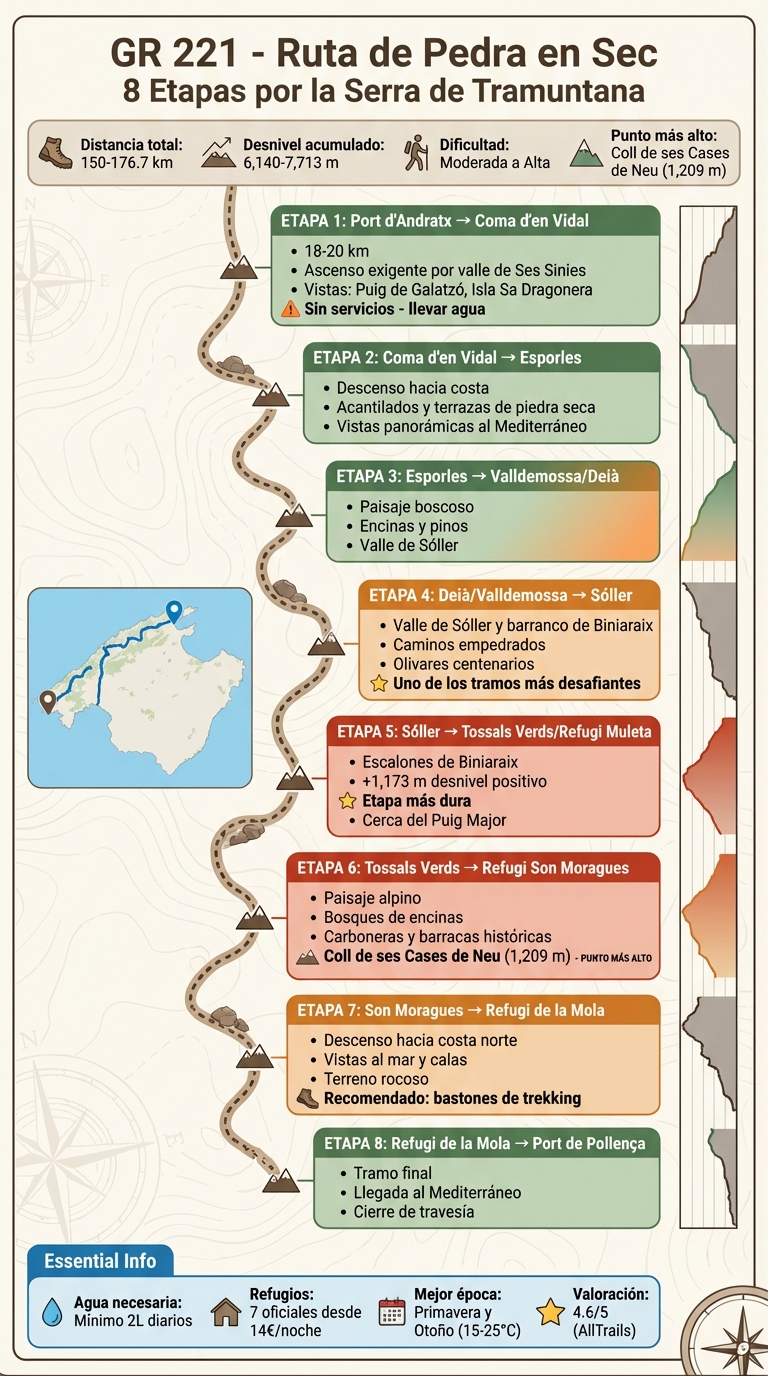
GR 221 Mallorca: 8 complete stages from Port d'Andratx to Pollença
The GR 221, also known as the Dry Stone Route, traverses the Serra de Tramuntana mountain range from southwest to northeast, divided into eight main stages. This route, covering between 150 and 176.7 km, accumulates a positive elevation gain of between 6,140 and 7,713 meters, making it a considerable physical challenge. Classified as moderate to high difficulty, it has received ratings of 4.6 out of 5 on AllTrails and 9 out of 10 on Hiking-Trails.com . Some sections, especially near Port d'Andratx, require experience and caution, as they include rocky sections where the use of hands is necessary for progress. Because certain sections lack complete signage, it is essential to carry GPX tracks and maps, either digital or paper. The stages of the GR 221, with their most notable characteristics, are detailed below.
Stage 1: Port d'Andratx to Coma d'en Vidal
Covering a distance of 18 to 20 km, this initial stage begins with a challenging climb through the Ses Sinies valley. Highlights along the way include views of Puig de Galatzó and the ruins of La Trapa monastery, from where you can see the island of Sa Dragonera. As this is a remote section with no services, it is essential to carry sufficient water and food.
Stage 2: Coma d'en Vidal to Esporles
The trail descends towards the coast, passing cliffs and traditional dry-stone terraces. This section offers panoramic views that allow you to appreciate the beauty of the region and its agricultural history.
Stage 3: Esporles to Valldemossa or Deià
At this stage, the landscape changes towards wooded areas that connect with the Sóller valley. The paths are lined with holm oaks and pines, providing shade in the higher sections, which is especially welcome on hot days.
Stage 4: Deià or Valldemossa to Sóller
This section crosses the Sóller Valley and the Biniaraix ravine, one of the most breathtaking areas of the route. The path combines cobbled trails with views of centuries-old olive groves, reflecting the typical character of the Mallorcan landscape. Without a doubt, it is one of the most challenging sections of the route.
Stage 5: Sóller to Tossals Verds or Refugi de la Muleta
Considered one of the toughest stages, it includes a long climb up the Biniaraix steps, with a positive elevation gain of 1,173 meters. This section approaches Puig Major and offers accommodation options in mountain refuges, ideal for those looking to rest after an intense day.
Stage 6: Tossals Verds to Refugi de Son Moragues
The landscape takes on an alpine character, with holm oak forests and historical remains such as charcoal kilns and dry-stone huts. The trail reaches the Coll de ses Cases de Neu, the highest point of the route, located at 1,209 meters, although some access points can reach 1,365 meters.
Stage 7: Son Moragues to Refugi de la Mola
This stage descends towards the north coast, offering sea views and small coves. Although the terrain is gentler, the rocky sections require caution. Trekking poles are recommended to protect your knees on the descents.
Stage 8: Final Stage to Port de Pollença
The final stretch culminates on the north coast, connecting with the Mediterranean and completing this journey through the Serra de Tramuntana. This last leg combines physical exertion, spectacular scenery, and a heritage recognized as a World Heritage Site by UNESCO.
| Aspect | Detail |
|---|---|
| General difficulty | Moderate to high |
| Total accumulated elevation gain | 6,140 - 7,713 m |
| Highest point | Coll de ses Cases de Neu (1,209 m) |
| Most demanding stage | Sóller to Tossals Verds (+1,173 m) |
| Daily water needs | Minimum 2 liters |
Shelters and accommodation on the GR 221
The GR 221 trail features a network of official mountain huts managed by the Consell de Mallorca (Mallorca Council). These huts, located in restored historic buildings, offer accommodation at the end of each stage in the Serra de Tramuntana mountain range. They are a key part of the GR 221 Mallorca trail and contribute to the hiking experience in the Serra de Tramuntana , a UNESCO World Heritage Site.
Some of the most outstanding shelters are:
- Galatzó : With capacity for 50 people, open since December 2022.
- Can Boi (Deià): 32 places in a former olive oil mill.
- Muleta (Port de Sóller): 30 places in a 1912 telegraph station.
- Tossals Verds (Escorca): Capacity for 42 people.
- Son Amer (near the Lluc Sanctuary): 54 places available.
- Pont Romà (Pollença): Accommodation for 42 people.
On the other hand, shelters such as Coma d'en Vidal and the Refugi de Son Trias in Esporles remained closed from March 2025. In these areas, it is recommended to opt for private accommodations such as the Sa Fita Backpackers hostel.
Reservations and prices
Reservations must be made between 4 months and 5 days before arrival through the Consell de Mallorca's central system (telephone: +34 971 173 700). A bank transfer of 80% of the total cost is required to confirm the reservation. Prices in 2025 are quite affordable.
- Bunk bed in shared dormitory : €14.
- Breakfast : €5.50.
- Two-course meal : €13.
- Dinner : €9.50.
- Picnic : €8.
In addition, holders of the Mountain Federation card enjoy a 20% discount on accommodation and a 10% discount on meals.
Services and recommendations
The mountain huts are equipped with dormitories, shared showers, and common areas with stunning views. You can also rent bedding for €4.50 and towels for €2. However, bringing your own sleeping bag liner is a more comfortable and hygienic option. Tap water is drinkable in all the huts, but during the day's hikes, it's advisable to carry at least two liters of water per person, as natural springs aren't always reliable.
With your accommodation arranged, you're ready to discover the best time to hike the GR 221 Mallorca .
Best time to do the GR 221
Spring and autumn are the ideal seasons for hiking the GR 221 Mallorca . During these months, temperatures range between 15°C and 25°C , creating perfect weather for long walks in the Serra de Tramuntana mountains . Summer , especially July and August, is not recommended. Temperatures often exceed 30°C , and many sections lack shade, increasing the risk of heat exhaustion. These conditions, combined with proper preparation, guarantee a pleasant experience on the trail.
Winter , while less popular, is also an option thanks to Mallorca's Mediterranean climate. In February 2026, some hikers reported daytime temperatures between 10°C and 20°C , although nights in the mountains can be cold and windy. According to Enzo W, a hiker:
"The weather was acceptable, between 10 and 20 degrees Celsius; with direct sun it is quite hot and at night it is cold and windy."
At the highest point of the route, the Coll de ses Cases de Neu, at 1,209 meters , temperatures can be noticeably lower than on the coast, especially in winter.
Although the Mediterranean climate allows the route to be hiked year-round, seasonal variations require appropriate equipment. As Bookatrekking.com points out:
"The mountains are full of surprises and the weather on an island can be unpredictable. It's possible to have a sunny start to the day with rain later on."
Therefore, even in spring or autumn, it's essential to wear waterproof clothing and extra layers to adapt to sudden temperature changes. High-factor sunscreen and a hat are also recommended to protect yourself from intense sun exposure during the hike. Staying hydrated is also key, as natural water sources are scarce and unreliable.
| Season | Temperature | Conditions | Recommendation |
|---|---|---|---|
| Spring | 15–25°C | Sunny, blooming flora | Highly recommended |
| Summer | 30°C+ | Intense heat, little shade | Avoid (July/August) |
| Autumn | 15–25°C | Stable, pleasant breeze | Highly recommended |
| Winter | 10–20°C | Humid, cold nights | Possible with the right equipment |
Equipment and physical preparation
The GR 221 is a challenging trail that demands both the right equipment and good physical preparation. At 140 km long and with almost 6,000 meters of accumulated elevation gain, it's not a route to be taken lightly. Footwear choice is key: sturdy hiking boots are recommended, ideal for limestone terrain and dry stone paths. While some prefer lightweight trail running shoes, these can cause blisters on longer sections. As Hike Tyson explains:
"The trail is very rocky. My feet hurt every day in trail running shoes. Even so, I wouldn't want to do this route in heavy boots."
As for clothing , a layering system is essential. You should pack two breathable T-shirts , a lightweight fleece , hiking pants , and a waterproof and windproof jacket . Karen Branscombe, an experienced hiker, emphasizes the importance of not overloading your backpack:
"It pays to be minimalist when hiking in the mountains; you'll soon regret it if you carry too much."
Hydration is also critical. You need to carry at least 2 liters of water per day , and up to 3 liters or more on the drier southern stages. A large-capacity, flexible water bottle, like those from Hydrapak , combined with a Katadyn -type water filter, will allow you to take advantage of natural springs. Trekking poles are also highly recommended for stability on rocky descents and steep slopes.
Beyond the equipment, physical preparation is essential to face days of 5 to 8 hours of hiking, with ascents that can exceed 1,345 meters in a single stage. Training should focus on improving cardiovascular endurance, strengthening the legs, and working on balance—crucial factors for navigating uneven terrain. According to Rintsje Bosch, a trekking expert:
"The route has no technical difficulties and is suitable for anyone with a decent level of fitness."
Some sections of the GR 221 are exposed and reach altitudes of up to 1,232 meters , so it's important to be comfortable at high altitudes. If you plan to carry your backpack for the entire route, it's advisable to train with the weight you'll be carrying, as this significantly increases the difficulty and will help you adapt to the actual conditions of the trail.
| Category | Essential elements | Grades |
|---|---|---|
| Footwear | Hiking boots with good grip | They protect the ankles on difficult terrain |
| Clothes | 2 t-shirts, fleece, waterproof jacket | Quick-drying materials |
| Hydration | 2-3 L bottle and water filter | Crucial in stages without natural sources |
| Navigation | 1:25k map, compass, GPS app ( Gaia / Komoot ) | Limited signage in some areas |
| Accessories | Walking sticks, headlamp, sunscreen | Useful for descents and exposed sections |
How to get to the start of the route
Getting to Port d'Andratx , the starting point of the GR 221 , from Palma de Mallorca is quite simple. The cheapest and most convenient way is to take bus 101 of the TIB (Transport de les Illes Balears) network. This bus departs from the Estació Intermodal , located in Plaça d'Espanya , right in the center of Palma. If you arrive at Palma Airport, you will first need to take a bus to the Estació Intermodal and, from there, the 101 to Port d'Andratx.
In addition to bus 101, there are other options that can be tailored to your needs. For example, if you prefer to start your route in places like Es Capdellà or Calvià , you can take bus line 107 , which also departs from Palma. After completing your journey in Pollença, bus line 301 will take you back to Palma in approximately one hour .
If you prefer more freedom, you can rent a car . In Port d'Andratx, there are medium-sized free parking lots near the start of the route. This option is ideal for groups or those seeking flexibility, but keep in mind how you will retrieve your vehicle at the end of the hike. Another alternative is taxis , useful if you are traveling in a small group or have a lot of luggage, although they are usually more expensive than public transport.
Whatever you choose, it's important to plan ahead and check the updated TIB bus timetables before traveling, as these can change depending on the season. The public transport network in Mallorca is reliable and well-connected, making it easy to reach both the start and end of your route.
Conclusion
The GR 221 Mallorca is not just a trail, it is a journey through the history and soul of the Serra de Tramuntana , declared a World Heritage Site by UNESCO in 2011. Each section of this route allows you to connect with centuries of tradition, among ancient cobbled paths, the emblematic snow houses and the dry stone terraces that define the landscape.
With a 4.6 out of 5 star rating on AllTrails, this experience combines the majesty of mountains reaching over 1,200 meters with breathtaking views of the Mediterranean. Furthermore, villages like Valldemossa , Deià, and Sóller offer a unique immersion into the essence of Mallorca.
"The Dry Stone Route is the flagship of the island's hiking offerings." - Antoni Barceló, Grandes Espacios
The GR 221 is much more than a hiking trail; it's an invitation to discover why Mallorca is a top destination for trekking enthusiasts in Spain. With all the information about its stages, mountain huts, the best time to go, and how to get there, all that's left is to take the first step. Book your huts in advance, pack your gear, and get ready to explore one of the most rewarding hiking experiences in Mallorca . The Serra de Tramuntana is ready to welcome you.