
Routes through Romanesque churches in the Pyrenees
The Pyrenees boast one of the highest concentrations of Romanesque art in Europe, with churches that have withstood the test of time since the 11th and 12th centuries. This architectural legacy is distinguished by its slender towers, historic frescoes, and its integration with mountainous landscapes. From the Boí Valley, a UNESCO World Heritage Site, to the Aragonese Serrablo or the French Conflent, each region offers a unique experience. The routes allow visitors to combine church visits with hiking, outdoor activities, and local cuisine.
Key points:
- Boí Valley : 9 Romanesque churches, videomapping in Sant Climent de Taüll and access to the Aigüestortes National Park .
- Aragonese Romanesque art : Jaca Cathedral , Monastery of San Juan de la Peña and Loarre Castle .
- French Pyrenees : Monastery of Saint-Martin du Canigou and the Basilica of Saint-Just-de-Valcabrère.
- Hiking : Routes such as the Boí Valley circuit or the Ariège Corniche combine history and nature.
The best time to visit is between May and September, with options for all interests, from families to mountain lovers. Check opening hours and plan accordingly to make the most of this trip back in time.
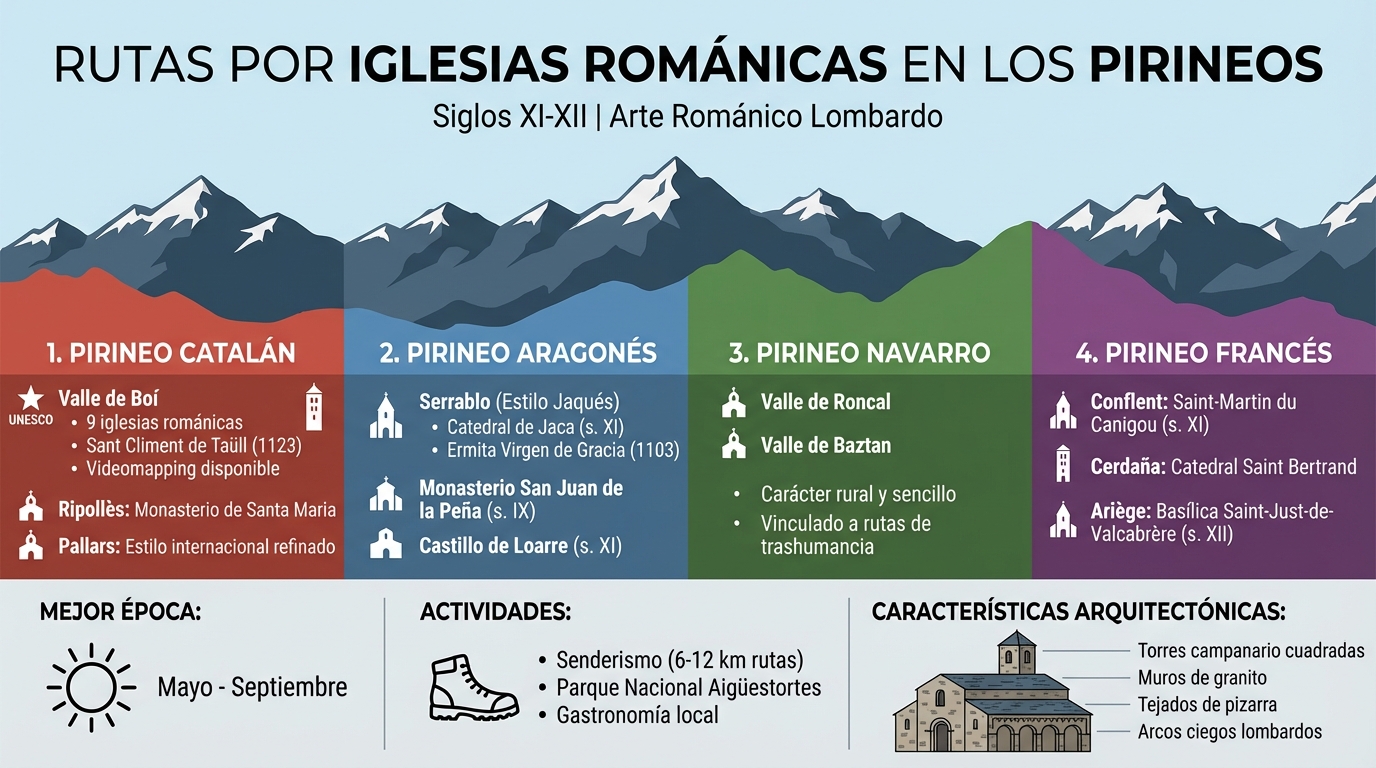
Map of Romanesque churches in the Pyrenees by region with main characteristics
A thousand years of Romanesque art in the Boí Valley
Why did the Pyrenees become a paradise for Romanesque art?
Romanesque art emerged around the year 1000 in northern Italy and quickly spread throughout Europe, reaching the Pyrenees. In this mountain range, it found an ideal environment thanks to a unique combination of historical and social factors.
Lombard master builders, renowned for their stonework techniques, blind arches, and decorative bands, played a key role in spreading this style throughout the region. Their influence was supported by local power, particularly by figures like Abbot Oliba, a central figure of the 11th century. From religious centers such as Ripoll, Cuixà, and Vic, Oliba spearheaded an architectural transformation that shaped the identity of the Pyrenees.
These buildings were not only aesthetically impressive, but also served practical functions in a deeply hierarchical medieval society. Nobles such as the Lords of Erill and the Bishopric of Roda de Isábena, in the Boí Valley, financed churches and monasteries to consolidate their power and reinforce their territorial control.
"These churches are the artistic reflection of an austere society, linked to the natural environment and strongly hierarchical." – Cultural Heritage, Generalitat of Catalonia
Beyond their architectural value, these churches played a crucial role as centers of social cohesion and communication in the isolated valleys of the Pyrenees. Their slender, square bell towers were not only decorative elements but also served as strategic points for surveillance and communication. The architecture, adapted to the environment, featured robust walls to support heavy barrel vaults, with few openings that provided protection from the elements and reinforced their defensive character.
The most important Romanesque churches by region
The Pyrenees are home to hundreds of Romanesque churches scattered throughout the mountain range. Each of these churches reflects the unique identity of its region, both culturally and geographically. Here is a selection of the jewels of Pyrenean Romanesque architecture, categorized by location.
Catalan Pyrenees: Boí Valley, Ripollès and Pallars
In the Catalan Pyrenees, Romanesque art blends seamlessly with the landscape, showcasing unique details in each building.
The Boí Valley is known for having one of the highest concentrations of Romanesque art in Europe. Here you'll find eight churches and a hermitage , renowned for their recent restoration and conservation work. Among them, Sant Climent de Taüll stands out, consecrated on December 10, 1123. Its six-tiered bell tower and iconic Pantocrator are outstanding features. The original Pantocrator fresco is on display at the MNAC in Barcelona, while a videomapping recreation can be enjoyed in the church. Another notable work is Santa Eulàlia d'Erill la Vall , known for its six-tiered tower and the carvings of the Descent from the Cross, created in the Erill workshop.
In Ripollès , the Monastery of Santa Maria de Ripoll is famous for its 12th-century portal, considered a masterpiece of Romanesque sculpture. In Pallars and Val d'Aran , a more refined and international style can be seen in churches such as Assumpció de Bossòst , Santa Maria d'Arties , and Sant Andreu de Salardú , which are notable for their carved portals and rich iconography.
Now let's turn to Aragonese Romanesque art, where tradition and innovation intertwine in a special way.
Aragonese Pyrenees: Serrablo and other emblematic examples
Romanesque architecture in Aragon is characterized by the Jaca style , whose finest example is Jaca Cathedral , built in the 11th century, which set a trend in the Serrablo region. In this area, the Hermitage of Our Lady of Grace in El Run is a prominent example of Lombard Romanesque architecture, consecrated in 1103 by Bishop Saint Raymond of Roda. Its bell tower, built directly on the roof, is one of its distinctive features.
The Monastery of San Juan de la Peña , partially carved into the rock and dating back to the 9th century, preserves important medieval frescoes. Another emblematic site is the 11th-century Loarre Castle , which combines military and religious elements in an imposing fortified structure. In Villanova , the churches of Santa María and San Pedro, located very close to each other, exemplify the high quality of Lombard stonework in the region.
Navarrese Pyrenees: Roncal Valley and Baztan
Navarrese Romanesque architecture has a more rural and simple character, adapted to small mountain villages and linked to ancient transhumance routes. In the Roncal and Baztan valleys , the churches retain their semicircular apses and original portals, although some have been modified in later centuries. These buildings offer a window to the past, reflecting the mobility and traditions of these mountainous areas.
French Pyrenees: Conflent, French Cerdanya and Ariège
On the French side, Romanesque architecture has its own characteristics that enrich the heritage of the Pyrenees.
In the Conflent region , the 11th-century Monastery of Saint-Martin du Canigou is set in a spectacular location. Meanwhile, Saint Genis des Fontaines is notable for its 11th-century Romanesque lintel, considered one of the earliest examples of the transition to monumental sculpture.
In the French Cerdanya and Ariège , the Cathedral of Saint Bertrand de Comminges stands out for its Romanesque cloister, while the Basilica of Saint-Just-de-Valcabrère (12th century) and the Collegiate Church of Saint-Pierre and Saint-Gaudens complete an essential tour for those who enjoy medieval art.
Hiking trails between Romanesque churches
Exploring the Romanesque heritage of the Pyrenees on foot is an experience that combines history, culture, and nature. The historic trails that once connected medieval communities offer a unique way to discover this heritage while enjoying the mountain scenery. Here are some routes that stand out for their historical richness and natural beauty.
Church circuit of the Boí Valley
The "Romanesque Trails" in the Boí Valley connect nine churches and chapels that form part of a UNESCO World Heritage Site. One of the most popular routes, between 6 and 8 km long, takes about 3 hours to complete and is of low to moderate difficulty. This trail links Taüll with Boí, passing by the churches of Sant Climent, Santa Maria, and Sant Joan, with spectacular views of the l'Aüt peak (2,532 m) on the horizon.
Another alternative is the river path that follows the course of the Noguera de Tor river, linking Sant Joan de Boí with Sant Feliu de Barruera. If you are looking for a more panoramic experience, the climb from Durro to Sant Quirc offers a privileged view of the valley.
From this very special location, we travel to the Aragonese Pyrenees to discover the Serrablo region.
Route of the churches of Serrablo
In the Aragonese Pyrenees, the Serrablo region boasts a collection of Lombard-style hermitages scattered along a 10-12 km route. This moderately difficult trail offers the opportunity to admire churches that have preserved their simple and functional architecture, distinctive characteristics of rural Romanesque architecture. Each stop is a journey through time, where the austerity of the buildings contrasts with the majesty of the surrounding landscape.
Ariège Corniche Trail
On the French side of the Pyrenees, this 8-km trail combines sections of secondary road with mountain paths. It connects the churches of Arnave, Axiat, and Vernaux, offering stunning views of the French valleys. The route is of moderate difficulty and is ideal to hike between May and September, when the weather is more favorable and allows you to fully enjoy the surroundings.
Boí Valley: UNESCO World Heritage Site

In the heart of the Pyrenean Romanesque region, the Boí Valley stands as one of the finest examples of Catalan Romanesque architecture. This enclave was recognized as a World Heritage Site by UNESCO on November 30, 2000, thanks to its impressive concentration of Romanesque architecture: eight churches and a hermitage that have remained virtually intact since the 11th and 12th centuries, all within a compact geographical area.
Its uniform style and state of preservation make it an extraordinary place. As journalist Irene Mayordomo Cabrejas points out:
"Finding such a homogeneous and unaltered Romanesque ensemble is exceptional."
The natural isolation of the valley was key to protecting these temples from the Gothic and Baroque modifications that transformed many churches in other parts of Europe, allowing them to retain their medieval essence.
Among the nine protected sites are Sant Climent and Santa Maria de Taüll, Sant Joan de Boí, Santa Eulàlia d'Erill la Vall, Sant Feliu de Barruera, La Nativitat and Sant Quirc de Durro, Santa Maria de Cardet, and L'Assumpció de Cóll. All of these buildings follow the Lombard Romanesque style, characterized by granite walls, slate roofs, blind arches, and decorative bands. Furthermore, their square bell towers not only served religious functions but also functioned as strategic points for communication and surveillance.
The interiors of these churches are equally rich in art. Although the original murals are housed in the MNAC (National Art Museum of Catalonia), Sant Climent de Taüll offers a unique experience with a videomapping projection of the 12th-century frescoes onto the original apse, restoring the colors and symbolism as they appeared in 1123. Meanwhile, Santa Eulàlia d'Erill la Vall preserves a reproduction of the "Descent from the Cross" from the Erill Workshop, a work that reflects the exceptionally high artistic level achieved in the valley during the Middle Ages.
The tour begins at the Centre del Romànic de la Vall de Boí, located in Erill la Vall, where the exhibition "A Thousand Years of Romanesque Art" provides historical context for this heritage site. Although Sant Quirc de Durro and l'Assumpció de Cóll are usually only viewed from the outside, their locations offer spectacular views. Furthermore, the natural surroundings of the Aigüestortes i Estany de Sant Maurici National Park, accessible by 4x4 taxi from Boí, enhance the experience with its more than 200 glacial lakes. All of this makes the Vall de Boí a place where cultural richness and natural landscape intertwine in a unique way, setting the stage for exploring other Romanesque routes and monasteries in the region.
sbb-itb-2b14d48
Must-see Romanesque monasteries
In the Pyrenees, beyond the iconic churches of the Boí Valley, lie Romanesque monasteries that played a central role in the spiritual and social life of the Middle Ages. These places were not only spaces for prayer, but also refuges for the local population and driving forces of architectural renewal in the region.
One of the most outstanding is Santa Maria de Ripoll , located in the Catalan Pyrenees. This monastery was key to the spread of the Romanesque style under the direction of Abbot Oliba in the 11th century. From Ripoll, along with the centers of Cuixà and Vic, Oliba promoted an architectural transformation that left its mark on the Catalan counties. Its sculpted portal, a masterpiece of Romanesque art, depicts biblical scenes with a level of detail that makes it a unique treasure.
Another essential example is Sant Pere de Rodes , located in the Alt Empordà region, perched on a cliff overlooking the Mediterranean. This Benedictine monastery combines defensive architecture with spirituality, reflecting the hierarchy of medieval society. Its bell tower and cloister stand out as symbols of power, associated with both the Bishopric of Roda de Isábena and the feudal lords of Erill.
On the French side, the monastery of Saint-Martin du Canigou rises in a breathtaking mountain landscape. Also linked to Abbot Oliba, it follows the Lombard Romanesque style, with robust walls, slender towers, and a functional design that prioritized utility over decoration. Inside, murals and wood carvings that conveyed spiritual messages to a society marked by austerity are still preserved.
These monasteries were not only religious centers, but also key points for community life in the Pyrenean valleys. Furthermore, their architecture reflects the birth of an artistic movement with stylistic unity, which began in northern Italy around the year 1000 and spread rapidly throughout Europe.
Tips for visiting the Romanesque churches of the Pyrenees
If you're planning to explore the Romanesque churches of the Pyrenees , here are some practical tips to make the most of your experience. Most churches in the Boí Valley have an individual entrance fee of around €2 , but you can save by purchasing a combined ticket from €7 if you plan to visit several. On the other hand, some more remote chapels, such as Sant Serni de Nagol (Andorra) , offer free entry between July 15th and September 15th, with opening hours from 10:00 to 13:00 and from 16:00 to 19:00.
To plan your visit, the Centre del Romànic de la Vall de Boí , located in Erill la Vall, is an excellent starting point. There you can get up-to-date information on opening hours, guided tour availability, and book special activities, such as the videomapping show at Sant Climent de Taüll . This audiovisual spectacle digitally recreates the original 12th-century frescoes—an experience you won't want to miss.
The best time to visit is between May and September, when temples extend their opening hours and mountain roads are fully accessible. In winter, tourism focuses more on skiing at Boí Taüll , and guided tours are less frequent. Keep in mind that some temples may be closed or have more limited opening hours during the off-season.
If you enjoy photography, you're in luck: taking photos inside the churches is permitted . You're also encouraged to share them on social media using the hashtag #romanicvalldeboi . However, keep in mind that many of the original frescoes are housed at the Museu Nacional d'Art de Catalunya (MNAC) in Barcelona, while the churches display high-quality reproductions or digital recreations.
During the summer, it's advisable to arrive early in towns like Taüll and Boí to find parking, as demand is usually high. Take advantage of the early hours of the day to enjoy the tranquility and unique atmosphere offered by these historical monuments in their natural surroundings.
How to combine Romanesque routes with hiking and nature
The Pyrenees are a place where cultural heritage and outdoor adventure meet in perfect harmony. The network of Romanesque Trails connects the charming villages and churches of the Boí Valley along ancient paths that seem straight out of a fairytale, surrounded by breathtaking landscapes.
From the village of Boí, you can connect to these historic trails and also access the Aigüestortes i Estany de Sant Maurici National Park . Here, 4x4 taxis will take you to places like the Planell d'Aigüestortes, saving you long initial hikes and allowing you to conserve energy for exploring wonders like the Estany de Llebreta lake or the Sant Esperit waterfall. A good idea is to spend your mornings visiting the Romanesque churches and your afternoons getting lost in the mountains.
If you prefer more leisurely routes, the River Trail follows the course of the Noguera de Tor between Boí and Barruera, with an almost flat route ideal for families. For those seeking a greater challenge, the climb from Durro to the Sant Quirc hermitage , located at 1,500 meters, rewards you with spectacular views of the entire valley. In winter, the Boí Taüll ski resort , just a few minutes from Taüll, offers the opportunity to combine skiing with cultural visits in the afternoon. And, after a day full of activities, the thermal baths of Caldes de Boí are the perfect place to relax.
The valley also offers activities such as rafting and kayaking on the Noguera Ribagorçana River (from May to September), climbing at the Cavallers Reservoir, and marked mountain bike trails that wind around the medieval churches. Furthermore, since 2018, the area has held Starlight Destination and Reserve certification, making it a fantastic place for stargazing after a day of exploring. This blend of nature and historical heritage transforms the Pyrenees into a destination that invites you to experience them in an active and unique way.
Best time to visit
If you're planning a visit to the Romanesque churches of the Pyrenees, the months of May through September are ideal. During this period, the weather is more favorable, allowing you to combine cultural activities with hiking. The paths are usually clear, and the churches extend their opening hours, making it easier to access more remote sites, such as the hermitage of Sant Quirc de Durro.
In June and July, the Falles celebrations, the torchlight descents on the summer solstice, add a special touch. These festivities, recognized as Intangible Cultural Heritage by UNESCO, are a unique opportunity to experience Pyrenean traditions while enjoying the Romanesque heritage. During July and August, it is advisable to arrive early at sites like Taüll or Boí to find parking without difficulty.
Winter, from December to March, offers a different experience. It's perfect for those who want to combine Romanesque art with winter sports, such as skiing in Boí Taüll or snowshoeing. However, some hermitages can be difficult to access due to snow, and specialized equipment may be necessary.
Autumn, with its landscapes painted in shades of ochre and gold, is a paradise for photography enthusiasts. Although the weather can be more unpredictable, the forests and mountains offer breathtaking views. Regardless of the season you choose to travel, it's essential to check the weather forecast for high mountain areas, as conditions can change rapidly and make access to some remote temples difficult.
Finally, remember to book both tickets and accommodation in advance, especially in popular spots like Taüll and Boí, where demand is high in summer. Now, with these recommendations in mind, read on to discover accommodation options to suit any plan in the Pyrenees.
Where to stay on the Pyrenean Romanesque routes
To fully appreciate Romanesque art in the Pyrenees, choosing good accommodation is key. A strategic location will allow you to easily combine cultural visits with nature excursions.
In the Boí Valley , the towns of Barruera and Taüll are the most convenient. From these bases, you can visit the valley's nine churches in just a few minutes. Taüll is ideal if you want to be close to the iconic Sant Climent and Santa Maria churches, while Barruera offers a more local atmosphere and full amenities.
If you're traveling with family, Pla de l'Ermita is a convenient option. This village, just five minutes from Taüll, offers apartments with kitchens, ample parking, and access to easy hiking trails. For those looking to relax after a day of sightseeing, Caldes de Boí is known for its historic thermal spa complex.
Boí is perfect if you plan to explore Aigüestortes National Park, as 4x4 taxis to the park depart from here. If you prefer a quieter, more traditional setting, Erill la Vall and Durro offer accommodation in rural houses built of stone and slate, reflecting the charm of the local architecture.
In the Aragonese region, Jaca is an excellent starting point for visiting the Serrablo route and the Monastery of San Juan de la Peña. If you decide to explore Andorran Romanesque architecture, the Chalet LES AVELLANES in Arinsal combines mountain style with modern amenities and is close to Sant Serni de Nagol.
It's advisable to book in advance, especially during peak season (May to September or in winter for skiing), as accommodations like those in Taüll and Barruera tend to fill up quickly. Opt for options with flexible cancellation for added peace of mind. With these alternatives, you can enjoy Romanesque art and the Pyrenean surroundings in complete comfort.