
The Cathar Trail: History and Hiking
The Cathar Trail combines medieval history and hiking adventure through the Pyrenees. This route follows in the footsteps of the "Bons Homes" (Good Men), persecuted in the 13th and 14th centuries, connecting iconic castles such as Montségur, Quéribus, and Peyrepertuse. Two main routes stand out: the GR-367 (250 km in France) and the GR-107 (190 km between Montségur and Berga, Spain). Both traverse mountainous landscapes, vineyards, and forests, offering a unique physical and cultural experience.
Key points:
- History: The Cathars, known as "Bons Homes", practiced a dualistic Christianity, rejected matter and faced the Albigensian Crusade (1209-1229).
- Castles: Montségur, Quéribus and Peyrepertuse are historical and defensive landmarks of the route.
- Routes: GR-107 (8 stages, 190 km) and GR-367 (12 days, 250 km).
- Preparation: Good physical condition, appropriate footwear, and planning are essential.
- Gastronomy: Cassoulet and local wines are highlights.
This path is not only a physical challenge, but also an immersion in the history and legacy of the Cathars.
The Cathars: History and Legacy
Cathar Beliefs and Origins of the Movement
The Cathars were a Christian movement that flourished between the 12th and 13th centuries in the Occitania region of southern France. They referred to themselves as "Bons Homes" (Good Men) or "Good Christians." Their theology was based on a dualism that distinguished between two opposing forces: a Good God, creator of the spiritual world and Light, and an Evil Power, responsible for the material world and Darkness.
According to their view, all matter, including the human body and the Catholic Church, was corrupt. They believed that human souls were spirits trapped in material bodies, separated from their spiritual origin. For this reason, they rejected the Old Testament, the cross, and most of the Catholic sacraments.
The only sacrament they recognized was the Consolamentum , a spiritual baptism conferred through the laying on of hands, either upon entering religious life or on one's deathbed. Within their community, there were two main groups: the "Believers" and the "Perfects" ( Perfecti ), the latter leading a life of celibacy, strict vegetarianism, and manual labor. Unlike in the Catholic Church, women could attain the status of "Perfects" and administer the Consolamentum .
The Cathar Church was organized into five bishoprics in Occitania, most notably Carcassonne (1167) and Razès (1226). Their open criticism of the wealth and corruption of the Catholic clergy, coupled with their adherence to a purer, apostolic form of Christianity, made them a threat to the dominant ecclesiastical establishment. This clash of beliefs and their robust organizational structure paved the way for the repression they would later suffer.
The Albigensian Crusade
When peaceful attempts at conversion failed, Pope Innocent III launched a military crusade in 1208 with the aim of eradicating the Cathars. The Albigensian Crusade, considered the first "holy war" in Europe, lasted for two decades (1209–1229) and brought with it the devastation of Occitan culture.
One of the most brutal episodes occurred in July 1209, during the Béziers massacre, where more than 20,000 people were killed in a single day. Years later, the siege of Montségur in 1244 marked the symbolic end of Cathar resistance: between 220 and 230 Cathars who refused to renounce their faith were burned alive in the "Prat dels Cremats" (Meadow of the Burned).
"Occitania in the 12th century was the most civilized country of that time."
– Friedrich Engels
The persecution did not end there. In 1233, Pope Gregory IX founded the Holy Inquisition, intensifying the hunt for Cathars. Many of them fled to Catalonia, following routes that today form the GR-107, known as the Camí dels Bons Homes (Path of the Good Men) . Faced with this relentless persecution, they sought refuge in fortified castles, whose ruins still tell the story of their resistance.
Cathar Castles and Fortifications
The Cathar fortresses, nicknamed "citadels of vertigo," were strategic refuges during the years of persecution. These impressive structures, located on rocky peaks or inaccessible ridges, such as Peyrepertuse, offered a nearly impenetrable defense thanks to their vertical walls up to 80 meters high.
| Castle | Historical Paper | Meaning on the Route |
|---|---|---|
| Montségur | Last stronghold of the Cathars; scene of the mass execution of 1244 | Most emblematic point of the route; located in the high mountains |
| Quéribus | Last military fortress to fall (1255) | It offers panoramic views of the Mediterranean and the Pyrenees |
| Peyrepertuse | Military fortress with 80-meter vertical walls | The largest castle on the route; an example of medieval defensive engineering |
| Carcassonne | Cathar center and seat of the Trencavel dynasty | Best-preserved medieval city in Europe; starting point for several stages |
Today, the Cathar Trail connects these historic sites, allowing hikers to retrace the steps of the "Bons Homes" (Good Men) as they fled to Spain. Places like the "Prat dels Cremats" (Meadow of the Burned), at the foot of Montségur, pay homage to the hundreds of Cathars who gave their lives for their beliefs after the fall of their last stronghold.
sbb-itb-2b14d48
The Cathar country, land of legends in the Pyrenees
The Route: Tour Details and Main Locations
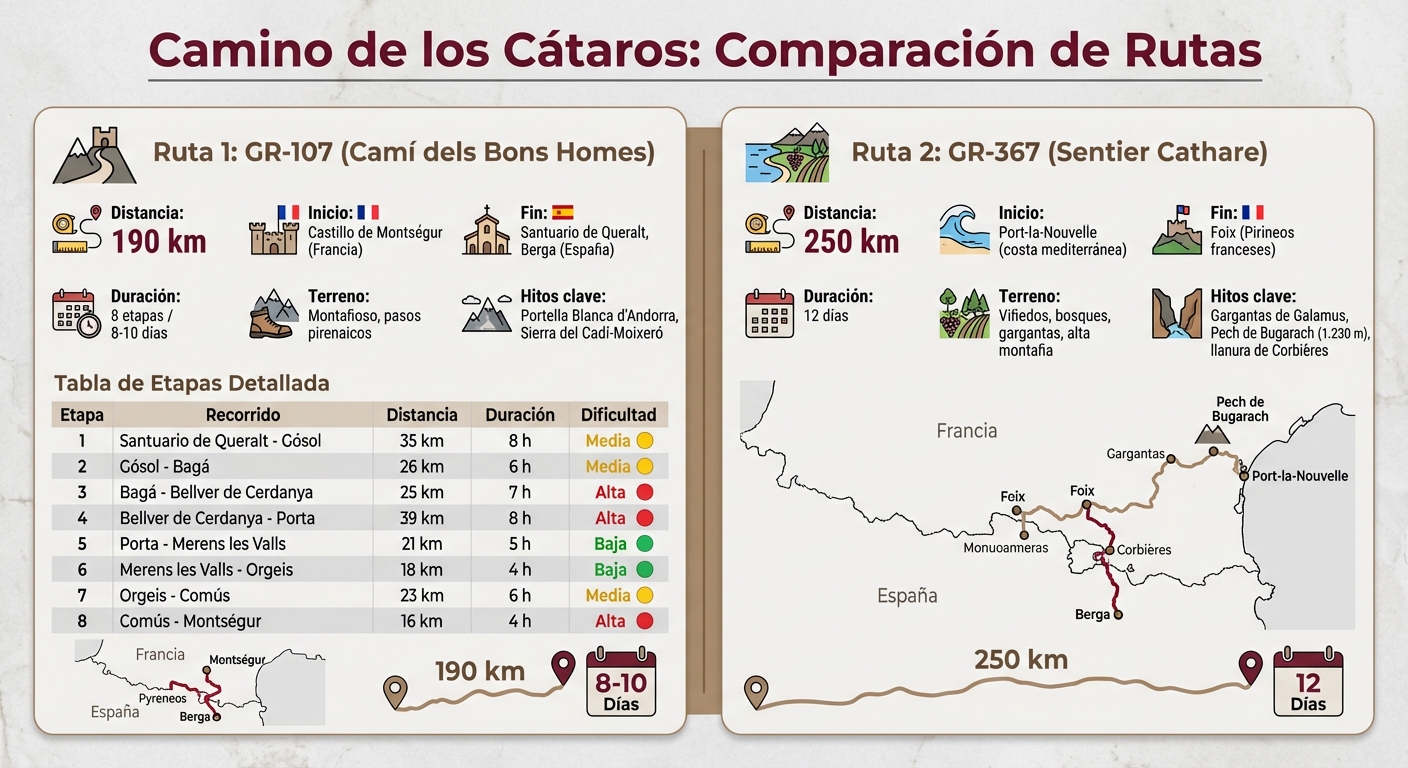
GR-107 vs GR-367: Stages and characteristics of the Cathar Trail
Distance, Terrain and Starting Points
The Cathar Trail offers two main routes connecting stunning landscapes in southern France and Catalonia. The GR-367 (Sentier Cathare) covers approximately 250 km from Port-la-Nouvelle on the Mediterranean coast to Foix in the French Pyrenees. The GR-107 (Camí dels Bons Homes) , on the other hand, stretches 190 km between Montségur Castle in France and the Sanctuary of Queralt in Berga, Spain, following the historical footsteps of the exiled Cathars.
The terrain is diverse and challenging: vineyards, dense forests, limestone ridges, and mountain passes such as the Portella Blanca d'Andorra and the Sierra del Cadí-Moixeró are all part of the route. This constant up and down demands good physical fitness. Completing the route takes between 8 and 10 days of intense hiking.
Next, we will explore the castles that give historical life to this route.
Main Cathar Castles on the Route
The Cathar castles are the historical heart of the route. Montségur Castle , located at an altitude of over 1,200 meters, is the symbol of the pilgrimage route and offers an unforgettable experience for those who visit it.
Peyrepertuse Castle , with its impressive 80-meter vertical walls, rises atop seemingly inaccessible rocky ridges. Meanwhile, Quéribus Castle , perched at 728 meters, rewards hikers with spectacular views of the Mediterranean and the Pyrenees. These fortresses, known as "citadels of vertigo," are not only architectural marvels but also reveal the Cathars' defensive strategy.
Beyond their historical value, these castles mark the rhythm of the stages of the journey, becoming key landmarks for hikers.
Route Stages and Daily Distances
The Cathar Trail combines history and physical challenge at every stage. The GR-107 , which connects Berga with Montségur, is divided into eight stages with varying levels of difficulty. For example, the first stage, from the Sanctuary of Queralt to Gósol , covers 35 km in about 8 hours, while the shortest stage, from Merens les Valls to Orgeis, covers 18 km in just 4 hours.
| Stage | Route | Distance | Duration | Difficulty |
|---|---|---|---|---|
| 1 | Queralt Sanctuary - Gósol | 35 km | 8 h | Average |
| 2 | Gósol - Bagá | 26 km | 6 h | Average |
| 3 | Bagá - Bellver de Cerdanya | 25 km | 7 h | High |
| 4 | Bellver de Cerdanya - Porta | 39 km | 8 h | High |
| 5 | Porta - Merens les Valls | 21 km | 5 h | Low |
| 6 | Merens les Valls - Orgeis | 18 km | 4 h | Low |
| 7 | Orgeis - Common | 23 km | 6 h | Average |
| 8 | Comús - Montségur | 16 km | 4 h | High |
The route reflects the diversity of the landscape and the effort required to complete it. Meanwhile, the GR-367 , which crosses France, takes about 12 days to complete. This trail leads hikers past coastal lagoons, vineyards, deep gorges like the Galamus Gorge, high-mountain forests, and the Pech de Bugarach, the highest point in the Corbières region, at 1,230 meters.
As an added incentive, hikers can get a credential stamped at each stage and receive a commemorative diploma upon completion of the trail.
Hiking Tips and Preparation
Following the trail of Cathar bravery, it is essential to prepare both physically and technically to overcome the challenges of this historic route.
Fitness Requirements and Trip Planning
The Cathar Trail, at approximately 300 kilometers, is no easy walk. Completing it involves about 11 days of continuous hiking. Demanding climbs, such as the one to Montségur, will test your physical endurance.
Before embarking on this adventure, dedicate time to training your cardiovascular endurance and strengthening your legs. Steep slopes, constant elevation changes, and rocky terrain require specific preparation to tackle demanding climbs.
Additionally, plan your itinerary considering your abilities. Booking accommodation in advance is key, especially during peak season, and breaking up longer stages can be a good idea if you don't have previous experience with this type of route.
With your body ready, the next step is to make sure you have the right equipment.
Equipment for Pyrenean Conditions
The right equipment can make all the difference on this route. Sturdy hiking boots with good traction are essential for navigating uneven terrain and climbing to high mountain fortifications. Rocky paths and narrow staircases demand footwear that offers stability and grip.
Layering is essential to adapt to changing conditions, from the cool forests of the Montagne Noire to the sun-drenched ridges of the Lauragais. While southwest France generally enjoys sunny weather, the proximity of the Pyrenees can bring surprises. Don't forget sunscreen, a hat, and sunglasses for exposed sections.
Hydration is another crucial aspect. Bring enough water to stay active in the dry Mediterranean-mountain climate. Detailed maps or a GPS are also essential for navigating the 300 kilometers of trails that traverse diverse landscapes.
Safety and Navigation
With your gear checked, it's time to focus on safety. Some technical sections, such as those at Quéribus and Peyrepertuse, include narrow staircases and vertical drops that demand extreme caution. Stay alert and avoid getting too close to the edges, especially if it's windy.
Take advantage of the resources available at historical sites. For example, at Peyrepertuse, the audio guides help you better understand the ruins, while at Quéribus, the documentaries in the annex offer interesting historical context.
If you decide to drive between stage start points, be careful on mountain roads, which are often winding and narrow. For those choosing to hike the entire route, it's essential to inform someone of your daily plan and always carry a fully charged mobile phone for emergencies. Coverage may be limited in some sections, so be prepared for unexpected situations.
Culture and Gastronomy on the Camino
The Cathar Trail is not only a historical route filled with castles and breathtaking landscapes, but also a cultural and culinary experience that enriches every step. The essence of Occitan permeates every corner, from the villages you visit to the dishes you taste, creating a special connection between history, tradition, and flavor.
Historical Markers and Information Points
The route is dotted with signs and monuments that recount key moments in Cathar history. One of the most moving is the Prat dels Cremats, at the foot of Montségur, which commemorates the sacrifice of 220 people burned alive in 1244 for their faith. This place invites reflection on the fortitude of those who walked these same paths centuries ago.
Another highlight is Puivert Castle , where the Salle des Musiciens (Musicians' Hall) evokes the splendor of the 14th century with depictions of troubadours. These images connect us to the fin d'amor culture, one of the jewels of medieval Occitania.
Furthermore, castles like Quéribus have audiovisual centers that offer documentaries to help you better understand the role these fortresses played in history. If you visit Peyrepertuse in August, you'll find a two-day medieval festival that includes falconry and displays of knights in armor, an experience that adds a special touch to your visit.
But history isn't the only thing that feeds the soul on this route; local gastronomy also plays a fundamental role.
Regional Gastronomy and Culinary Traditions
Every dish you taste on the Cathar Trail is a window into the region's rich culinary heritage. In Languedoc , the cuisine reflects its agricultural tradition with recipes passed down through generations. Cassoulet is undoubtedly the star dish: a hearty stew of white beans, duck confit, pork ribs, and local sausages. It's perfect for refueling after a day of hiking. In Lastours, a traditional cassoulet costs around €20, while regional set menus typically range from €18 to €25.
Another must-see is the Moulin de Cucugnan, famous for its travel tarts. These tarts, designed to be nutritious and long-lasting, were a staple food for pilgrims, directly connecting them to the history of the Camino.
The route also passes through renowned wine-growing areas, such as the Corbières plain, where local wines are an essential part of the region's identity. Languedoc's culinary tradition is as strong and rich as the castles that grace its landscapes. To make the most of your visit, you can purchase the Cathar Country Sites Passport for just €2. This allows you to get discounts on monument entrance fees, such as reducing the price from €8.50 to €6.50, and use those savings to sample local specialties.
Conclusion
The Cathar Trail is much more than a simple hiking route; it's a journey steeped in history, marked by fortifications and refuges that bear witness to the struggle of a persecuted community. Each ascent to fortresses like Montségur or Quéribus is not only a physical challenge, but also connects the traveler with the rugged and strategic terrain the Cathars chose for their defense, making every step a tribute to their resilience.
Beyond the physical exertion, this route is an immersion into the history of the Cathar exile. Following the historic Camí dels Bons Homes (Path of the Good Men) allows you to relive the routes taken by 13th-century refugees to escape the Inquisition. Upon reaching the Prat dels Cremats (Meadow of the Burned), at the foot of Montségur, where 220 people were burned at the stake in 1244 for refusing to renounce their faith, it is impossible not to feel the weight of their sacrifice and conviction.
Proper preparation is key to making the most of every moment of this journey, where every castle and valley resonates with echoes of a struggle that shaped history. As Friedrich Engels said:
"Occitania in the 12th century was the most civilized country of that time"
This statement turns this demanding walk into an opportunity to reflect on a medieval society that stood out for its focus on equality and tolerance.
The varied landscape, with its valleys, forests, and cliffs, not only enriches the visual experience but also reinforces the historical narrative at every turn. These heights, which once served as a refuge for the Cathars, invite you to imagine their life far removed from the material world. Prepare yourself, explore, and delve into each fortress that tells the story of their resistance and legacy.
FAQs
How many days does it take to complete the Cathar Trail?
The Cathar Trail is generally completed in 6 to 8 days , although this depends on the pace of each traveler and the stages chosen. The duration can be adjusted according to individual planning and the stops decided upon along the way.
Is it necessary to book accommodation?
There's no need to book accommodation far in advance. Along the way, you'll find options like gîtes and guesthouses, allowing you to arrange your nights according to availability as you travel.
Can it be done as a family?
Absolutely! The Cathar Trail offers options to suit different levels and ages, making it an ideal experience to enjoy as a family. For example, the 40-kilometer route between Axat and Duilhac includes more accessible sections, perfect for those traveling with children or people with less hiking experience.
This tour not only combines nature and spectacular landscapes, but also an immersion in history, making it educational and entertaining for all ages.