
The 3 best winter routes in the Sierra de Guadarrama: safety and necessary equipment
Exploring the Sierra de Guadarrama in winter is an incredible, yet challenging, experience. Its most popular routes, such as Siete Picos, Peñalara , and the Fuenfría Valley, offer snowy landscapes and options for all levels. However, the extreme weather and icy terrain require planning, the right equipment, and safety precautions. Here are the essentials for enjoying it:
- Basic equipment : 3-layer clothing, waterproof boots, crampons, ice axe and snowshoes depending on the route.
- Safety : Check the AEMET forecast, inform someone you trust of your plan, and carry a physical map.
-
Featured routes :
- Seven Peaks : From the Navacerrada Pass, ideal for snowshoes or crampons depending on the variant.
- Peñalara : A technical route with spectacular views; crampons are essential.
- Fuenfría Valley : Easier and more protected, perfect for beginners.
The weather changes quickly, so always prioritize your safety. Below, I've detailed what you need to know to enjoy these routes safely.
Essential equipment for winter mountaineering in the Sierra de Guadarrama
sbb-itb-2b14d48
Essential equipment for winter hiking
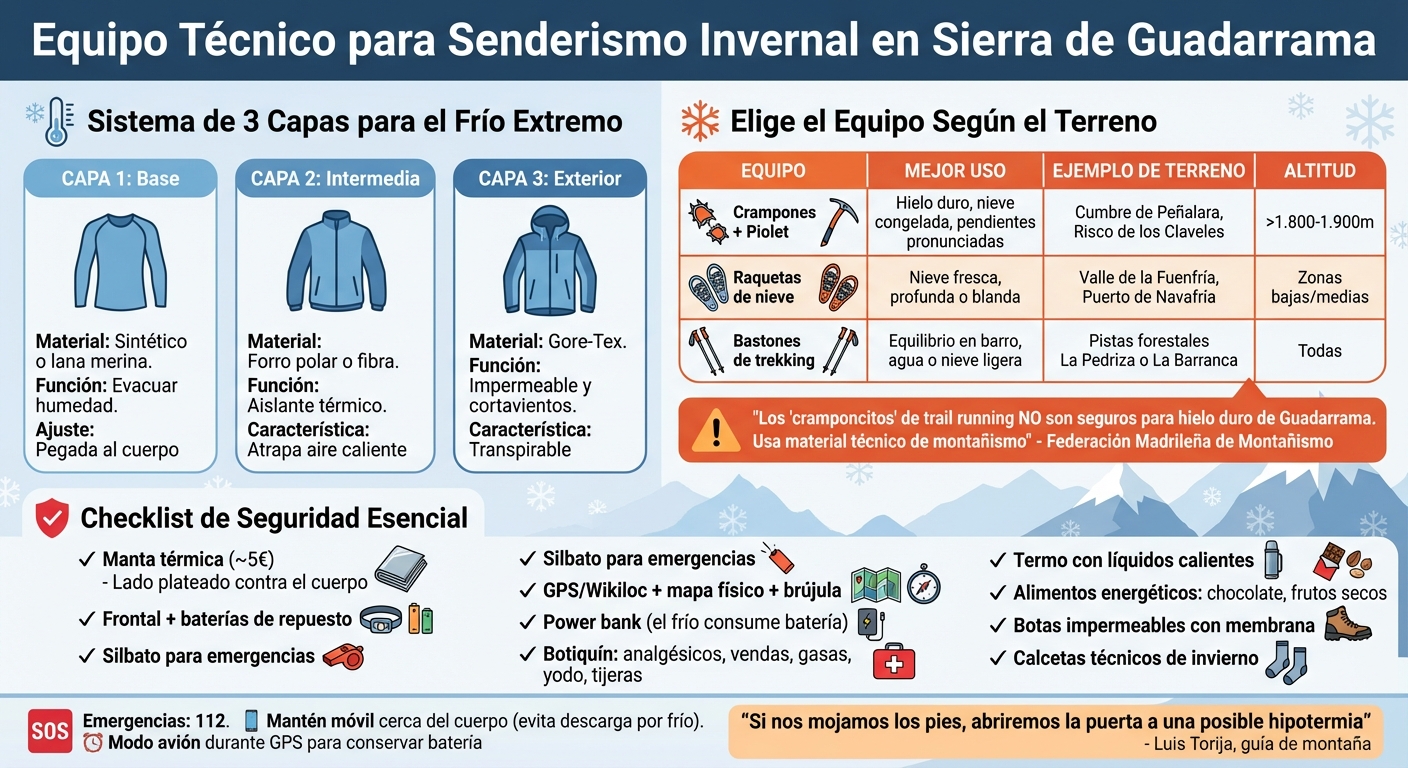
Technical equipment guide for winter hiking in the Sierra de Guadarrama
Clothing: 3-layer system explained
The three-layer system is key to facing extreme cold in areas like the Guadarrama Mountains. The base layer should be close-fitting, made of synthetic materials or merino wool, and designed to wick away moisture effectively. As mountain guide Luis Torija points out:
"If we get our feet wet, we'll open the door to possible hypothermia."
The mid-layer acts as insulation, trapping a pocket of warm air around your body. A fleece or synthetic base layer are excellent choices here. Finally, the outer layer should be waterproof and windproof, ideally made of materials like Gore-Tex , to protect you from snow and wind while still allowing your body to breathe.
Don't forget your feet: wear rigid or semi-rigid boots with a waterproof membrane, combined with technical winter socks. Wet feet are not only uncomfortable, but they also increase the risk of hypothermia. Additionally, protect your hands and arms, as a fall on hard snow can cause friction burns similar to those caused by sandpaper.
Technical tools: crampons, ice axes and snowshoes
The appropriate technical equipment depends on both the terrain and snow conditions. In high mountain areas, above 1,800–1,900 meters, where the ice is hard and nights cause refreezing, technical mountaineering crampons and an ice axe are essential. The Madrid Mountaineering Federation warns:
"Trail running crampons or snowshoes are not safety equipment for the hard ice of Guadarrama. Use technical mountaineering equipment."
On the other hand, snowshoes are perfect for fresh, deep snow, as they allow you to float and prevent you from sinking. They are especially useful in areas like the Fuenfría Valley or the Navafría Pass. Trekking poles are also essential, as they help maintain balance on slippery terrain and better distribute physical effort.
| Equipment | Best use | Example of land |
|---|---|---|
| Crampons and ice axe | Hard ice, frozen snow, steep slopes | Peñalara Summit, Risco de los Claveles |
| Snowshoes | Fresh, deep or soft snow | Fuenfría Valley, Navafría Pass |
| Trekking poles | Balance in mud, water, or light snow | Forest tracks in La Pedriza or La Barranca |
Safety equipment checklist
A thermal blanket is an essential and inexpensive item, costing approximately €5. If you need to use one, keep this advice in mind:
"The silver side should be placed against the body because it reflects body heat inwards, preventing it from escaping."
Other crucial items include a headlamp with spare batteries , since daylight hours in winter are limited, and an emergency whistle.
For navigation, combine digital tools like GPS or apps like Wikiloc with a physical map and compass . Keep your phone in airplane mode while using GPS to conserve battery, as the cold drains it quickly. Also, bring a power bank as a backup.
Your basic first-aid kit should include pain relievers, bandages, gauze, adhesive sutures, iodine, scissors, and blister treatment supplies. In addition, a thermos of hot liquids and energy-rich foods like chocolate or nuts will help you stay warm and energized.
3 winter routes in the Sierra de Guadarrama
Route 1: Navacerrada Pass to Siete Picos
This route offers two options: an easier version, following the Schmidt Trail to the Siete Picos Meadow (2–3 hours, 300 meters of elevation gain, 10 km), and a more challenging version known as the "ridge." The ridge variant traverses all seven peaks in about 5 hours, requiring greater physical exertion. The seventh peak, which is closer to the Navacerrada Pass, rises to 2,138 meters.
For the basic route, snowshoes and trekking poles are recommended. For the ridge, technical crampons and an ice axe are essential, as hard ice and steep slopes are common. Weather conditions on the ridge can be extreme: with temperatures around 0°C and winds of 30–40 km/h, the wind chill can drop to -10°C.
Critical points: If fog reduces visibility, if progress becomes too slow, or if you encounter hard ice without the proper equipment, it's best to turn back. You should also be careful when crossing active runs like "El Bosque" or "Telégrafo." Additionally, always check the terrain for black ice or holes in the rocks.
The parking lot usually fills up before 9:00 AM, so it's advisable to take the C-9 train from Cercedilla (approximately €9) or the 691 bus from Madrid. Guided snowshoeing tours cost around €27 for a 3-hour introductory session. Before setting out, always check the AEMET Mountain forecast to ensure safe conditions.
Route 2: Summit of Peñalara via the normal route
The ascent to Peñalara, the highest point in the Sierra de Guadarrama at 2,428 meters, is a true high-mountain experience. The most popular route starts from the Puerto de Cotos pass, with an elevation gain of 600 meters and an approximate duration of 1.5 hours to the summit. Given the technical terrain, the use of technical crampons and an ice axe is mandatory, especially at altitudes above 1,800–1,900 meters, where the ice hardens due to the low nighttime temperatures.
The climate varies drastically between the base and the summit. For example, in the parking lot (at 1,386 meters) the temperature can be around 3°C, but at the summit it can drop to -7°C. With wind, the wind chill can reach -15°C.
Critical points: Stop the ascent if you notice you're moving slower than expected, if you start shivering, or if you lose manual dexterity (such as using your phone or unzipping a zipper). If you encounter "hard ice" and don't have the proper equipment, it's best to turn back. Fog can also be a problem, so it's helpful to carry a GPS with the route downloaded and a physical map as a backup.
The parking lot at Puerto de Cotos fills up quickly on weekends, and cell phone coverage in the area is limited. Therefore, always let someone know your planned route and estimated return time.
Route 3: Fuenfría Valley
If you're looking for an easier option or if the weather is unpredictable, the Fuenfría Valley is perfect. Its forest tracks are located in lower and mid-altitude areas, offering more accessible terrain and less risk of getting lost than high mountain routes. Furthermore, the forest provides protection from the wind, and the risk of avalanches is low.
Basic equipment includes waterproof boots, but snowshoes are useful if there is heavy snow. Trekking poles are essential for balance, as shaded or leeward areas may have hidden patches of ice. Nighttime temperatures can refreeze trails, turning them into veritable ice rinks. Keeping your feet dry is key to avoiding hypothermia.
Navigation: Download routes on Wikiloc and carry a physical map and compass. If crossing streams, check that the ice is safe before stepping on it and avoid getting wet, as this increases the risk of hypothermia. Fog is common both in the forest and at higher elevations, significantly reducing visibility.
Conditions in the Sierra de Guadarrama can change rapidly, turning a simple route into a dangerous one. A recent example was the rescue of 20 children and 3 counselors near Bola del Mundo, who suffered from hypothermia and disorientation after a sudden change in the weather.
Safety protocols and emergency procedures
Weather monitoring and route planning
Before heading out, check AEMET Mountain both the night before and first thing in the morning; conditions can change rapidly. Also, use the National Park Meteorological Network (RMPSG) to access up-to-date data from the last 48 hours.
A key piece of information is the 0°C isotherm : for example, on February 2, 2026, this was at 1,800 meters, indicating where snow turns into hard ice. Also, consider the wind chill : on that same day, although the minimum temperature in Peñalara was -8°C, the wind chill made it feel as low as -19°C.
Adjust your plans to the available daylight hours in winter and add extra time, as walking in snow requires greater physical exertion. Check road conditions and parking availability, especially in popular spots like Puerto de Cotos, which is often full before 9:00 AM on weekends. Also, inform someone of your exact route and estimated return time, sending location updates whenever possible.
After checking the conditions, make sure you have the right equipment to deal with any unexpected situation.
Emergency and response equipment
Keep your phone close to your body to prevent the cold from draining the battery quickly. Download routes for offline use and always carry a physical map and compass as a backup.
If you notice your progress slowing down, dense fog appears, or you experience tremors, clumsiness in your hands, or mental confusion, turn back immediately. Remember that helicopter rescues are not possible after nightfall. In case of emergency, contact 112 and provide your exact coordinates. As Carlos Soria aptly puts it:
"We have to climb the mountains, but above all we have to return home, and if possible, in one piece."
Conclusion
In short, following these protocols can be the key to enjoying a safe mountain experience and avoiding unnecessary risks. The Sierra de Guadarrama is a place of breathtaking beauty, but it also demands respect, planning, and careful preparation. It's not just about having the right equipment; anticipation and organization are equally important.
Before setting out, always consult AEMET Mountain and the National Park Meteorological Network. Weather conditions can change drastically between the start of the route and the summit, completely altering the difficulty and character of the hike.
It's advisable to plan ahead, allowing ample time, and arrive at the main parking areas before 9:00 AM if visiting the area on the weekend. Also, inform someone you trust of your itinerary and estimated return time. If you experience delays, dense fog, or signs of exhaustion such as clumsiness, don't hesitate to turn back immediately. Remember that helicopter rescues do not take place after dark.
The mountains always reward prudence. Avoid improvisation, enjoy the surroundings, and prioritize your safety in every decision you make. As Carlos Soria aptly puts it:
"We have to climb the mountains, but above all we have to return home, and if possible, in one piece."
FAQs
What equipment is essential for walking on hard snow in the Sierra de Guadarrama?
To move safely on packed snow or ice in the Sierra de Guadarrama mountains, crampons and an ice axe are essential. These accessories provide the necessary traction and stability, minimizing the risk of falls or slips on challenging terrain.
Appropriate clothing: the 3-layer system
Clothing also plays a crucial role. Ideally, you should dress following the 3-layer system :
- Thermal inner layer : Keeps your body dry and retains heat.
- Insulating middle layer : Helps retain body heat.
- Waterproof and windproof outer layer : Protects against moisture and wind.
Security and planning
Carrying a safety kit is essential. This should include:
- A thermal blanket for emergencies.
- A portable charger to keep your device running.
- A mobile phone with rescue applications, which can be vital in an emergency.
On less technical routes, you could opt for appropriate footwear and trekking poles with safety tips. However, it's always important to assess terrain conditions and check weather forecasts before setting off. Preparation is everything!
What impact does extreme weather have on safety during winter routes in the Sierra de Guadarrama?
Winter in the Sierra de Guadarrama is not just cold; it's a challenge that requires preparation and caution. Strong winds, sub-zero temperatures, snow, and ice can turn a hike into a dangerous experience. These factors increase the risk of falls, hypothermia, and even disorientation. And if that weren't enough, some areas present a real danger of avalanches, which can be fatal if care isn't taken.
How can you minimize these risks? The key is planning. Before setting out, always check the weather forecast and verify the condition of the access routes. The right equipment is essential: crampons, thermal clothing, and other essential items are not optional. Furthermore, it's important to continuously assess the conditions along the route. These measures not only protect your safety but also allow you to enjoy the mountains with greater peace of mind.
What are the basic precautions for winter hiking in the Sierra de Guadarrama?
Before venturing out on a winter route through the Sierra de Guadarrama, it's essential to be well-prepared and aware of the risks associated with this time of year. The first step is to consult up-to-date weather reports , such as those provided by AEMET Montaña. This will help you avoid setbacks like sudden changes in the weather, storms, or the appearance of dense fog. Additionally, be sure to check the condition of access routes and snow conditions, especially in areas prone to avalanches.
Basic equipment for winter routes
Having the right equipment can make the difference between a safe experience and a dangerous situation. Here are the essentials:
- 3-layer system : An inner thermal layer, an insulating middle layer, and an outer waterproof and windproof layer.
- Crampons and ice axe : Essential if the terrain has ice or hard snow.
- Thermal blanket : Useful in case of emergency.
- Extra charger : Make sure you bring one to keep your devices running.
Planning and prudence
Planning your route in advance is another key aspect. Identify strategic points where you can turn back if weather conditions worsen. Prudence and prior information, combined with the right equipment, are essential for enjoying the mountains safely during winter.