
The best hiking routes in the Serra de Tramuntana
Exploring the Serra de Tramuntana is an unforgettable experience. This corner of Mallorca, a UNESCO World Heritage Site, combines spectacular landscapes, history, and trails for all levels. From the famous GR 221 , ideal for adventurers, to PR routes perfect for a day hike, each trail offers something different. Here's a summary:
- GR 221 (Dry Stone Route): A complete tour through the mountains, ideal for those looking for a multi-day trek.
- PR trails: Designed for day trips, from family-friendly routes to more technical trails.
- Best times to visit: Spring and autumn, with pleasant temperatures and vibrant landscapes.
- Essential equipment: Hiking boots, sufficient water, and layered clothing.
Each route has its own charm, from peaks like Puig de Massanella to historic trails like Camí des Correu. Prepare well, respect the environment, and enjoy this natural gem of Mallorca.
The Serra de Tramuntana
sbb-itb-2b14d48
The best PR routes in the Serra de Tramuntana
I've explored these routes throughout the year, discovering how each season transforms their character. Here's a selection of trails, organized from north to south, to help you plan. Keep in mind that an easy path in spring can become challenging after a storm.
Below, I detail the routes according to their location, so you can choose the one that best suits your starting point.
Northern routes: Lluc and Pollença area
Puig de Massanella (PR-M 15) is the second highest peak in Mallorca, at 1,364 meters. Although accessible, it's not an easy hike. The circular route from Lluc, 16.7 km long with 1,010 m of elevation gain, offers spectacular views after about 6 hours of walking.
The trail winds through oak forests before opening up to a limestone landscape that looks like something from another planet. On clear days, you can admire the entire island from the summit. You'll also find an old snow pit, 20 meters deep, used centuries ago to store ice. Don't forget walking sticks and plenty of water.
Puig d'en Galileu , at an altitude of 1,181 meters, is notable for its "voltes d'en Galileu," a system of stone zigzags designed to transport snow. The restored snow houses will transport you three centuries back in time. Although the level of difficulty is moderate, the rocky terrain requires appropriate footwear.
Lluc to Pollença via Ternelles (PR-M 5) connects the Lluc monastery with the sea, crossing the Ternelles estate, accessible only from July to January. This linear trail combines mountains and views of Cap de Formentor. As it is a linear route, you will need to plan return transportation.
Routes in the city center: Sóller and Alaró area
In the heart of the Serra de Tramuntana, Sóller and Alaró offer trails steeped in history and breathtaking landscapes.
Barranc de Biniaraix (PR-M 10) is an example of dry stone engineering, featuring medieval steps and ancient aqueducts. The short version to the waterfall takes about 2 hours round trip, ideal for families. The full route connects with the GR 221 and leads to Tossals Verds. After rain, the steps can be slippery. This trail has a 4.8 out of 5 star rating from hikers.
Volta des General (PR-M 1) is a classic circular route that combines views of the northern coast with the orange grove valley. Although it includes some uphill sections, it is suitable for most people. Its name comes from General Weyler, who popularized this path in the 19th century. At the end, you can enjoy a drink in Plaça Constitució in Sóller.
Castell d'Alaró (PR-M 2.1) combines history and hiking. This medieval castle, located at 822 meters, offers breathtaking views of the island. The climb is steady but not technical, and at the top you'll find a refuge serving homemade food. It's best to visit during the week to avoid the crowds.
Western routes: from Valldemossa to Andratx
In this area, the trails stand out for their viewpoints and coastal landscapes.
The Camí de s'Arxiduc (PR-M 6) is a cobbled path built by Archduke Ludwig Salvator in the late 19th century, featuring viewpoints designed to offer stunning coastal views. Starting from Valldemossa, the path winds along the ridge, providing constant vistas of the Mediterranean. While not technically difficult, some exposed sections require caution on windy days. It's an ideal route for first-time visitors to Mallorca who want to understand why the Serra de Tramuntana is a UNESCO World Heritage Site.
The La Trapa trail (PR-M 110) begins in Sant Elm and climbs to the ruins of the Trappist monastery founded in 1810. This circular route offers views of the island of Sa Dragonera. Along the way, you can observe features such as a threshing floor, a water gallery, and dry-stone terraces. The descent is challenging, so carry a light backpack. Spring is the best time to enjoy the wildflowers.
Southern routes: Puigpunyent and Esporles
In the south, the iconic peaks offer unforgettable challenges and landscapes.
Puig de Galatzó (PR-M 7) , at 1,027 meters, is the first major challenge for many hikers on the island. From Puigpunyent, the route is well-marked, with a 6 km ascent through holm oak and pine forests. Starting from Estellencs increases the difficulty, and from Es Capdellà, it's only recommended for the most experienced hikers. The summit offers 360° views, including Palma, the bay, and, on clear days, Cabrera. Bring a windbreaker, even in summer.
Camí des Correu (PR-M 4) is an old 15th-century royal road that connected Esporles and Banyalbufar. Its route and history make it a special experience for those seeking to connect with the past.
Comparative table of PR routes
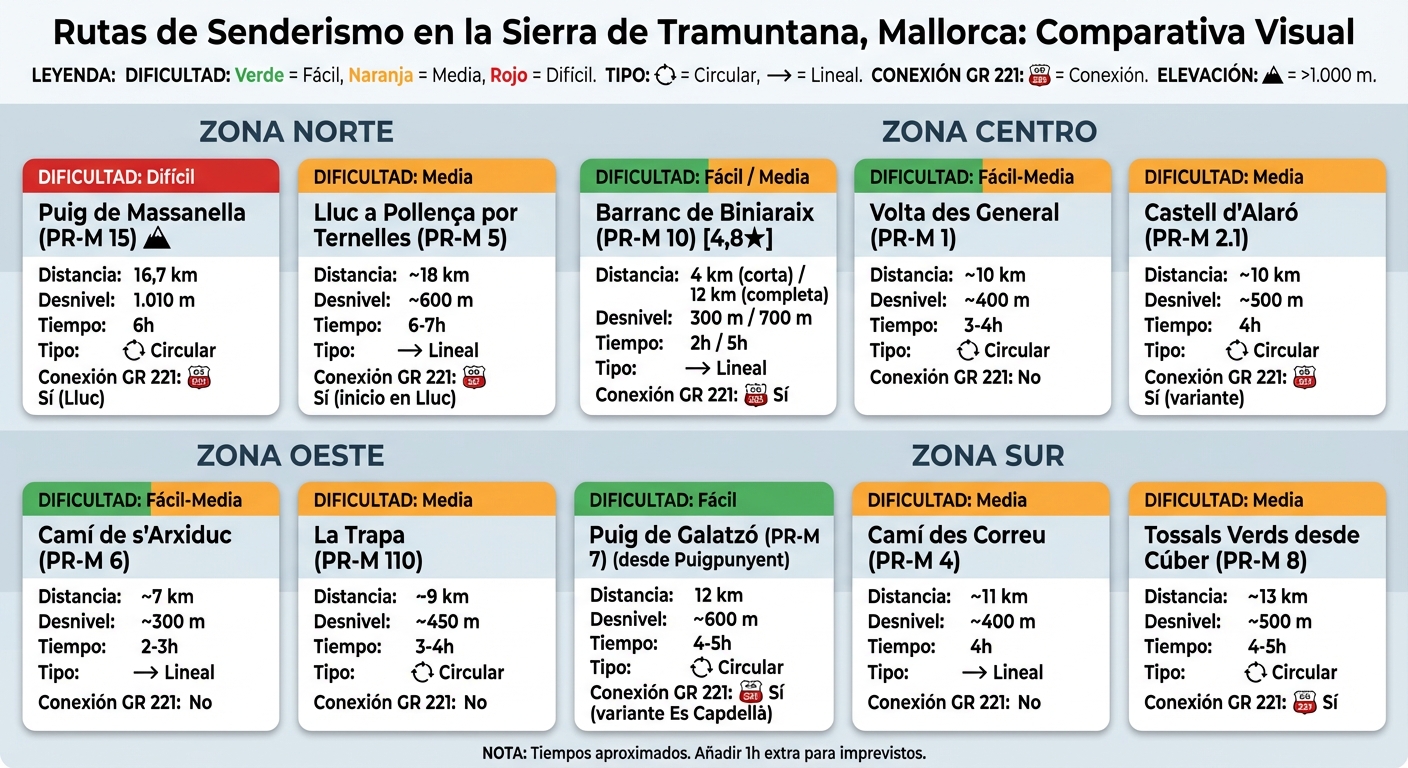
Comparison of PR hiking routes in the Serra de Tramuntana
To complement the descriptions, here is a table summarizing the key data for each route. You can use it to easily compare distances, elevation changes, and times.
The times indicated are approximate and may vary depending on the pace and conditions. It is advisable to add an extra hour for possible unforeseen circumstances.
| Route / Code | Distance (km) | Elevation difference (m) | Difficulty | Time | Guy | GR 221 Connection |
|---|---|---|---|---|---|---|
| Puig de Massanella (PR-M 15) | 16.7 | 1.010 | Difficult | 6h | Circular | Yes (Lluc) |
| Tossals Verds from Cúber (PR-M 8) | ~13 | ~500 | Average | 4–5h | Circular | Yes (Barranc de Biniaraix connection) |
| Lluc to Pollença through Ternelles (PR-M 5) | ~18 | ~600 | Average | 6–7h | Linear | Yes (starting in Lluc) |
| Barranc de Biniaraix (PR-M 10) | 4 (short) / 12 (full) | 300 / 700 | Easy / Medium | 2h / 5h | Linear | Yes (Tossals Verds connection) |
| Volta des General (PR-M 1) | ~10 | ~400 | Easy – Medium | 3–4h | Circular | No |
| Castell d'Alaró (PR-M 2.1) | ~10 | ~500 | Average | 4h | Circular | Yes (variant) |
| Camí de s'Arxiduc (PR-M 6) | ~7 | ~300 | Easy – Medium | 2–3h | Linear | No |
| La Trapa (PR-M 110) | ~9 | ~450 | Average | 3–4h | Circular | No |
| Puig de Galatzó (PR-M 7) | 12 (Puigpunyent) | ~600 | Easy | 4–5h | Circular | Yes (Es Capdellà variant) |
| Camí des Correu (PR-M 4) | ~11 | ~400 | Average | 4h | Linear | No |
If you choose linear routes, remember to arrange your return transport. Circular routes, on the other hand, will take you back to your starting point without any problems. This table will help you choose the route that best fits your plans for the day.
Equipment and preparation for hiking in the Tramuntana
What to pack in your backpack for the Tramuntana routes
Proper footwear is essential: hiking boots with good grip are a must. Sneakers or, even worse, flip-flops, are unsafe on the Tramuntana mountain range. The limestone, especially when wet, can be extremely slippery. Also, wear technical socks with your boots to prevent chafing, a common problem on long descents.
For clothing, the layering system is your best friend. Start with a breathable technical base layer and always carry a lightweight windbreaker, even in summer. If you're planning winter routes or higher altitude climbs, such as the Massanella, add warmer layers to your kit.
Water is essential. Carry between 1.5 and 2 liters per person, but in summer or on very exposed routes, increase the amount to 3 liters or more. Remember that many springs dry up in the warmer months, and the water isn't always drinkable. A hat will be your best friend on sections where the sun beats down directly on the white rock.
Before setting out, download the GPX tracks of your route. In areas with poor coverage, an offline map can be crucial, as the trail disappears or the markings are unclear in some places.
If you need to equip yourself, you can visit Peregrin Tuk (www.peregrintuk.es), a shop with more than 30 years of experience advising those who explore the Tramuntana.
With the equipment ready, the next step is to understand how to deal with the weather and terrain of the mountains.
How to deal with the climate and terrain of the Tramuntana
The weather in the Tramuntana mountains is unpredictable. In a single day, you can go from scorching sunshine to dense fog, strong winds, or heavy rain. Don't rely on the general weather forecast from Palma; consult specialized mountain sources, such as AEMET or Meteoblue , for more accurate information.
Avoid technical routes like Torrent de Pareis or Puig Tomir if it has rained recently. Wet limestone becomes a slippery trap, and sections with loose pebbles are even more dangerous. If there is a north wind, it's best to postpone exposed routes like the summits of Massanella or L'Ofre.
During the summer, the heat can be extreme, and many high-altitude routes lack shade. Start hiking at dawn and avoid the midday hours. The best times to explore the Tramuntana mountains are usually spring (April-May) and autumn (September-October), when temperatures are more pleasant and the scenery is at its best.
Finally, always let someone know your route and estimated return time. Carry energy-rich foods like nuts, bananas, apples, or dark chocolate to keep your energy up during the more demanding sections.
Safety and regulations on the trails
How to stay safe on the roads
Before setting off on your adventure, be sure to check the specific mountain weather forecast from sources like AEMET or Meteoblue. Don't rely on the forecast from Palma: the weather in the mountains can be completely different. As Toni, editor of Click Mallorca, wisely advises, always adapt your route to the weather conditions.
Inform someone you trust about your planned route and approximate return time, especially if you're hiking alone. Remember that cell phone coverage can be unreliable in deep canyons or high mountain areas. While a charged phone is important, don't rely solely on it for navigation. A physical map, such as those published by Editorial Alpina at a scale of 1:25,000, can be your best friend in challenging situations.
If there are strong northerly winds, avoid exposed routes such as Massanella or L'Ofre. These conditions can make these summits dangerous.
Being a member of a mountaineering federation is highly recommended, as it includes specific insurance for mountain activities. If you're a beginner, join established groups to gain experience. And if the terrain seems too difficult or the group is too large for the route, don't hesitate to turn back. Caution should always be your priority.
In addition to looking after your personal safety, it is equally important to follow local rules while enjoying these trails.
Local regulations and best practices
In many cases, the trails cross private estates, known as possessions . It is essential to respect chains, security cameras, and signs indicating that entry is prohibited. Some traditional access points, such as the one at Coma des Cairats in Valldemossa, have been closed and replaced by new sections of the GR-221. On certain estates, such as Turixant or Son Torrella near Puig Major, you will need to obtain permission from the owner before entering.
Always stay on marked trails. The Consell de Mallorca currently manages 183.3 kilometers of restored GR-221 paths, which follow ancient dry-stone routes. As serradetramuntana.eu reminds us:
Respect nature, respect private property, and leave no trace of your passage through the mountain.
Fires are strictly prohibited at any time of year. Also, always close gates after passing through to prevent livestock from escaping. Do not drink water from natural springs without treating it first, as many may be dry, contaminated, or frequented by animals. Finally, please note that some areas, such as Mortitx, have restricted access and are only open from July to January.
Experienced hikers know that personal safety and respect for the environment are essential to preserving the unique legacy of the Tramuntana.
Conclusion
Hiking the trails of the Tramuntana mountains is like stepping into centuries of history and nature. Each PR route holds its own story: from the old mail routes that connected remote villages to the paths used by charcoal burners who climbed the mountains in search of firewood.
What makes this network of trails special is the connection between human activity and the Mediterranean landscape, recognized by UNESCO as cultural heritage. Along the 183.3 km of the GR 221 and its network of PR trails, you will discover medieval irrigation channels, dry-stone constructions, and traditional structures that have withstood the test of time.
With such richness at every turn, it's essential to plan your route responsibly. Start with more accessible trails, such as the Barranc de Biniaraix or La Trapa, and as you gain confidence, take on more demanding challenges. Always respect the environment, follow local rules, and prepare thoroughly before setting out. As Pasión por la Serra de Tramuntana reminds us:
Respect nature, respect private property, and leave zero trace of your passage through the mountain.
For those of us who love the Tramuntana mountains, every trail reveals something new about this mountain range. And to fully enjoy the experience, having the right equipment is essential. If you need to get kitted out before setting off, you'll find Peregrin Tuk in Palma. We've been helping those who explore the island for over 30 years. Visit us in our shop or check out our website.
See you on the road!
FAQs
What is the best hiking route in the Serra de Tramuntana for beginners?
The Cap Andritxol route is perfect for those new to hiking in the Serra de Tramuntana mountains. At just 3.5 km long, it offers spectacular views without requiring any prior experience or technical challenges. It's an ideal option for enjoying nature in an accessible way.
What is the difference between the PR trails and the GR 221 in the Tramuntana?
The PR (Short Distance) trails are routes that range from 10 to 50 kilometers, designed to be completed in a single day. They are marked with yellow and white blazes and are generally of low to medium difficulty, making them accessible to most hikers. On the other hand, the GR 221 (Long Distance) is a long-distance trail that crosses the entire mountain range. This trail requires greater physical effort and places special emphasis on exploring the landscapes and the rich historical heritage of the area.
What is the best time to go hiking in the Serra de Tramuntana?
Spring and autumn offer ideal conditions for enjoying hiking in the Serra de Tramuntana mountains. During these seasons, the weather is mild and the temperatures are pleasant enough to explore its spectacular landscapes at your leisure.
In contrast, summer can be challenging due to the extreme heat and dryness, making hikes more demanding and less enjoyable. On the other hand, in winter, rain and adverse weather conditions can turn some routes into an unnecessary challenge. Therefore, choosing the right time of year will make all the difference to your experience.
Is it possible to go hiking in the Tramuntana mountains in summer?
Yes, you can enjoy hiking in the Tramuntana mountains during the summer, but it's important to take certain precautions due to the heat. Here are some key tips:
- Stay hydrated : Bring enough water for the entire route, as high temperatures can cause dehydration quickly.
- Sun protection : Use sunscreen, sunglasses, and a hat or cap to protect yourself from the sun.
- Choose shady routes : Whenever possible, opt for trails that offer wooded areas or natural shade.
- Appropriate footwear : Make sure you wear boots or shoes specifically designed for dry stone terrain, which is common in the area.
- Leave early : Plan your walks for early in the morning to avoid the hottest hours.
With proper preparation, you can enjoy the beauty of the Tramuntana even in the hottest months.
What footwear do I need for walking in the Serra de Tramuntana?
To explore the Serra de Tramuntana, hiking boots with good grip are essential. The limestone trails can be very slippery, especially on wet days. Proper footwear will not only provide greater stability but also safety throughout your hike.
Where to buy hiking gear in Mallorca?
In Mallorca, you can get hiking equipment at Peregrin Tuk , a shop located in Palma with over 30 years of experience.
Is the Serra de Tramuntana a UNESCO World Heritage Site?
The Serra de Tramuntana was recognized as a World Heritage Site by UNESCO in 2011 thanks to its spectacular cultural landscape and its intricate network of historic paths built using the dry stone technique.