
Which is better, North Face or Patagonia?
It depends on your priorities: North Face excels in technical performance for extreme activities, while Patagonia focuses on durability and a strong commitment to the environment. Both offer high quality, but their approach, prices, and philosophy are different. If you're looking for clothing for demanding expeditions, North Face might be your choice. If you prioritize sustainability and long-lasting garments, Patagonia is more suitable.
Key Differences:
- Technical Performance: North Face is geared towards extreme conditions with more accessible prices in certain ranges.
- Environmental Commitment: Patagonia reinvests its profits in protecting the planet and uses more recycled materials.
- Durability and Repairs: Patagonia offers free lifetime repairs; North Face has a similar program, but it's less integrated.
- Prices: Patagonia is usually more expensive, but its durability reduces the long-term cost.
Quick Comparison:
| Aspect | North Face | Patagonia |
|---|---|---|
| Technical Performance | High | High, but less specialized |
| Recycled Material | Less than Patagonia | Higher percentage |
| Warranty | Industry standard | Lifetime (Ironclad) |
| Repairs | Available (Renewed) | Free and frequent |
| Initial Price | More accessible | Higher |
Conclusion: Choose North Face if you're looking for technical functionality at a good price, and Patagonia if you value durability and environmental responsibility.
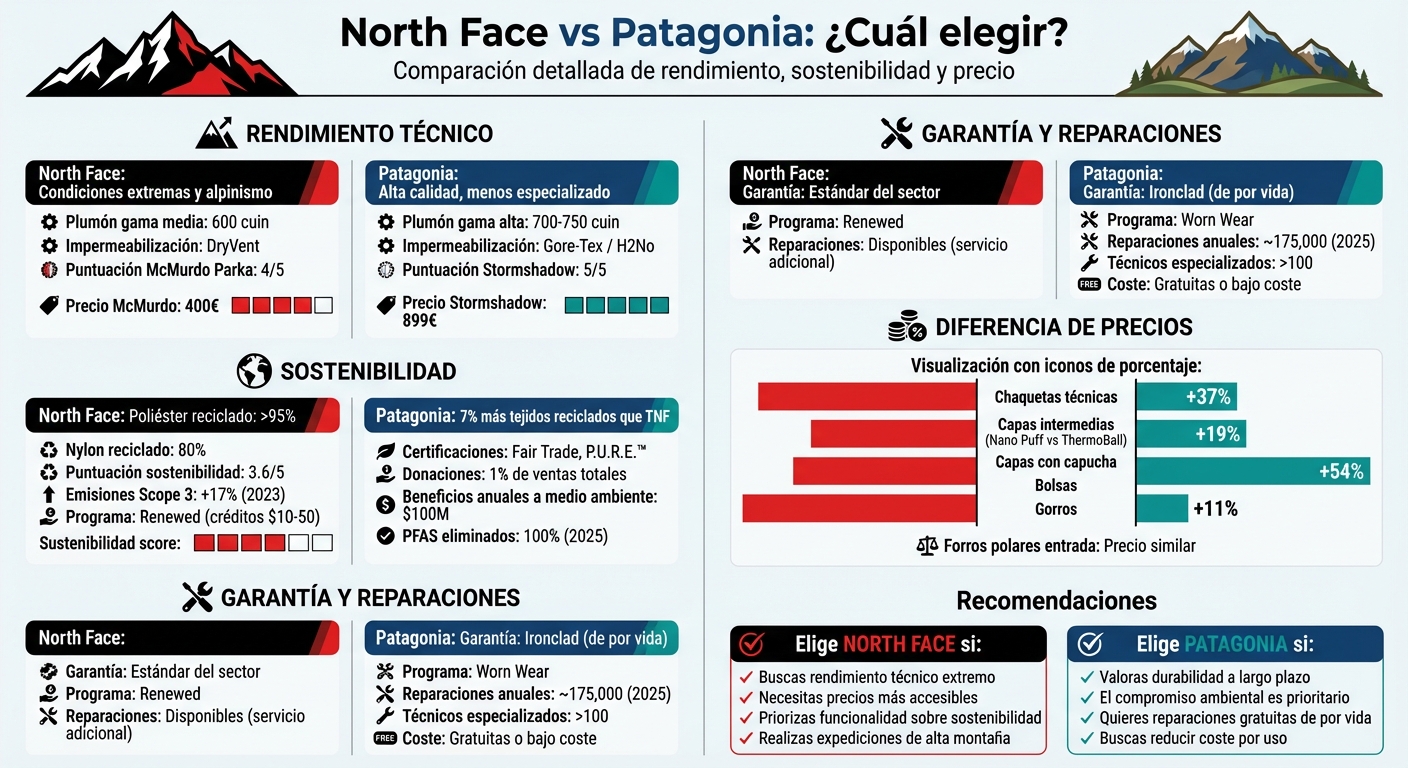
North Face vs Patagonia Comparison: Features, Prices, and Sustainability
The Difference Between North Face And Patagonia
sbb-itb-2b14d48
Two Brands, Two Distinct Philosophies
To understand the essential differences between these two brands, it's important to look at their origins. North Face, founded in 1966, was created with the goal of providing equipment for extreme conditions, focusing on high-mountain expeditions, technical mountaineering, and use by professional athletes. Its slogan, "Never Stop Exploring," reflects that mindset of challenge and overcoming the elements.
North Face: Designed for Extreme Performance
North Face has dedicated itself to creating products that enable people to face nature in its most adverse conditions. This translates into constant technical advancements, the use of high-quality materials, and a design entirely oriented towards performance. With revenues exceeding 2 billion dollars annually, it positions itself as a leader in the outdoor sector.
On the other hand, Patagonia has a very different history and approach.
Patagonia: Environmental Activism from Day One
Patagonia emerged from a different vision when Yvon Chouinard founded it in 1973 in Ventura, California. It all started with an ethical dilemma: the steel pitons he manufactured damaged rock walls. This conflict marked the beginning of a philosophy based on producing less, but with higher quality, and taking responsibility for the impact of each product.
"Instead of extracting value from nature and transforming it into wealth, we are using the wealth that Patagonia creates to protect the source." - Yvon Chouinard, founder of Patagonia
Patagonia's purpose is reflected in its statement: "We're in business to save our home planet." In September 2022, Chouinard made a radical decision to transfer 100% of the company's shares to the Patagonia Purpose Trust and the Holdfast Collective. This ensures that all profits - approximately 100 million dollars annually - are dedicated to fighting climate change and protecting natural spaces. It's not an advertising strategy, but a legal structure that reinforces their commitment to the environment. While North Face focuses on conquering the mountain, Patagonia bases its existence on respecting and preserving nature.
These differences in their roots and philosophies are key to analyzing aspects such as quality, materials, and sustainability in the following sections.
Quality and Materials - How Do They Compare?
Each brand's identity is reflected in the quality and selection of its materials. Both stand out for offering high-quality products, but their approaches are very different. North Face prioritizes technical performance, while Patagonia combines functionality with a clear commitment to sustainability. Let's analyze these differences in detail.
Technical Mountain and Mountaineering Equipment
In extreme conditions, both brands excel, but with important nuances. Patagonia uses higher quality down in its premium range, with fills between 700 and 750 cuin, compared to the 600 cuin that North Face uses in its mid-range urban parkas. This allows Patagonia to offer more warmth with less weight and bulk.
In waterproofing, both brands have outstanding solutions. Patagonia combines its H2No Performance technology with Gore-Tex in more technical products, while North Face opts for its DryVent membrane, an effective and more affordable option. In tests, Patagonia's Stormshadow Parka (€899) scored a perfect 5/5 for weather protection, while North Face's McMurdo Parka (€400) achieved a respectable 4/5.
Garment construction also makes a difference. The Stormshadow is characterized by its robustness, soft linings, and durable polyester. On the other hand, the McMurdo, while featuring a tough 70D x 160D outer nylon, has received criticism for details such as snagging flaps and less reliable zippers.
Additionally, Patagonia uses 7% more recycled fabrics than North Face. In comparable technical products, such as the Nano Puff and the ThermoBall Eco, both brands use 100% recycled fill, but Patagonia adds certifications like Fair Trade and P.U.R.E.™ (production with lower emissions), which increases its price by approximately 19%.
In everyday use, the differences between the two brands become even more apparent.
Casual and Everyday Wear
In this category, Patagonia has an advantage. Its iconic garments, such as the Better Sweater, the Synchilla, and its organic cotton basics, are known for their durability. This recognition is no coincidence: Patagonia has been manufacturing fleeces since the 1970s, and many of these products remain benchmarks.
Quality is perceived in details such as reinforced seams, dense fabrics, and finishes that withstand numerous washes without losing shape or color. Although North Face offers good products in this category, its mid-range can have variations in quality. If you are looking for a garment that will last a decade of intense use, Patagonia is a more reliable option.
Durability and Repair Services
Beyond materials, durability and after-sales services highlight the differences between these brands. Patagonia stands out for its focus on repairing and extending the lifespan of its products. Its repair center in Reno, the largest in the United States, employs over 100 specialized technicians. In 2025, they repaired nearly 175,000 garments. Furthermore, their Ironclad guarantee covers manufacturing defects for life, and their Worn Wear program facilitates repairs even on heavily used products.
North Face also offers repairs through its Renewed program and works towards a more circular model, but it doesn't reach the same level of commitment. For Patagonia, repair is a fundamental part of its philosophy; they prefer you fix your jacket rather than buy a new one. In North Face's case, repair is more of an additional service.
Here's a summary of these differences:
| Aspect | Patagonia | North Face |
|---|---|---|
| Down (high-end) | 700-750 cuin | 600 cuin (mid-range) |
| Waterproofing | Gore-Tex / H2No | DryVent |
| Recycled fabrics | 7% more than TNF | Increasing (2025 target) |
| Warranty | Ironclad (lifetime) | Industry standard |
| Annual repairs | ~175,000 (2025) | Service available |
Sustainability - Not All Green is Equal
Sustainability marks a significant difference between these two brands. Although both highlight their commitment to the environment, the depth of their actions is very different. While North Face promotes some ecological initiatives, its strategy is influenced by its membership in VF Corporation. On the other hand, Patagonia has made environmental activism the foundation of its business model.
Patagonia's Structural Environmental Commitment
In September 2022, Yvon Chouinard made a radical decision: he transferred 100% of Patagonia's ownership to the Patagonia Purpose Trust and the Holdfast Collective, a non-profit organization. This means that the $100 million it generates annually is directly dedicated to environmental protection and the fight against climate change.
Patagonia is also a founding member of 1% for the Planet, committing to donate 1% of its total sales (yes, sales, not profits) to environmental causes. Additionally, its products have certifications such as Fair Trade and P.U.R.E.™ (Producing Upcycled, Recycled, and Environmentally friendly), which increases production costs but reduces environmental impact. By 2025, they managed to completely eliminate PFAS from all their products.
"Patagonia has always been considered the benchmark in eco-friendly clothing, leading the way and showing other retailers what it truly means to be an environmentally conscious brand." – Lectra/Retviews
This approach demonstrates how Patagonia integrates sustainability into every aspect of its business. However, North Face adopts a different strategy in its ecological efforts.
North Face's Sustainability Programs
North Face has also implemented several interesting initiatives. Its Renewed program offers the possibility to purchase refurbished products and rewards with in-store credits (between $10 and $50) for used garments. In 2024, they launched the Remade collection, which transforms irreparable pieces into new products, such as vests and chalk bags. Additionally, they managed to source over 95% of their polyester and 80% of their nylon from recycled or renewable materials, and eliminated PFAS by mid-2025.
However, being under the umbrella of VF Corporation, North Face faces significant challenges with Scope 3 emissions, which include the entire supply chain. Although VF Corporation managed to reduce its Scope 1 and 2 emissions by 46% since 2017, Scope 3 emissions increased by 17% in 2023. In 2024, they were unable to report these emissions due to delays in data collection from their suppliers. By the end of 2025, North Face scored a sustainability rating of 3.6/5 in an analysis of 23 products. While this is a good result, the difference with Patagonia lies in the focus of its business model, rather than the amount of effort invested.
Price - Which Gives You More for Your Money?
Price Comparison by Product Category
When it comes to prices, Patagonia generally positions itself in a higher range. For example, in technical jackets, Patagonia's maximum price is 37% higher than North Face's. A clear case is the Patagonia Stormshadow Parka, which costs €899, compared to approximately €400 for the North Face McMurdo Parka. In synthetic mid-layers, such as Patagonia's Nano Puff versus North Face's ThermoBall Eco, the average difference is 19%, and in hooded models, it reaches 21%.
However, not all Patagonia products are more expensive. In categories like backpacks and gloves, North Face has higher prices. On the other hand, in bags, Patagonia is 54% more expensive, while for hats the difference is tighter, at 11%. For entry-level fleeces, such as Patagonia's Micro D versus North Face's TKA Glacier, prices are practically the same.
This price difference in Patagonia is explained, in part, by the use of 7% more recycled fabrics and by including certifications such as Fair Trade and P.U.R.E.™, which increase production costs. For its part, North Face usually offers more accessible options, ideal for those seeking functionality without paying for extra certifications.
Long-Term Value and Cost Per Use
Initial price isn't everything; long-term value also matters. Although Patagonia has a higher initial cost, its durability and robust repair service can significantly reduce the cost per use over the years. For example, a Patagonia garment that lasts 10 to 15 years with free repairs can be more economical than a North Face garment that needs frequent replacements.
Patagonia's Worn Wear program allows sending garments for free or low-cost repairs throughout their lifespan, significantly extending their use. North Face also has the Renewed program, which offers credits between $10 and $50 for used garments and sells refurbished products. However, this program is not as integrated into the brand's philosophy as Patagonia's.
To give a practical example: a Nano Puff that lasts 12 years with two free repairs will have a much lower cost per use than a ThermoBall that needs replacement every 4 years, even if the latter is cheaper initially.
Expert analyses support this idea. Patagonia products like the Jackson Glacier or the Stormshadow receive durability scores of 4.5/5, with construction described as "customarily excellent." On the other hand, although North Face's McMurdo also gets ratings of 4.5/5, it has been criticized for details like zippers and flaps that show "slightly subpar construction." With this information, you can decide which option best suits your needs and long-term budget.
Who is Each Brand For?
After comparing quality, sustainability, and price, it's time to analyze which type of user best fits each brand.
When The North Face is the best option
The North Face is perfect for those seeking superior technical performance. If you're into high-mountain mountaineering, participate in expeditions in extreme environments, or need specialized gear, The North Face offers products designed to withstand the most demanding conditions. However, this commitment to functionality is often reflected in slightly higher prices, especially for specific accessories. Additionally, its urban-sporty style stands out, making it an option that fits both the mountains and the city.
If budget is a concern, The North Face also has more affordable options within its technical range. For example, the ThermoBall Eco jacket costs approximately 19% less than its Patagonia equivalent.
When Patagonia is the best option
Patagonia is ideal for those who prioritize durability and a real commitment to the environment. If you enjoy hiking in Mediterranean climates or outdoor activities in moderate conditions, Patagonia offers garments that perform equally well in the mountains and in daily life. In fact, their products cover nearly 95% of the needs for these types of activities.
If you care about the ethics behind the products you buy, Patagonia is hard to beat. Their repair and reuse program makes their garments a long-term investment, which helps offset a slightly higher initial price by reducing the cost per use.
In summary, The North Face is the choice for technical and extreme activities, while Patagonia stands out for its durability, versatility, and environmental commitment. The final decision will depend on your priorities and how you plan to use the garments.
FAQs
Is Patagonia or The North Face better in terms of quality?
Both brands are renowned for their quality, though they excel in different areas. Patagonia focuses on sustainability and durability, using recycled materials, certified processes, and offering a lifetime warranty. Additionally, its Worn Wear initiative encourages extending the lifespan of its products. On the other hand, The North Face specializes in technical innovation and performance in extreme conditions, positioning itself as a reliable option for mountain activities and challenging expeditions.
Why is Patagonia more expensive than The North Face for some products?
Patagonia tends to have higher prices due to its focus on sustainable materials and transparent manufacturing processes, which increases production costs. Additionally, its products are designed for greater durability and come with strong warranties, thus justifying the price. All of this reflects its commitment to quality and respect for the environment.
Which has a better warranty, The North Face or Patagonia?
Patagonia has its "Ironclad" guarantee, which covers all of its products. This guarantee includes repairs, replacements, or refunds if the product doesn't meet your expectations or if you're simply not satisfied. While The North Face also has a warranty service, Patagonia's commitment to its repair program and the durability of its products has gained greater recognition.
Is The North Face more sustainable than Patagonia?
Patagonia stands out against The North Face in terms of sustainability. The brand uses a higher proportion of recycled materials in its products, prioritizes more ethical production practices, and demonstrates a stronger commitment to environmental and social causes.
While The North Face also has ecological initiatives, its scope does not reach the level of Patagonia, whose approach to sustainability is broader and more deeply integrated into its business model.
Which brand lasts longer, The North Face or Patagonia?
Both brands are known for the durability of their products, but Patagonia particularly stands out thanks to its lifetime warranty and its Worn Wear repair program. This program allows for significantly extending the lifespan of its garments with proper care. On the other hand, The North Face also offers durable options, though its focus on repairs does not reach the comprehensive level offered by Patagonia.
Where can I buy Patagonia in Mallorca?
In Mallorca, Patagonia products can be purchased both in specialized physical stores and through their online store. They also offer more affordable alternatives through outlets and the official second-hand program, Worn Wear, an initiative that promotes reuse and environmental care.