
Real differences between the French Way of St. James and the Northern Way
The French Way and the Northern Way are two of the most popular routes to Santiago de Compostela , but they offer very different experiences. Here's a summary of the main differences to help you decide:
- French Way : Ideal if you're looking for a social experience, with many pilgrims, well-developed infrastructure, and varied landscapes (mountains, plateau, and forests). It's physically easier, with less elevation gain and more sections of trail.
- Northern Way : Perfect for those who prefer tranquility, spectacular coastal scenery, and a greater physical challenge. It has more ascents and descents, more stretches of paved road, and fewer available services.
Both paths have their charm, but the choice depends on your preferences, your physical condition, and the type of experience you are looking for.
Quick comparison:
| Aspect | French Way | Northern Way |
|---|---|---|
| Total distance | ~780 km | ~825–835 km |
| Typical duration | 30–33 days | 32–35 days |
| Physical difficulty | Moderate | High |
| Main landscapes | Mountains, plateau, forests | Coast, cliffs, beaches |
| Infrastructure | Excellent | Limited |
| Level of overcrowding | High | Low |
| Daily budget | €35–50 | €40–60 |
If you're looking for company and comfort, choose the French Way. If you prefer peace and quiet and coastal scenery, opt for the Northern Way.
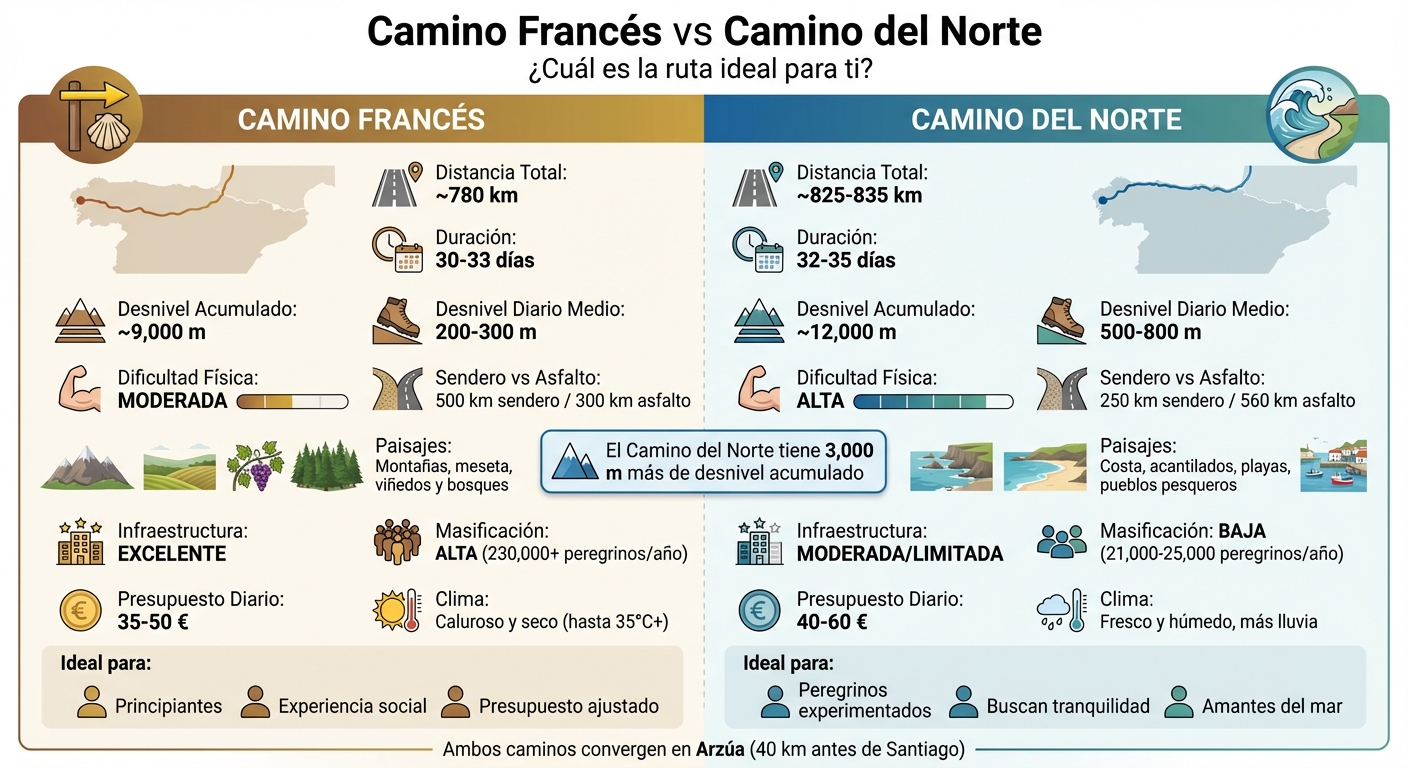
Comparison of the French Way vs. the Northern Way: distance and characteristics
Northern Way vs French Way
sbb-itb-2b14d48
Quick Comparison Table
Take a look at the main differences between the two routes:
| Aspect | French Way | Northern Way |
|---|---|---|
| Total Distance | ~780 km | ~825–835 km |
| Typical Duration | 30–33 days | 32–35 days |
| Accumulated Elevation Gain | ~9,000 m | ~12,000 m |
| Average Daily Elevation Gain | 200–300 m | 500–800 m |
| Physical Difficulty | Moderate | High |
| Trail versus Asphalt | 500 km trail / 300 km asphalt | 250 km trail / 560 km asphalt |
| Main Landscapes | Mountains, plateau, vineyards and forests | Coast, cliffs, beaches and fishing villages |
| Infrastructure | Excellent | Moderate |
| Level of overcrowding | High (especially in the last 100 km) | Low |
| Annual Pilgrims | More than 230,000 | 21,000–25,000 |
| Average Daily Budget | €35–50 | €40–60 |
| Climate | Hot and dry (up to 35°C+ on the plateau) | Cool and humid, with increased rainfall |
One striking fact: The Northern Way has a cumulative elevation gain 10,000 feet greater than the French Way. This equates to climbing approximately 3,000 meters more, which represents a considerable physical effort, especially in the stages through the Basque Country .
In the following sections, we analyze each category in detail to help you choose which path to take.
Landscapes and Environment
French Way
The French Way traverses a variety of landscapes that reflect the richness of the Iberian Peninsula's interior. It begins with a crossing of the Pyrenees, followed by a descent into the vineyards ofLa Rioja and Navarre. Then, you enter the vast Castilian Plateau, stretching between Burgos and León with its endless plains, wheat fields, and seemingly infinity horizons. Upon reaching Galicia , the landscape changes dramatically, giving way to lush forests, verdant meadows, and picturesque stone villages.
For many pilgrims, the Meseta leaves an indelible mark. Its austere character and tranquil atmosphere make silence a constant companion, while the open sky seems to encompass everything.
Northern Way
In contrast to the inland route of the French Way, the Northern Way follows the Cantabrian coast, offering a journey where the sea is the main feature for over 75% of the route. Its cliffs, some 300 beaches, and charming fishing villages create a unique environment.
"The Northern Way is possibly one of the options that will provide us with the greatest scenic beauty, thanks to its interplay between sea and mountains, where the green of small Basque, Cantabrian, Asturian, or Galician villages blends into the distance with the pristine blue of the Cantabrian Sea." – Pilgrim.es
The route connects coastal cities like San Sebastián , with its famous La Concha beach, Santander , and Gijón . However, the terrain is challenging: the constant ascents and descents towards the coast, with very few flat stretches, demand considerable physical effort. Unlike the French Way, you won't find a plateau here to rest and recover; instead, the terrain resembles a sawtooth pattern, alternating between sea level and the nearby mountains.
These differences in landscape and terrain difficulty are key aspects to consider when choosing the route that best suits each pilgrim.
Physical Difficulty
Each route offers unique challenges that suit the abilities and preferences of different pilgrims.
French Way
The French Way is notable for its gentle elevation profile . Although the initial section between Saint-Jean-Pied-de-Port and Roncesvalles requires crossing the Pyrenees, the rest of the route is more manageable, with rolling hills and long stretches of flat terrain . The Castilian Plateau, for example, is known for its uniform terrain, ideal for maintaining a steady effort without any sudden changes in elevation.
Stretching 780 km across 33 stages and rated as moderately difficult, this route is perfect for beginners, families, and older pilgrims. Furthermore, the trails are well-maintained, with a predominance of dirt and gravel surfaces that minimize the impact on joints.
On the other hand, the Northern Way offers a completely different physical experience.
Northern Way
The Northern Way is known for being remarkably challenging . From the very beginning, with the ascent of Mount Jaizkibel between Irún and San Sebastián, the terrain demands continuous effort due to its constant changes in elevation . Unlike the French Way, there is no respite here: the route alternates between sea level and mountains in a pattern that tests physical endurance.
"The northern alternative is more of a 'leg-breaker,' a term often used in cycling jargon to describe stages where flat terrain is scarce and slopes abound, both uphill and downhill." – Noelia, Woman To Santiago
Stretching 825-860 km across 34-36 stages and rated as difficult, this route is ideal for those seeking a greater physical challenge. The Basque Country andAsturias contain the most demanding sections, with notable climbs such as Monte Arno (stage 4) and Monte de O Fiouco upon reaching Galicia. Furthermore, the higher percentage of paved sections compared to the French Way increases the impact on joints and fatigue, especially on hot days. It is crucial to wear appropriate footwear that offers good cushioning and, if necessary, to break up the longer stages to better manage the changes in elevation.
Infrastructure and Accommodation
The availability of services can make a big difference between the two routes and directly affects the amount of planning needed before starting the trip.
French Way
The French Way is known as the best-equipped route . It offers an extensive network of hostels, restaurants, pharmacies, health centers, and shops in almost every town. The last 100 km from Sarria are famous as the "golden mile" thanks to the abundance of services available. In most towns, you'll find multiple accommodation options, making daily logistics much easier.
Planning is generally straightforward, although in August the high influx of pilgrims makes it necessary to book weeks in advance. Outside of peak season, availability is much more relaxed. Furthermore, prices tend to be more affordable due to strong competition and a focus on pilgrims. For example, a package from Sarria to Santiago (6 nights) starts at €395.
Northern Way
The Northern Way, on the other hand, has a rather different infrastructure. The services offered exclusively to pilgrims are noticeably fewer than on the French Way, although they have improved in the last five years to accommodate the increase in walkers. While shops and bars generally appear every 6 km, there are challenging sections, such as those connecting Lourenzá and Abadín, Ribadeo and Lourenzá, or Gernika and Lezama, where services are limited.
In many stages, you'll only find one public hostel at the end of the day, a stark contrast to the numerous options available on the French Way. Furthermore, when passing through coastal tourist destinations like San Sebastián, Santander, or Gijón, you'll have to compete with other tourists for beds, especially during the summer. A similar package from Vilalba to Santiago (7 nights) starts at €455.
Advance planning is essential on the Northern Way. Booking private accommodation during peak months is not optional; it's crucial to ensure you have a place to rest at the end of each day. These differences in infrastructure can be decisive when choosing the route that best suits your needs.
Overcrowding and Loneliness
Understanding how the social environment influences the experience of each route is just as important as analyzing its infrastructure. The French Way and the Northern Way offer very different experiences, and these differences can define your pilgrimage, whether surrounded by other pilgrims or in moments of introspection. Here we explore how the social atmosphere of each route makes them special.
French Way
The French Way is undoubtedly the social heart of the pilgrimage. With over 300,000 pilgrims a year walking this route, especially the last 100 km from Sarria, the experience is characterized by constant interaction with others. This is because this minimum distance is required to obtain the Compostela certificate. During August, the route can become so crowded that many choose to start early or book private accommodation in advance.
Furthermore, the well-developed infrastructure – with plenty of bars, shops, and hostels – encourages frequent encounters. This makes the feeling of loneliness virtually nonexistent on this route.
"If you like the boundless pilgrim atmosphere, perhaps the French Way of St. James is your best destination."
– Noelia, Founder, Woman of Santiago
Northern Way
The Northern Way, in contrast, offers a respite of tranquility and a deeper connection with nature. With a relatively low level of traffic, it's common to walk for long hours without encountering other pilgrims, especially along the coastal sections that make up 75% of the route. However, this solitude doesn't mean total isolation; in the summer months, the route reaches a perfect balance, with enough company without becoming as crowded as the French Way.
The experience changes upon reaching Arzúa , where both routes converge on the final stretch to Santiago. Here, after weeks of coastal tranquility, you are immersed in the vibrant social life characteristic of the French Way.
"The Northern Way... will envelop us with the tranquility of coastal and fishing villages."
– Pilgrim.es
These differences between crowds and solitude not only enrich the experience, but also help you decide which route best suits your expectations and needs as a pilgrim.
Who is each route and budget intended for?
There's no single ideal route; it all depends on your fitness level, your expectations, and how much you're willing to spend. As we've seen, each route has its own unique character and amenities, which directly impacts the experience. Here's a breakdown of who can best enjoy each route and how much it costs to hike it.
Ideal for the French Way
The French Way is perfect for those embarking on their first pilgrimage, those who enjoy history, and those who value social interaction. If it's your first time, this route stands out for its excellent infrastructure: hostels every few kilometers, easy-to-follow signage, and plenty of available services. It's also the most economical option, with daily expenses between €35 and €50, thanks to the wide range of public hostels and reasonably priced pilgrim menus.
"The French Way is the most famous and busy, ideal if you're looking for a rich social and cultural experience."
– Camino de Santiago Project
If you're in moderate fitness or on a budget, the final stretch from Sarria (111 km) is a great option. Organized packages start at €395. This part of the Camino is especially sociable, with pilgrims from all over the world sharing stories and creating a unique community atmosphere.
On the other hand, if you're looking for a more challenging experience and coastal scenery, the Northern Way might be more suitable for you.
Ideal for the Northern Way
The Northern Way is designed for experienced hikers seeking tranquility and good physical fitness. If you're drawn to coastal landscapes, high-quality cuisine—especially seafood—and a more introspective experience away from the crowds, this route is for you. However, the terrain is demanding, with constant ascents and descents, requiring a solid level of physical preparation.
"The Northern Way is not easy due to its 860 km with steep slopes... its mountainous and coastal terrain requires good physical preparation."
– Camino de Santiago trips
The daily cost on this route is somewhat higher, between €40 and €60, as there are fewer hostels specifically for pilgrims and prices in coastal areas tend to be higher. If you decide to start from Vilalba (120 km), organized packages range from €420 to €455. To save money, avoid July and August, when high demand may force you to opt for more expensive private accommodations.
How to choose the right route
Selecting the ideal route depends on your physical condition, the type of landscape that appeals to you, the time of year, and whether you prefer to walk alone or in company.
If it's your first time and you value ample infrastructure, clear signage, and a more social atmosphere, the French Way is a recommended option. This route is especially pleasant between April and June or from September to October, avoiding July and August due to the high temperatures on the Meseta Central plateau and the crowds.
On the other hand, if you already have experience, are in good physical shape, and are looking for less crowded coastal landscapes, the Northern Way might be just what you need. Although it's more physically demanding, it offers greater tranquility. In summer, the breeze from the Cantabrian Sea makes it more pleasant, but it's important to book accommodation in advance, as options are limited.
Once you've chosen the route that best suits you and the time of year, it's crucial to prepare your body for the challenge. Adapt your training to the route's characteristics: the Northern Way requires more effort due to its continuous climbs, while starting from Sarria or Vilalba reduces the difficulty and makes completing the final kilometers to Santiago easier.
Remember that both routes converge in Arzúa , giving you the flexibility to adjust the final stretch according to your energy and stamina. From there, you'll share the last 40 km to Santiago with other pilgrims. Choose the route that best suits your needs and enjoy the experience.
FAQs
What is the best time to do the Northern Way?
Spring (March to May) and autumn (late August to October) are the ideal seasons to walk the Northern Way. During these months, temperatures are usually pleasant, rainfall is less frequent, and the landscapes are at their best. All of this makes the experience much more comfortable and enjoyable.
Summer, especially July and August, is also a popular option thanks to the warm weather. However, coastal areas can be more crowded with tourists, which might detract from the tranquility of your hike. If you decide to hike during this season, be sure to protect yourself from the heat properly.
On the other hand, winter is less advisable due to the cold, constant rain, and even the possibility of snow. Even so, there are experienced pilgrims who venture to do it at this time of year, always with the necessary preparation to face the harshest conditions.
How should I prepare physically to walk the French Way?
Before embarking on the French Way, it's crucial to prepare your body for the physical demands of the journey. A good idea is to incorporate exercises that strengthen the muscles in your legs, hips, and back. This not only helps prevent injuries but also improves your stamina for the long days ahead.
Walking progressively longer distances is an ideal way to simulate the stages of the Camino and get used to daily exertion. Furthermore, combining these walks with activities like climbing stairs or hiking on varied terrain can make a big difference. These activities not only strengthen your muscles but also improve your aerobic endurance.
Finally, don't forget to include stretching in your routine. This improves muscle flexibility and reduces the risk of physical discomfort during your journey. Preparing your body in this way will allow you to enjoy each stage of the Camino more. Your prior effort will be evident in every step!
How does the overcrowding of the French Way differ from that of the Northern Way?
The French Way is undoubtedly the busiest route of the Camino de Santiago, especially during peak seasons and at iconic stages like Sarria and Roncesvalles. This means that hostels tend to fill up quickly, the paths are more crowded, and the experience becomes very social. It's a fantastic option for those who want to share their journey with other pilgrims and enjoy a friendly atmosphere.
On the other hand, the Northern Way offers a striking contrast. This route is much quieter, with fewer pilgrims both on the paths and in the hostels. It's ideal for those seeking a more introspective journey and a deeper connection with nature. However, because some sections have less infrastructure, it may require more detailed planning.
In short, the French Way is perfect for those who enjoy a lively and social environment, while the Northern Way is ideal for those seeking peace and solitude.